Bright Line Eating Alternatives: 7 Practical Options
- Tony Lindsay
- Aug 2
- 9 min read

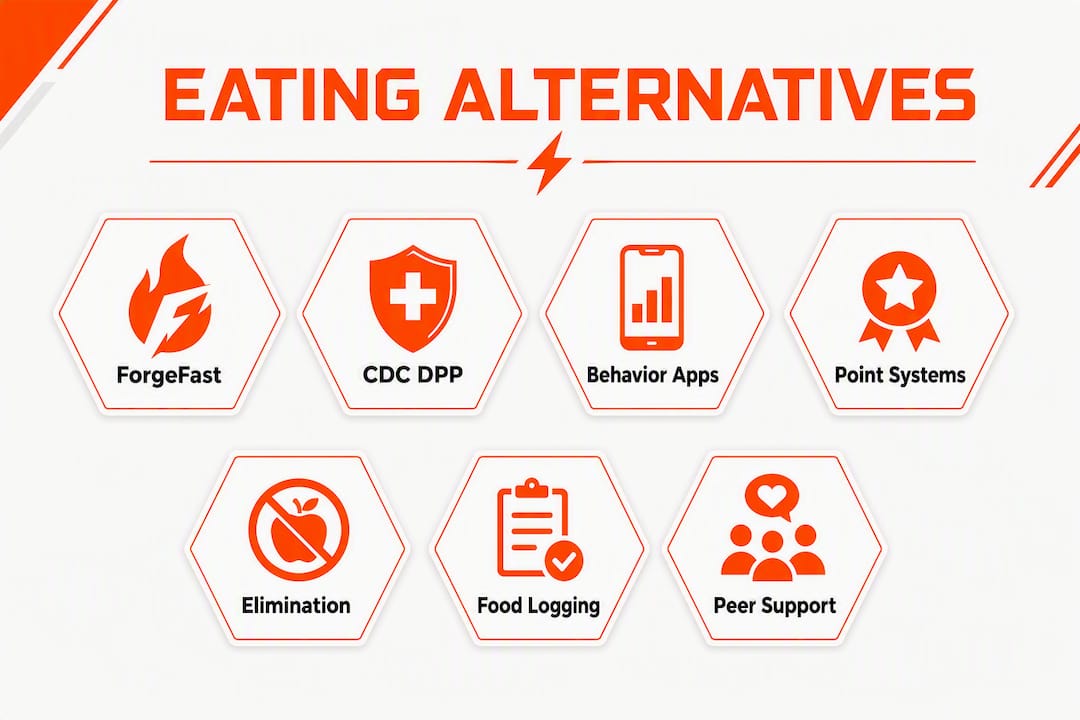
The most practical alternatives to Bright Line Eating are ForgeFast, the CDC Diabetes Prevention Program, subscription behavior-change apps (like Noom), point-based weight-management systems (like WW/WeightWatchers), food-logging apps (like MyFitnessPal), elimination-style short programs (like Whole30), and free community or peer-support groups. Each one trades some of Bright Line Eating’s rigid “no sugar, no flour, no snacking” structure for a different balance of flexibility, cost, and support. Multiple aggregation sites confirm a wide ecosystem of substitute programs exists, so the real question is which trade-off fits your life.
ForgeFast — intermittent fasting plus mental-discipline coaching; structured but not punitive; best for people who want lasting metabolic change without food-policing rules
CDC Diabetes Prevention Program — free or low-cost, evidence-based, group-facilitated; best for people with prediabetes or metabolic risk
Subscription behavior-change app (e.g., Noom) — psychology-led, app-based coaching; monthly subscription; best for people who want guided behavior change with flexibility
Point-based weight-management system (e.g., WW/WeightWatchers) — flexible point budget; subscription; best for people who want structure without total food elimination
Food-logging/calorie-tracking app (e.g., MyFitnessPal) — free or low-cost; self-guided; best for data-driven, self-motivated people
Elimination-style short program (e.g., Whole30) — short-term reset; one-time or free; best for people who want a short, defined commitment
Free community or peer-support groups — accountability-focused; free; best for people who need social reinforcement on a tight budget
Table of Contents
What are the best Bright Line Eating alternatives?
Program Category | Approach / Core Method | Typical Cost | Structure | Support & Community | Best For | Timeline | US Availability |
ForgeFast | Intermittent fasting + mental discipline framework | Subscription | Structured, habit-focused | App, coaching, content | People seeking metabolic flexibility and lasting habits | Ongoing; habits form in weeks | ✅ US-based |
CDC Diabetes Prevention Program | Evidence-based lifestyle change; group-facilitated | Free or low-cost | Moderate; weekly sessions | Group cohort + facilitator | Prediabetes, metabolic risk | an extended program period | ✅ Nationwide |
Subscription behavior-change app | Psychology-led tracking + coaching | Monthly subscription | Flexible with guided nudges | App + coach messaging | Behavior-change beginners | several months typical | ✅ App-based |
Point-based weight-management system | Daily point budget; no food is off-limits | Monthly subscription | Flexible | App + in-person groups | People who dislike elimination rules | Ongoing | ✅ Nationwide |
Food-logging / calorie-tracking app | Calorie and macro awareness | Free or low-cost tier | Self-guided | App only | Self-motivated, data-driven users | Ongoing | ✅ App-based |
Elimination-style short program | 30-day food reset; reintroduction phase | Free or one-time | Strict for 30 days | Online community | Short-commitment reset seekers | a month plus reintroduction phase | ✅ DIY / online |
Free community / peer-support | Accountability, shared experience | Free | Varies | Peer groups, forums | Budget-constrained; social learners | Ongoing | ✅ Online + local |
Free or low-cost options: CDC DPP, food-logging apps, and community groups. Subscription options: behavior-change apps, point-based systems, ForgeFast. One-time or DIY: elimination-style programs.
Profiles: what each alternative actually offers
ForgeFast
ForgeFast pairs intermittent fasting windows with a structured mental-discipline framework, targeting the psychological side of eating patterns rather than issuing a list of banned foods. The focus is metabolic flexibility and habit formation, not calorie obsession.
Pros: Addresses the mental mechanics of hunger; builds long-term habits; no food-policing rules; US-based with ongoing content and coaching support. Cons: Requires comfort with fasting windows; not designed for people with active eating disorders. Who it suits: People leaving a rigid protocol who want structure without punitive rules, and anyone prioritizing metabolic health and mental clarity alongside fat loss.
CDC Diabetes Prevention Program
The CDC DPP is a group-based lifestyle program with documented effectiveness for weight loss and reducing diabetes risk. It runs through local health systems, YMCAs, and telehealth partners, making it accessible across the US.

Pros: Evidence-backed; often free or covered by insurance; group accountability; clinically supervised. Cons: Requires a commitment over multiple sessions; not designed for people without metabolic risk factors. Who it suits: Anyone with prediabetes, insulin resistance, or a family history of Type 2 diabetes.
Subscription behavior-change app (e.g., Noom)
These apps layer behavioral psychology on top of food logging. You track meals, read short lessons on cognitive patterns, and message a coach. The flexibility is real: no food is banned.
Pros: Psychology-based; flexible; accessible anywhere via smartphone. Cons: Monthly cost adds up; coaching quality varies; requires consistent self-reporting. Who it suits: People who want guided behavior change without rigid elimination rules.
Pro Tip: Before subscribing to any behavior-change app, check whether a free trial is available and test the coaching response time. A coach who replies once a week is closer to a chatbot than a real accountability partner.
Point-based weight-management system (e.g., WW/WeightWatchers)
WW assigns point values to foods and gives you a daily budget. Nothing is technically off-limits, which is a meaningful psychological difference from Bright Line Eating’s absolute rules. In-person and virtual meeting options add a community layer most apps skip.
Pros: No forbidden foods; strong community; flexible for social eating. Cons: Monthly subscription; point-counting can become its own obsession for some people. Who it suits: People who struggled with Bright Line Eating’s all-or-nothing framing but still want daily structure.
Food-logging / calorie-tracking app (e.g., MyFitnessPal)
The free tier of a food-logging app gives you a calorie and macro dashboard with a massive food database. It teaches nutritional awareness fast. The catch: it does not replace coaching, and self-regulation is entirely on you.
Pros: Free or very low cost; flexible; builds data literacy about food. Cons: No behavioral coaching; adherence depends entirely on the user; can trigger obsessive tracking in some people. Who it suits: Self-motivated people who want awareness without rules or a coach.
Elimination-style short program (e.g., Whole30)
A short-term elimination protocol removes common inflammatory foods, then reintroduces them systematically. The defined endpoint is psychologically easier than an open-ended commitment. That said, without a clear reintroduction plan, rebound patterns are common.
Pros: Time-limited; free to follow; teaches food-body awareness. Cons: Strict for 30 days; requires planning; rebound risk without a structured exit. Who it suits: People who want a defined reset rather than a permanent lifestyle overhaul.
Free community or peer-support groups
Reddit communities, Facebook groups, and local meetups offer accountability at zero cost. Quality varies widely depending on moderation, but pairing a free community with an evidence-based framework sharpens the results considerably.
Pros: Free; social accountability; diverse experience sharing. Cons: Uneven quality; no clinical oversight; misinformation risk. Who it suits: Budget-constrained people who learn best through shared experience.
Pro Tip: Pair any free community with at least one evidence-based resource, whether that’s the CDC DPP, a food-logging app, or ForgeFast’s habit-building framework. Community alone rarely produces lasting change.
How do you pick the right alternative for your needs?
The single most useful filter is this: match your support need and your tolerance for rigid rules before you look at anything else.
Set a budget ceiling first. Free options exist (CDC DPP, food-logging apps, community groups). If cost is a real constraint, start there before evaluating subscriptions.
Assess your history with strict diets. If Bright Line Eating’s rules triggered anxiety, guilt, or obsessive behaviors, avoid any program that replaces one absolute rule set with another.
Decide how much coaching you need. Self-guided apps work for disciplined, data-driven people. If you need external accountability, look for programs with a real coach or group facilitator.
Check for medical conditions. Prediabetes or insulin resistance? The CDC DPP is purpose-built for you. Active eating disorder history? Seek clinical guidance before starting any structured program.
Estimate your weekly time. Group programs like the CDC DPP require scheduled sessions. App-based options are asynchronous and fit irregular schedules better.
Red flags to avoid in any program:
Absolute food rules with no flexibility or reintroduction pathway
Punitive language around “cheating” or “breaking” the protocol
No clinical referral pathway for people showing disordered behaviors
Support that is entirely peer-driven with no professional oversight
Signals of a safer program:
Encourages curiosity about hunger and fullness rather than fear of food
Builds skills gradually rather than demanding immediate perfection
Offers a clear exit or transition plan
A practical example: someone who thrived on Bright Line Eating’s structure but burned out on the rigidity would likely do well with ForgeFast (structured fasting windows, mental-discipline focus, no banned-food list) or a point-based system (daily structure, nothing forbidden). Someone with prediabetes and a preference for group accountability is a near-perfect fit for the CDC DPP.
Why rigid dieting rules can hurt more than they help
Nutritionist Monica Reinagel warns that black-and-white rules in highly restrictive protocols can mirror disordered eating patterns, and that safer alternatives should encourage curiosity and gradual, sustainable habit change rather than absolute prohibition.
The core psychological risk is what practitioners call the shift from external rigid rules to internal regulation. When a program never builds that internal skill, leaving it feels destabilizing. Understanding the psychology of controlled hunger is one of the most underrated steps in any successful transition.
Red flags that warrant a clinician’s input:
Intense anxiety when a food rule is broken
Measuring or weighing food to a degree that disrupts daily life
Social withdrawal to avoid situations where “off-plan” eating might occur
Guilt or shame cycles after any deviation
Pro Tip: Transitioning off a rigid protocol works best in stages. Reintroduce one food category at a time over two to four weeks, and track how you feel physically and emotionally, not just the number on the scale. If behaviors start resembling the red flags above, consult a registered dietitian or therapist who specializes in eating behavior before continuing.
When to seek clinical help: If any of the red flags above sound familiar, contact a registered dietitian or a therapist trained in eating disorders before starting a new program. A structured diet is not a substitute for clinical care.
Why ForgeFast fits the affordability and sustainability criteria
ForgeFast aligns with the core criteria this list is built around: it is behavior-focused, emphasizes mental discipline over food policing, and targets metabolic flexibility rather than rigid elimination.
Intermittent fasting framework: time-restricted eating windows that build metabolic flexibility without banning specific foods
Mental-discipline coaching: addresses the psychological patterns that drive overeating, not just the calories
Habit formation focus: builds lasting habits rather than short-term compliance with external rules
No punitive rules: no “bright lines” that trigger shame cycles when crossed
US-based, accessible: available online with structured content and coaching support
ForgeFast is not the right fit for people who need clinical eating disorder treatment or who require a medically supervised program for a specific condition like prediabetes (the CDC DPP serves that need better). For everyone else who wants structure, mental-health awareness, and a sustainable fat-loss framework, it belongs near the top of this list.
Key Takeaways
The most durable weight-loss programs match your support need and rule-rigidity tolerance before anything else.
Point | Details |
Match support to your needs | Self-guided apps suit disciplined users; coached or group programs suit people who need external accountability. |
Free options are real | The CDC DPP, food-logging apps, and community groups cost little to nothing and deliver evidence-backed results. |
Avoid punitive rule sets | Programs with absolute food bans and shame-based language carry psychological risk; prioritize curiosity-based approaches. |
Short programs need an exit plan | Elimination-style resets work best when paired with a structured reintroduction phase to prevent rebound. |
ForgeFast as a structured alternative | ForgeFast combines intermittent fasting with mental-discipline coaching, offering structure without food-policing rules. |
The gap between rigid rules and lasting change
Rigid diet programs sell certainty, and certainty feels good when you’re exhausted by decision fatigue. The problem is that certainty borrowed from an external rule set never becomes your own. When the program ends, or when life interrupts it, there is nothing internal to fall back on.
What actually works long-term tends to look less dramatic: a consistent eating window, a gradual reduction in processed food, and a growing ability to read your own hunger signals. That is not a compelling sales pitch, but it is what the evidence points toward. The programs on this list that last are the ones that build that internal skill alongside the external structure.
Individual differences are real. Some people genuinely need more structure to get started, and there is no shame in that. The goal is to use structure as a scaffold, not a permanent cage. Test options with a short trial, watch for red flags, and adjust. Iterative is not weak; it is how durable change actually happens.
ForgeFast: a structured, sustainable path forward

If you have been searching for a Bright Line Eating substitute that keeps the structure but drops the punitive rules, ForgeFast is worth a serious look. It pairs intermittent fasting windows with a mental-discipline framework built around habit formation and metabolic flexibility, not a list of forbidden foods. The result is a program that trains your mind and your metabolism at the same time. No shame cycles, no food policing, and no open-ended commitment to rules that were never yours to begin with. Visit ForgeFast to see the full program and take the first step toward a sustainable approach that actually fits your life.
Sources and further reading
Bright Line Eating: Diet or Disordered Eating? | Nutrition Over Easy — nutritionist critique of rigid protocols and disordered eating risk
ForgeFast | Intermittent Fasting & Sustainable Fat Loss — ForgeFast program overview and landing page
The Psychology of Controlled Hunger | ForgeFast — mental mechanics of hunger and habit change
Intuitive Eating vs Fasting | ForgeFast — comparing flexible and fasting-based approaches
Avoid Diet Burnout With a Smarter Fasting Approach | ForgeFast — practical guidance for transitioning off rigid diets
Recommended
Comments