Do You Want to Eat? A Guide for Indecisive Eaters
- Tony Lindsay
- 8 hours ago
- 7 min read
“Do you want to eat?” is grammatically correct and works perfectly as a direct offer or question about food. If you’re staring at your kitchen right now, unable to decide whether or what to eat, here’s what to do quickly:
Immediate action checklist:
60-second hunger check: Place one hand on your stomach. Is there a hollow, growling, or empty sensation? That’s physical hunger. If you feel restless or bored instead, that’s a craving.
Three-choice rule: Name three meals or snacks you could make right now. Pick the one that sounds best. Done.
Quick randomizer: If you still can’t choose, try an AI-powered meal quiz that asks two or three preference questions and spits out a suggestion in under a minute.
Three ready-to-use meal prompts (pick one without overthinking):
Snack: Peanut butter on toast with a banana
Light meal: Scrambled eggs with whatever vegetables are in the fridge
Comfort meal: Pasta with olive oil, garlic, and parmesan
Key Takeaways
Deciding what to eat gets easier when you replace open-ended choices with a short, pre-built structure you return to automatically.
Point | Details |
Grammar check | “Do you want to eat?” is correct; “Are you hungry?” checks physical hunger specifically. |
60-second hunger test | Rate yourself 1–5 on the hunger scale before opening the fridge or an app. |
Three-choice rule | Limit options to three before deciding; use the 20-5-1 method for takeout. |
Rotating menu fix | Four go-to dinners on a weekly rotation eliminates most daily food decisions. |
ForgeFast structure | ForgeFast’s habit tools and fasting protocols reduce daily decision fatigue long term. |
Table of Contents
Do you want to eat, or are you actually hungry? Understanding the phrase
“Do you want to eat?” is a standard English question used to offer food or invite someone to a meal. TextRanch confirms it’s grammatically sound because “want” is a standard action verb that pairs naturally with “do.” The phrase “do you hungry,” by contrast, is wrong: “hungry” is an adjective, so it needs the linking verb “are,” giving you “Are you hungry?”
The two questions serve different purposes, and mixing them up creates confusion.
“Do you want to eat?” = an offer or invitation. You’re asking if someone is ready or willing to eat, regardless of whether they’re physically hungry. “Are you hungry?” = a physiological check. You’re asking about their body’s actual hunger signal.
When to use each:
Polite offer to a guest: “Would you like to eat something?” or “Care for a meal?”
Checking in on a child or partner: “Are you hungry yet?”
Casual, decisive: “Do you want to eat now or wait?”
Formal/restaurant context: “Are you interested in dining early this evening?”
For non-native speakers who need the Spanish equivalent, SpanishDict’s translation tool shows that “what do you like to eat” becomes “qué te gusta comer,” a useful reference when switching between languages.
How to tell if you’re actually hungry or just want to eat
Physical hunger and the urge to eat feel similar but come from different places. Knowing the difference saves you from eating when you don’t need to and from ignoring your body when you do.
Physical hunger cues:
Stomach growling or a hollow, empty feeling
Gradual onset, usually 3–5 hours after your last meal
Willingness to eat almost anything, not just a specific craving
Mild lightheadedness or difficulty concentrating
Emotional or craving-driven urges:
Sudden onset, often triggered by stress, boredom, or seeing food
A very specific craving (chips, chocolate, something crunchy)
Eating feels more like a reward or escape than a need
The urge passes after 10–15 minutes of distraction
A 5-step hunger scale you can use in 30 seconds
Rate yourself 1–5 before you open the fridge:
Ravenous (1): Eat now. A real meal, not a snack.
Hungry (2): Eat soon. A normal meal or a substantial snack.
Neutral (3): Wait 15–30 minutes, then check again.
Slightly full (4): Hydrate first. Drink a glass of water and reassess in 10 minutes.
Full (5): Re-evaluate. You’re not hungry; identify what’s actually driving the urge.
Pro Tip: If you’re unsure whether you’re at a 2 or a 3, drink a full glass of water and wait 10 minutes. Genuine hunger returns; a craving often fades. This is sometimes called the “waiting-window test” in behavioral nutrition circles.
The psychology of controlled hunger matters here: understanding why you want to eat is often more useful than just deciding what to eat.
Fast, practical ways to decide what to eat right now
Decision paralysis around food is real, and the fix is almost always the same: fewer options, faster. Here’s a compact toolkit.

The three-choice rule (and the 20-5-1 method)
Limit yourself to three options before you open a menu or a delivery app. If you’re ordering takeout, pick a cuisine category first (Mexican, Italian, Asian), then pick one restaurant, then pick one dish. That’s 20 cuisines → 5 restaurants → 1 meal. The constraint does the work.
Applying it to different situations:
Cooking at home: Name three things you have ingredients for. Pick the fastest one.
Takeout: Pick your cuisine mood, then go to your most-used app and sort by rating. Order the first thing that looks good.
Snacking: Keep only three snack options visible on the counter. Grab one.
A quick decision tree
Check your hunger level (use the 1–5 scale above).
Identify your constraints: How much time do you have? What’s your budget? What equipment is available?
Pick a category: hot or cold, savory or sweet, cooked or assembled.
Pick the meal. Stop there.
The quiz and ingredient-first method
When you’re staring at a half-empty pantry, start with what you have. Pull out three ingredients and search for a recipe that uses all three. Sites like Tasty are built for exactly this: ingredient-first, minimal-step cooking.
Alternatively, use a structured quiz. Freudly’s “What Should I Eat” quiz asks about craving type, effort level, time, and budget to generate tailored suggestions. The ProProfs “What Should I Eat Today?” quiz uses similar rapid questions (craving, who you’re eating with, how much time you have) to cut through choice overload in under a minute.
Three one-pan/assembly prompts for right now:
Sheet pan eggs: Crack four eggs onto a baking sheet with whatever vegetables you have, roast at 400°F for 12 minutes.
Rice bowl: Leftover rice, a fried egg, soy sauce, and any protein in the fridge.
Wrap: Tortilla, hummus, sliced vegetables, and cheese. No cooking required.
A simple hunger-awareness framework for fewer long-term decisions
If you find yourself asking “what do I want to eat?” multiple times a day, the problem isn’t willpower. It’s the absence of structure. A simple framework built around sustainable eating habits can cut most of those daily decisions before they happen.
The framework has three parts: a defined eating window (even a loose one, like “I eat between noon and 8 PM”), two or three go-to meal categories for each slot, and a weekly five-minute planning ritual where you pick this week’s dinners from a short rotating list. That’s it.
Behavioral habits that support the framework:
Write your three dinner options for the week on a sticky note on the fridge.
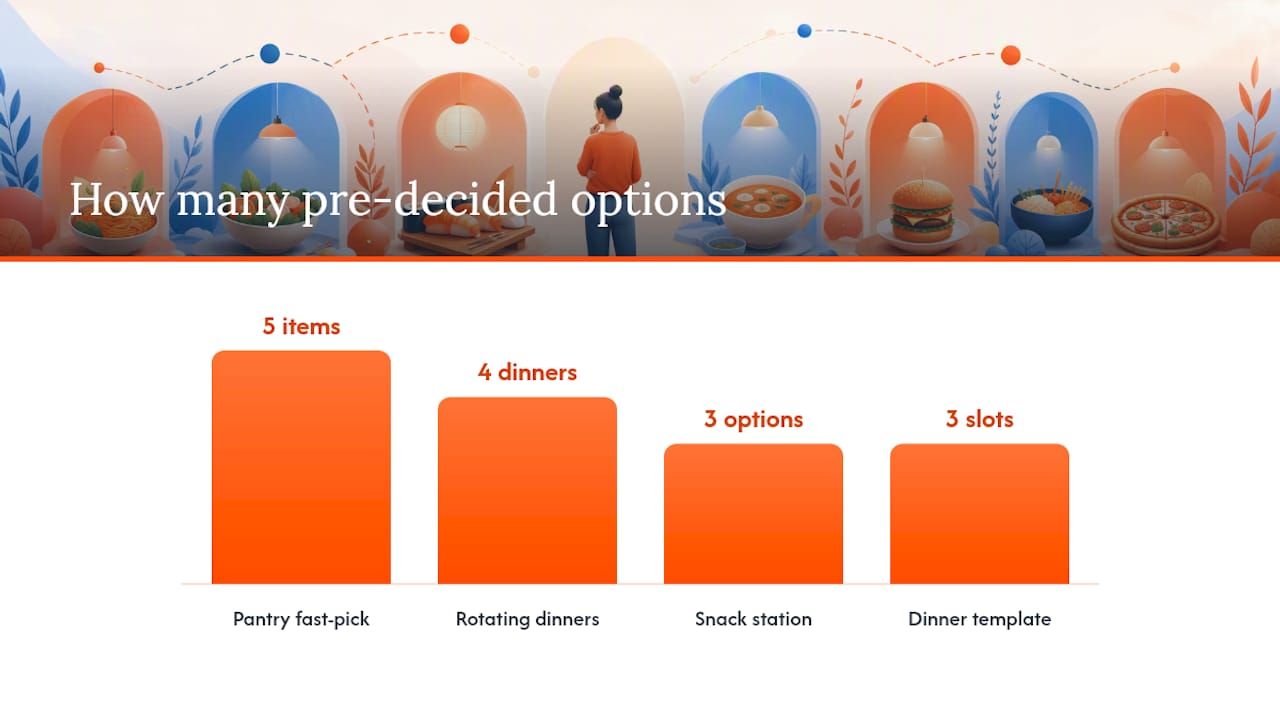
Keep a “fast pick” shelf in the pantry: five ingredients that always combine into something edible.
Set one consistent meal time per day as an anchor, even if the others float.
Use the intuitive eating vs. fasting comparison to decide whether a structured window or a hunger-signal approach fits your lifestyle better.
Pro Tip: If you’re experiencing persistent confusion about hunger, significant appetite changes, or eating patterns that feel out of control, talk to a registered dietitian or your primary care physician. The tactics here are general wellness guidance, not medical advice.
Small habit changes that stop daily food paralysis
Recurring indecision about food is usually a systems problem, not a willpower problem. The fix is pre-made choices that feel like freedom.
Four low-friction habit fixes to test this week:
Weekly rotating menu: Pick four dinners you like. Rotate them every week. You never start from zero.
Four go-to dinners: Write them on a whiteboard or a note in your phone. When someone asks “what do you want to eat tonight?”, point to the list.
Pantry fast-pick shelf: Designate one shelf for five items that always work together (pasta, canned tomatoes, olive oil, garlic, parmesan). When you’re blank, that shelf is your answer.
Snack station: Put three snack options in one visible spot. Rotate them weekly so they don’t get boring.
A fill-in template for your three dinner options:
Slot | Your pick |
Quick weeknight (under 20 min) | _____________ |
Batch cook (Sunday prep) | _____________ |
Comfort/weekend meal | _____________ |
Sample weekly rotation:
Monday: Sheet pan chicken and vegetables
Tuesday: Pasta with marinara
Wednesday: Stir-fry with rice
Thursday: Tacos (any protein)
Pro Tip: Pre-decided options feel like freedom because they eliminate the cognitive tax of starting from scratch. Decision architecture research consistently shows that fewer choices at the point of decision leads to higher satisfaction with the outcome, not lower.
Why fewer food decisions actually makes life better
The conventional wisdom says more options equal more freedom. With food, the opposite tends to be true. Every time you stand in front of the fridge running through possibilities, you’re spending mental energy that could go somewhere else. The people who seem most relaxed about eating usually have a quiet structure underneath: a few reliable meals, a loose rhythm, a short list they return to.
That’s not boring. That’s a system that works. The three-choice rule, the rotating menu, the hunger scale — these aren’t restrictions. They’re the scaffolding that makes spontaneous choices feel easy instead of exhausting. When you’ve already handled Monday through Thursday, Friday’s “whatever sounds good” actually sounds good.
How ForgeFast helps you build a structure that sticks

Indecisive eating is often a sign that your eating pattern lacks a clear framework, not that you lack discipline. ForgeFast is built around exactly this problem: it gives you structured intermittent fasting protocols, habit-tracking tools, and psychological coaching designed to reduce the number of daily food decisions you face. Instead of starting from scratch every meal, you work within a defined eating window with pre-built meal categories and rotating options that adapt to your schedule.
The result is fewer “what do I want to eat?” moments and more consistent follow-through. ForgeFast also covers the mental side of eating patterns, including how decision fatigue connects to fasting and why structure preserves flexibility rather than killing it. If you’re ready to stop negotiating with yourself at every meal, start with ForgeFast and explore the free resources on the site.
Sources
Recommended
Comments