Fasting and Body Fat Percentage: What Science Shows


Fasting is defined as a structured period of voluntary caloric abstinence that directly lowers body fat percentage by forcing the body to shift from glucose metabolism to fat oxidation. This metabolic switch, known as metabolic switching, is the core mechanism behind intermittent fasting and fat loss. A 2025 randomized controlled trial published in Nature Communications found that six months of intermittent fasting reduced body fat by roughly 16% and body weight by 8% in overweight adults. That result is not a rounding error. It represents a clinically meaningful change in body composition driven by a consistent energy deficit and repeated fat-burning cycles.
How fasting and body fat percentage are linked by science
The most direct evidence comes from a 2025 Nature Communications randomized controlled trial tracking middle-aged adults with overweight across six months of intermittent fasting. Body fat percentage dropped by roughly 3.1 percentage points, moving participants from approximately 39 to 40 percent down to 36 to 37 percent. That shift matters because even a 2 to 3 point reduction in body fat percentage correlates with measurable improvements in cardiometabolic risk markers.
Fat mass loss was the dominant component of total weight lost. Lean mass did decrease slightly, but fat loss outpaced lean loss, which is exactly what you want when the goal is improving body composition rather than just dropping scale weight. This distinction separates meaningful fat reduction from the kind of weight loss that strips muscle and leaves metabolic rate worse off.

Measurement method matters more than most people realize. The Nature trial used dual-energy X-ray absorptiometry, or DXA, which is the most reliable tool for tracking body fat percentage changes in fasting studies. DXA provides reliable fat data compared to bioimpedance scales or skinfold calipers, both of which can swing by several percentage points based on hydration alone. If you are tracking your own progress, understanding which measurement tool your data comes from changes how you interpret the numbers.
Pro Tip: If you are using a smart scale at home, weigh yourself at the same time each day, under the same hydration conditions, and treat the trend line over weeks as the signal. Single readings are noise.
Metric | Before fasting (6 months) | After fasting (6 months) |
Body fat percentage | ~39 to 40% | ~36 to 37% |
Body weight change | Baseline | ~8% reduction |
Fat mass change | Baseline | ~16% reduction |
Lean mass change | Baseline | Slight decrease, less than fat loss |
How fasting compares to continuous calorie restriction for fat loss
The honest answer is that fasting and continuous calorie restriction produce similar fat mass loss when total calorie deficits are matched. Fat loss is primarily driven by adherence to an energy deficit, not by the specific timing pattern used to create it. A 2025 to 2026 clinical review confirmed that fasting produces fat mass dominant weight loss comparable to traditional dieting when calorie intake is equivalent.
Where fasting pulls ahead is in sustainability and metabolic flexibility. Repeated metabolic switching, the process of cycling between glucose and fat as primary fuel, trains the body to access stored fat more readily over time. Metabolic switching is central to fasting’s fat-loss advantage beyond simple calorie math. For many people, eating within a defined window is psychologically easier than counting every calorie across every meal, which directly affects long-term adherence.
Lean mass preservation is roughly equivalent between the two approaches in controlled trials. Neither fasting nor continuous restriction causes dramatic muscle loss when protein intake is adequate. The practical takeaway is that fasting is not a metabolic shortcut. It is a structure that makes sustaining an energy deficit more manageable for a specific type of person.
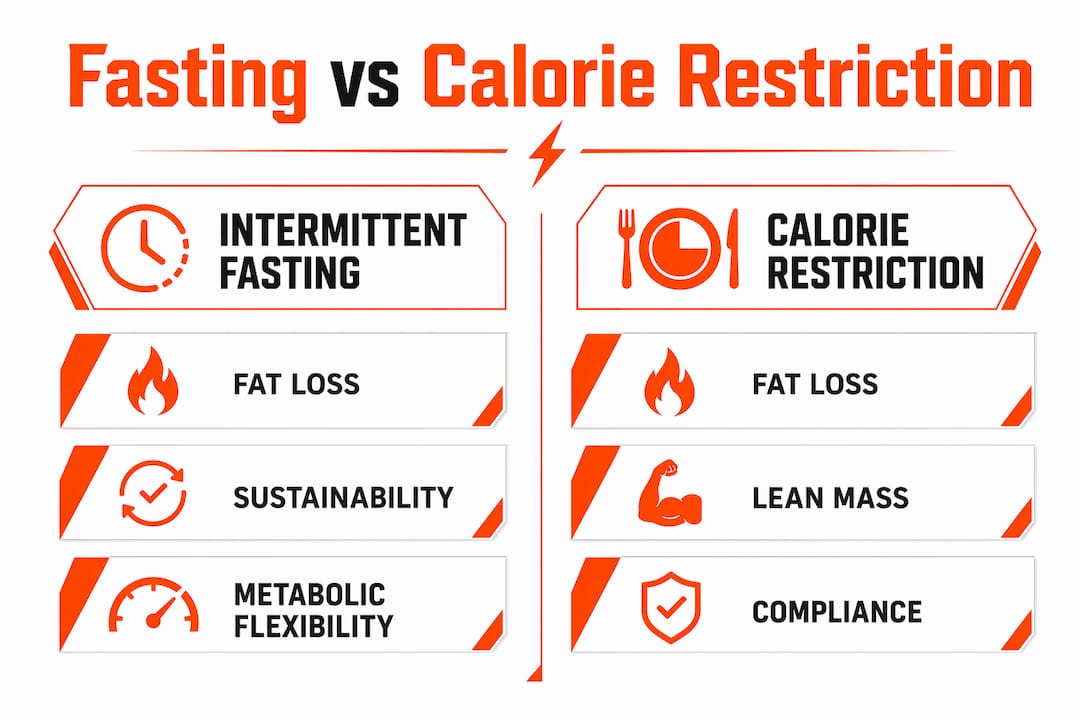
Factor | Intermittent fasting | Continuous calorie restriction |
Fat mass loss | Comparable when calories matched | Comparable when calories matched |
Lean mass loss | Small, fat loss dominant | Small, fat loss dominant |
Metabolic switching | Yes, repeated cycles | Minimal |
Adherence ease | Higher for some individuals | Requires constant tracking |
Flexibility | Defined eating windows | Spread across all meals |
Does adding exercise improve fat loss during fasting?
Exercise combined with intermittent fasting produces results that neither approach achieves alone. A 2026 multilevel meta-analysis published in Frontiers in Nutrition, covering 65 randomized controlled trials and 3,293 participants, found that exercise plus fasting produces statistically significant reductions in body fat percentage and fat mass without lean mass loss. The effect size is described as small but consistent, meaning it shows up reliably across diverse populations and protocols.
The practical implication is that exercise preserves the lean mass that fasting alone tends to reduce slightly. When fat loss outpaces lean loss and exercise keeps muscle tissue intact, body fat percentage drops faster and more sustainably. This is the combination that actually changes how your body looks and performs, not just what the scale reads.
For optimal results, the research points to a specific exercise prescription:
Session length: 45 to 60 minutes per session produces the strongest body composition outcomes according to the optimal exercise dosage meta-analysis.
Frequency: Four sessions per week is the evidence-backed target for maximizing fat loss while preserving lean mass.
Exercise type: Both aerobic training and resistance training contribute, but resistance training is particularly effective at protecting muscle during a caloric deficit.
Timing: Training during the eating window allows for better fueling and recovery, though fasted cardio can be effective for lower-intensity aerobic sessions.
Pro Tip: If you can only do two things, prioritize resistance training twice a week over daily cardio. Muscle tissue is metabolically active and directly improves your body fat percentage even when you are not exercising.
What actually happens metabolically when you fast
Metabolic switching from glucose to fatty acid oxidation begins after approximately 12 hours of fasting for most people. Ketosis and fat burning start once liver glycogen stores are depleted, at which point the body mobilizes stored triglycerides and converts them to ketone bodies for fuel. This is not a dramatic overnight transformation. It is a gradual metabolic shift that becomes more efficient the more consistently you practice it.
The key mechanisms driving body fat reduction during fasting include:
Glycogen depletion: After roughly 12 hours without food, liver glycogen runs low, signaling the body to access fat stores.
Lipolysis activation: Fat cells release stored fatty acids into the bloodstream for energy use.
Ketone production: The liver converts fatty acids into ketones, which fuel the brain and muscles during extended fasting.
Insulin suppression: Lower insulin levels during fasting periods remove the primary hormonal brake on fat burning.
“The metabolic switch from glucose to fatty acid oxidation is not just a fuel preference. It is a whole-body adaptation that, when repeated consistently, reshapes how your body stores and uses energy over time.” — Johns Hopkins Medicine expert overview on intermittent fasting mechanisms
One critical nuance: longer is not better. Fasting beyond 24 to 72 hours can trigger energy conservation responses that actually increase fat storage tendencies. The body reads extreme restriction as a threat and adapts accordingly. Standard intermittent fasting patterns, such as 16:8 or 5:2, sit in the productive range where fat oxidation is elevated without triggering these counterproductive survival responses.
Key takeaways
Fasting reduces body fat percentage by creating a sustained energy deficit combined with repeated metabolic switching that favors fat oxidation, and exercise integration amplifies these results without sacrificing lean mass.
Point | Details |
Fasting drops body fat percentage | A 2025 RCT showed a 3.1 percentage point reduction over six months of intermittent fasting. |
Fat loss dominates weight loss | Fat mass loss outpaces lean mass loss during fasting, improving body composition directly. |
Fasting equals calorie restriction | When calories are matched, fat loss outcomes are comparable between fasting and continuous restriction. |
Exercise amplifies fat loss | Four weekly sessions of 45 to 60 minutes maximize fat loss and protect lean mass during fasting. |
Avoid extreme fasting durations | Fasting beyond typical intermittent patterns can trigger energy conservation and reduce fat-burning efficiency. |
What the evidence actually tells me about fasting and fat
I have spent years reading the research on body fat reduction methods, and the pattern that stands out most is how often people conflate weight loss with fat loss. The scale is a blunt instrument. A 2025 Nature Communications trial used DXA to show that body fat percentage dropped by over 3 points during six months of intermittent fasting, even as lean mass declined slightly. That nuance gets lost when people judge their progress by pounds alone.
The other thing I see consistently underestimated is the role of adherence. Mastering intermittent fasting long-term is not primarily a biological challenge. It is a psychological one. The people who see the best body composition results are not the ones who fast the longest or restrict the hardest. They are the ones who build a structure they can maintain for months, not days.
What I find most compelling about the 2026 Frontiers in Nutrition meta-analysis is the specificity of the exercise prescription. Forty-five to sixty minutes, four times a week, combined with a fasting protocol. That is not vague lifestyle advice. That is a concrete, testable plan. The research on hunger psychology during fasting reinforces this: structure reduces decision fatigue, and reduced decision fatigue improves adherence. The biology is straightforward. The hard part is building the habits that let the biology do its job.
— Tony
Start tracking what actually changes your body composition
Forgefastmethod was built specifically for people who want to move beyond generic diet advice and apply the kind of structured, evidence-based approach that the research actually supports.

The ForgeFast method integrates personalized fasting schedules with body composition monitoring, grounded in the same metabolic science covered in this article. The ForgeFast app lets you set fasting windows, log meals within your eating period, and track body fat trends over time rather than just daily weight fluctuations. For those who want to go deeper, the ForgeFast book lays out the full protocol, including how to combine fasting with resistance training for maximum fat loss. If you are serious about lowering your body fat percentage, the tools to do it with precision are available now.
FAQ
How much can fasting lower body fat percentage?
A 2025 Nature Communications randomized controlled trial found that six months of intermittent fasting reduced body fat percentage by approximately 3.1 percentage points in overweight adults. Individual results vary based on calorie deficit, exercise habits, and adherence.
Is intermittent fasting better than calorie restriction for fat loss?
When total calorie intake is matched, intermittent fasting and continuous calorie restriction produce comparable fat mass loss. Fasting may be easier to sustain for some people due to its structured eating windows, which can improve long-term adherence.
How long does it take for fasting to start burning fat?
Metabolic fat burning typically begins after approximately 12 hours of fasting, once liver glycogen stores are depleted. At that point, the body shifts to fatty acid oxidation and begins producing ketones for fuel.
Does exercise improve body fat loss during fasting?
A 2026 meta-analysis of 65 randomized controlled trials found that combining exercise with intermittent fasting produces significant reductions in body fat percentage and fat mass without lean mass loss. Four sessions of 45 to 60 minutes per week is the evidence-backed optimal dose.
What is the best way to measure body fat percentage changes during fasting?
DXA scanning is the most reliable measurement method for tracking body fat percentage changes in fasting interventions. Bioimpedance scales and skinfold calipers introduce more variability, particularly when hydration levels fluctuate during fasting periods.
Recommended
Comments