Fasting vs Low-Carb Diet: Which One Actually Works?
- Tony Lindsay
- Aug 2
- 14 min read


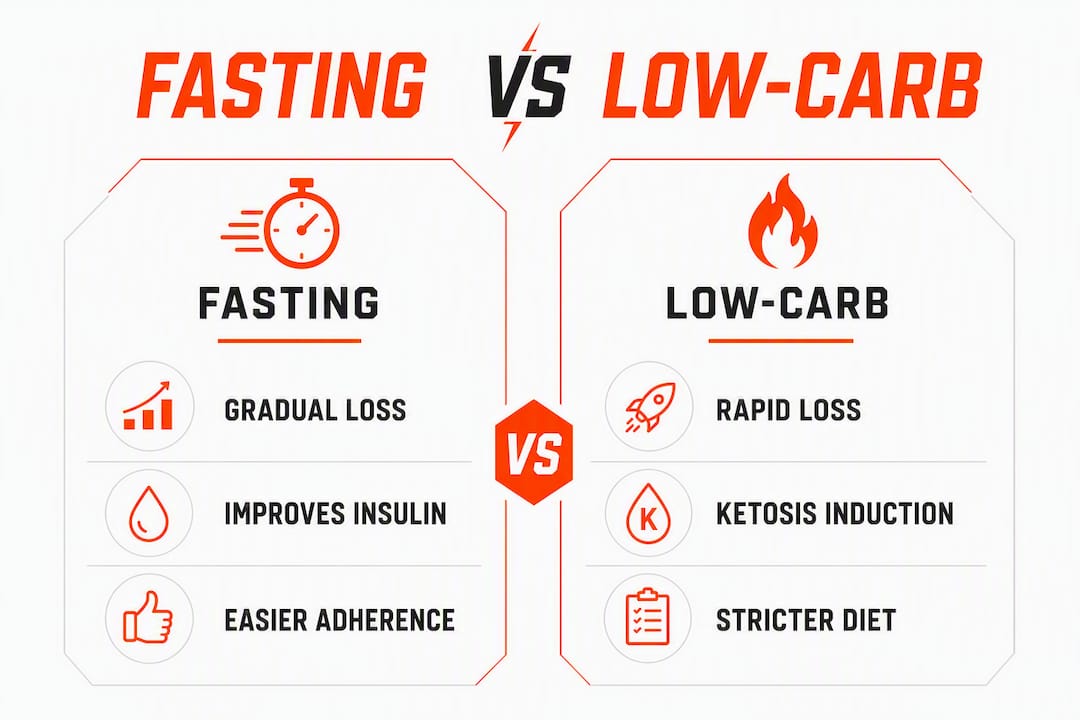
Low-carb and ketogenic diets typically win for rapid short-term weight loss. Intermittent fasting tends to edge ahead for long-term metabolic health and real-world adherence. That is the honest verdict from the current body of evidence, including randomized controlled trials, systematic reviews, and clinical endpoints like visceral fat reduction, fasting insulin, and HbA1c.
The distinction matters because most people pick a method based on what sounds fastest, then quit within three months. Randomized trials comparing time-restricted eating (TRE) to continuous calorie restriction show similar weight loss when calories are matched, which tells you the protocol itself is less decisive than whether you can actually stick with it. Research from Harvard T.H. Chan School of Public Health confirms that daily time-restricted eating can reduce calorie intake by about 250 kcal per day and produce gradual weight loss alongside improvements in blood pressure and oxidative stress. ForgeFast’s habit-first framework is built around exactly this insight: the method you sustain is the one that works.
Key findings at a glance:
Low-carb/keto produces faster weight loss in the first 6–12 months, largely from water loss and glycogen depletion early on.
Intermittent fasting produces modest but consistent weight loss with strong behavioral advantages.
Both approaches improve insulin sensitivity and reduce visceral fat; the magnitude depends heavily on adherence and food quality.
Combined TRE plus low-carb protocols show additive benefits in some RCTs, particularly for visceral fat and metabolic syndrome markers.
After 12 months, weight-loss differences between methods narrow significantly as adherence diverges.
Table of Contents
What are intermittent fasting and low-carb diets, exactly?
These terms get used interchangeably in popular media, which creates real confusion when you try to compare them. They describe fundamentally different things: one is about when you eat, the other is about what you eat.
Intermittent fasting variants
Time-restricted eating (TRE): You eat within a set daily window, typically 6–10 hours, and fast the rest. The 16:8 protocol (16 hours fasting, 8-hour eating window) is a commonly studied version. Practically, that often means skipping breakfast and restricting eating to an 8-hour window each day.
Alternate-day fasting (ADF): You alternate between regular eating days and fasting or very-low-calorie days (roughly 500 kcal). More aggressive than TRE and harder to sustain socially.
5:2 protocol: Five days of normal eating, two non-consecutive days of severe calorie restriction (around 500–600 kcal). Popularized in the UK, it has a reasonable evidence base for weight loss and metabolic improvements.
Low-carbohydrate diet variants
StatPearls’ clinical review defines carbohydrate ranges used to classify diets, such as moderate low-carb, low-carb, and very-low-carb or ketogenic. Keto is the extreme end of carbohydrate restriction, inducing nutritional ketosis when carbohydrate intake is very low.
One important overlap: combining a short eating window with a very-low-carb diet accelerates ketosis because the fasting period depletes glycogen faster. That is why “fasting vs keto” is sometimes a false choice. Many people do both simultaneously, intentionally or not.
What does the evidence show about weight loss outcomes?
Short-term, low-carb wins on speed. Long-term, the gap closes. That pattern holds across most well-designed trials.
Short-term speed and early results
Keto and very-low-carb diets consistently show faster weight loss in the first 6–12 months compared with other dietary approaches. Mayo Clinic’s clinical guidance notes this speed advantage while flagging that adherence challenges tend to erode it over time. Part of that early loss is water weight: glycogen stores in muscle and liver hold water, and depleting them in the first 1–2 weeks produces a rapid drop on the scale that is not pure fat.
Intermittent fasting produces more gradual results. A systematic review cited across multiple clinical sources found that intermittent fasting protocols typically produce 7–11 pounds of weight loss over about 10 weeks. That is meaningful, but slower than what most keto trials report in the same window.

The calorie question
Here is the part most diet content glosses over: when calorie intake is matched between groups, intermittent fasting and continuous calorie restriction produce similar weight loss. The fasting pattern itself does not appear to confer a unique metabolic advantage in most measures. What it does confer is a behavioral one. Harvard Health’s clinical commentary notes that fasting simplifies eating decisions and reduces decision fatigue, which helps people perceive genuine hunger and maintain a deficit without tracking every gram.
What trials show at 3, 6, and 12 months
Timepoint | Low-carb/keto | Intermittent fasting | Key driver |
3 months | Faster loss (partly water/glycogen) | Gradual | Glycogen depletion vs. calorie reduction |
6 months | Continued advantage in most trials | Comparable when adherent | Adherence begins to diverge |
12 months | Differences narrow significantly | Similar outcomes in RCTs | Calorie deficit and adherence dominate |
The Harvard POUNDS LOST trial, a two-year head-to-head study comparing diets with varying macronutrient ratios, found that healthy diets with different carbohydrate proportions worked equally well long-term. The macronutrient split mattered less than whether people could follow the plan.
How do these approaches affect metabolic health markers?
Weight on a scale is one thing. What happens to your insulin, blood sugar, triglycerides, and visceral fat is often more clinically significant, especially if you are managing prediabetes or cardiovascular risk.
Insulin sensitivity and glucose control
Both approaches improve insulin sensitivity, but through different mechanisms and at different speeds. Very-low-carb diets reduce postprandial glucose spikes almost immediately by limiting carbohydrate substrate. Intermittent fasting improves insulin sensitivity through periods of low insulin during the fasting window, allowing cells to reset their response.

For HbA1c specifically, low-carb diets have a stronger short-term evidence base in people with type 2 diabetes (T2D). Reducing carbohydrate intake directly lowers the glycemic load the body must manage. TRE also improves fasting glucose and insulin, particularly when the eating window is placed earlier in the day, aligning with the body’s circadian insulin sensitivity peak.
Pro Tip: If glucose control is your primary goal, consider an earlier eating window (for example, 8 AM to 4 PM rather than noon to 8 PM). Research on circadian biology suggests morning-aligned TRE produces stronger improvements in fasting insulin and postprandial glucose than evening-heavy eating patterns.
Lipids, blood pressure, and visceral fat
Metabolic marker | Low-carb/keto effect | Intermittent fasting effect |
Triglycerides | Strong reduction | Moderate reduction |
HDL cholesterol | Often increases | Modest improvement |
LDL cholesterol | Variable; may rise on keto | Generally neutral or slight decrease |
Blood pressure | Moderate improvement | Improvement noted with TRE |
Visceral fat | Significant reduction | Significant reduction |
Fasting insulin | Marked improvement | Marked improvement |
One nuance on LDL: keto diets can raise LDL in some individuals, particularly those who are “hyper-responders” to saturated fat. Mayo Clinic’s guidance specifically recommends monitoring lipid panels and prioritizing food quality, not just carbohydrate exclusion, for this reason.
A 2022 RCT published in PMC examined time-restricted eating with or without a low-carbohydrate diet and found both conditions reduced visceral fat and improved metabolic syndrome markers. The combination arm showed additive benefits. Visceral fat reduction is particularly meaningful because it is the fat depot most strongly linked to insulin resistance and cardiovascular risk.
Emerging research also questions whether calorie timing or carbohydrate restriction is the primary driver of certain metabolic improvements. Some recent analyses suggest restricting carbohydrates can elicit metabolic effects similar to fasting, which complicates clean attribution in trials that do not control both variables simultaneously.
Why do both methods work? The biology behind the results
The mechanisms differ, but they share one critical pathway: both reduce the amount of time your body spends in a fed, insulin-elevated state.
What happens during a fast
Hours 0–4: Blood glucose and insulin fall as the meal is processed.
Hours 4–12: Liver glycogen begins depleting; the body shifts toward fat oxidation.
Hours 12–18: Glycogen stores are largely depleted; ketone production begins rising; ghrelin (the hunger hormone) peaks and then, counterintuitively, begins to stabilize.
Hours 18–72: Ketones become a significant fuel source; autophagy (cellular cleanup) accelerates; growth hormone rises to protect lean mass.
What happens on a low-carb or ketogenic diet
Carbohydrate restriction achieves a similar metabolic state through a different route. By limiting carbohydrate intake to 20–50 g/day, you keep insulin chronically low and force the liver into ketone production without requiring a prolonged fast. StatPearls’ review confirms that very-low-carb diets reliably induce nutritional ketosis, typically within 2–4 days of strict adherence.
The shared pathway explains why combining both approaches accelerates ketosis: a 16-hour fast on top of a low-carb diet depletes glycogen faster and pushes ketone levels higher than either method alone.
Where they diverge is in hunger management. Fasting changes ghrelin patterns over time, often reducing appetite during the fasting window after an adaptation period of 1–2 weeks. Low-carb diets reduce hunger partly through ketone-mediated appetite suppression and partly by stabilizing blood glucose, eliminating the postprandial glucose crash that drives mid-afternoon cravings.
Adherence, side effects, and who should avoid each approach
The best diet is the one you can follow for more than 90 days. Both approaches have real friction points.
Adherence patterns
Low-carb diets tend to have higher dropout rates over time. The restrictions are socially demanding: restaurant meals, social gatherings, and travel all require active management. “Keto flu,” the 3–7 day adaptation period of fatigue, headache, and irritability as the brain shifts to ketone fuel, deters many beginners. Strict macro tracking adds cognitive load.
Intermittent fasting has a different friction profile. The early days involve genuine hunger during the fasting window. But Harvard Health’s clinical commentary notes that fasting reduces decision fatigue over time, which is a meaningful adherence advantage. You are not counting grams or reading labels; you are watching a clock.
Practical pros and cons:
Intermittent fasting: — Slower start, simpler rules, easier to maintain in social settings, and tends to improve hunger awareness over weeks.
Who should avoid each approach or consult a clinician first
Contraindications to know before starting: Intermittent fasting: Avoid or get medical clearance if you are pregnant or breastfeeding, have a history of disordered eating, are under 18, take insulin or sulfonylureas (hypoglycemia risk during fasting windows), or are frail or elderly with low muscle mass. Low-carb/keto: Avoid or get medical clearance if you have a history of pancreatitis, active gallbladder disease, impaired fat metabolism disorders, kidney disease (high protein intake risk), or thyroid conditions requiring careful carbohydrate management. People on diabetes medications need close monitoring as medication doses may need rapid adjustment. Both approaches: Consult a clinician if you have any chronic condition, take prescription medications, or are an elite athlete with high glycogen demands.
Pro Tip: Before starting either protocol, get a baseline metabolic panel: fasting glucose, fasting insulin, HbA1c, a lipid panel, and a basic metabolic panel. Recheck at 8–12 weeks. These numbers tell you whether the approach is working metabolically, independent of what the scale says.
Does combining fasting with low-carb actually add benefit?
The short answer: yes, with caveats. The combination is not for everyone, and the evidence base is still building.
A 2022 RCT found that time-restricted eating combined with a low-carbohydrate diet produced greater reductions in visceral fat and metabolic syndrome markers than either approach alone. A 2019 trial examining alternate-day fasting combined with a low-carbohydrate diet also showed effectiveness for weight loss and metabolic risk factors. Neither trial is large enough to be definitive, but the direction of evidence is consistent.
How to phase in both approaches safely
Weeks 1–2: Start with a 12:12 eating window (12 hours eating, 12 hours fasting). Keep carbohydrates at a moderate level (under 130 g/day) but do not restrict severely yet. Focus on hydration and electrolytes (sodium, potassium, magnesium).
Weeks 3–4: Narrow the eating window to 16:8 if the 12:12 window feels manageable. Reduce carbohydrates toward 50–75 g/day. Watch for keto flu symptoms; increase sodium intake if fatigue or headache appears.
Weeks 5–6: If tolerated, push carbohydrates below 50 g/day to target nutritional ketosis. Maintain the 16:8 window. Check fasting glucose if you have a monitor; note energy levels and sleep quality.
Weeks 7–8: Assess results against baseline metabolic panel. Adjust eating window or carbohydrate level based on energy, performance, and lab results. This is also the point to consult a clinician if you are on any medications.
Anyone on insulin, sulfonylureas, or blood pressure medications must involve their prescriber before combining these approaches. Blood glucose can drop significantly, and medication doses often need adjustment within days of starting.
For those interested in blending carbohydrate manipulation with fasting timing, carb cycling combined with fasting offers a structured middle path that avoids the rigidity of strict keto.
How do you choose the right approach for your goals?
The right method depends on what you are optimizing for and what your life actually looks like.
Match your goal to the method
Athletic performance and muscle preservation: Moderate low-carb or TRE with adequate protein. Strict keto can impair high-intensity performance; structured fasting for athletic lifestyles requires careful protein timing.
Long-term metabolic health maintenance: — Intermittent fasting, particularly TRE, shows stronger adherence data over 12+ months.
Questions to ask your clinician before starting
Do any of my current medications require dose adjustment if I fast or cut carbohydrates?
Should I monitor blood glucose at home during the first few weeks?
Are there any lipid or kidney concerns that make keto higher risk for me?
What baseline labs should I collect before starting?
An 8-week testing timeline
Week 0 (baseline): Fasting glucose, fasting insulin, HbA1c, lipid panel, weight, waist circumference.
Week 2 (check-in): Note energy, hunger patterns, sleep quality, and any side effects. Adjust eating window or carb level if symptoms are significant.
Week 4 (mid-point): Recheck weight and waist circumference. Assess adherence honestly. If dropout risk is high, simplify the protocol rather than pushing harder.
Week 8 (outcome review): Repeat metabolic panel. Compare against baseline. A meaningful result is a reduction in fasting insulin or fasting glucose alongside weight loss, not just scale movement.
Realistic expectations: most people see 7–11 pounds of weight loss over about 10 weeks on a well-followed intermittent fasting protocol, with measurable improvements in fasting glucose and triglycerides if adherence is consistent. Expecting 20 pounds in 8 weeks sets up the kind of disappointment that drives protocol abandonment.
Intermittent fasting schedules for busy professionals can help you map a realistic eating window to your actual workday before you commit.
How ForgeFast’s structured approach improves long-term adherence
The evidence is clear that adherence drives outcomes more than protocol choice. What is less discussed is that adherence is a skill, not a personality trait. It can be built systematically.
ForgeFast’s methodology addresses this directly. Rather than handing users a fasting schedule and leaving them to manage hunger, mood swings, and social friction alone, the platform combines:
Progressive fasting schedules: Starting at 12:12 and advancing based on individual readiness, not a fixed calendar.
Behavioral coaching prompts: Psychological tools drawn from habit science to reduce the friction of skipping breakfast or navigating a social dinner during a fasting window.
Behavior tracking: Logging not just eating windows but energy, mood, and hunger signals, so patterns become visible and adjustable.
Educational content: Science-backed explanations of what is happening metabolically, which reduces anxiety during adaptation phases.
The platform’s approach reflects a key insight from the clinical literature: fasting’s behavioral advantage, reducing decision fatigue and improving hunger awareness, is most powerful when it is supported by structure. Without structure, the simplicity of fasting can become vagueness, and vagueness is where habits collapse.
Pro Tip: Use ForgeFast’s behavior tracking alongside a basic home glucose monitor for the first 8 weeks. Correlating your fasting window data with fasting glucose readings gives you objective feedback that is far more motivating than scale weight alone, and it flags any concerning drops early.
Key Takeaways
Both intermittent fasting and low-carb diets produce meaningful weight loss and metabolic improvements; the method that wins long-term is the one you can sustain, supported by structure and consistent habit design.
Point | Details |
Short-term speed | Low-carb/keto produces faster initial weight loss, partly from water and glycogen depletion in the first couple of weeks. |
Long-term parity | After 12 months, weight-loss differences narrow significantly; adherence and calorie deficit drive outcomes more than protocol. |
Metabolic markers | Both approaches improve insulin sensitivity and reduce visceral fat; low-carb has a stronger short-term HbA1c evidence base for T2D. |
Combination benefit | Pairing TRE with low-carb shows additive visceral fat and metabolic syndrome improvements in RCTs, but requires careful phasing and medication monitoring. |
ForgeFast advantage | ForgeFast’s habit-first framework builds the adherence infrastructure that makes intermittent fasting sustainable beyond the initial 8–12 weeks. |
The case for choosing sustainability over speed
The most common mistake in this comparison is treating it as a performance contest between two protocols. It is not. It is a question of which behavioral system you can operate inside your actual life, not the idealized version of your life where you meal-prep every Sunday and never travel for work.
Low-carb diets are genuinely effective. The speed of early results is real, and for someone with prediabetes who needs rapid glucose improvement, that speed matters clinically. But the dropout data is also real. A protocol that produces excellent results for 10 weeks and then collapses under social pressure or food monotony has not solved the problem; it has deferred it.
Intermittent fasting’s quieter advantage is that it asks less of you in terms of food knowledge and label reading, while still producing the calorie deficit and metabolic shifts that matter. The 250 kcal/day reduction that TRE produces without conscious restriction is not dramatic, but compounded over months, it is meaningful. And the behavioral simplicity, you are watching a clock, not a macro calculator, makes it easier to maintain when life gets complicated.
The real question is not which diet is better in a trial. It is which approach you will still be following in month six. That answer is almost always the one with fewer rules, clearer structure, and a support system that adapts when you hit friction.
Pro Tip: Run a two-week experiment before committing to either approach fully. Try 16:8 TRE for two weeks with no other dietary changes. Track hunger, energy, and mood. The data you collect on yourself is more predictive of your long-term success than any population-level trial result.
ForgeFast: structured fasting that actually sticks
Most people who try intermittent fasting quit within the first month, not because the science is wrong, but because they are doing it without a framework. ForgeFast is built for exactly that gap. The platform delivers structured fasting protocols, behavioral coaching, and habit-tracking tools designed to move you past the adaptation phase and into the metabolic results that matter.

Where generic fasting apps give you a timer, ForgeFast gives you a progression system: schedules that advance at your pace, psychological coaching that addresses the real friction points (hunger anxiety, social eating, travel), and educational content that explains the biology so you trust the process. The result is a fasting practice that holds up past week two.
If you are on medications or managing a metabolic condition, consult your clinician before starting. Then start your ForgeFast free trial and run your own 8-week experiment with real metrics.
Useful sources for further reading
The studies and clinical resources below form the evidence base for this article. Each is linked directly to its primary source.
Time-restricted eating with or without low-carbohydrate diet (PMC, 2022): The RCT most directly relevant to the combination question. Reports visceral fat reduction and metabolic syndrome improvements for TRE alone and TRE plus low-carb. Best for citing combination outcomes and visceral fat data.
Alternate-day fasting combined with a low-carbohydrate diet (PMC, 2019): RCT evidence for ADF plus low-carb on weight loss and metabolic risk factors. Use for the combining strategies section and ADF-specific claims.
Low-Carbohydrate Diet, StatPearls (NCBI Bookshelf): The most rigorous clinical definition of carbohydrate intake categories (very-low-carb, low-carb, moderate). Use for definitions and mechanism claims.
The health benefits of intermittent fasting, Harvard T.H. Chan School of Public Health: Reports the ~250 kcal/day reduction from TRE and associated metabolic improvements. Best for quantifying TRE’s calorie and blood pressure effects.
Low-Carbohydrate Diets, Harvard T.H. Chan Nutrition Source: Covers the POUNDS LOST trial and long-term macronutrient comparison data. Use for 12-month convergence claims and diet quality framing.
Intermittent Fasting, Harvard T.H. Chan Nutrition Source: Comprehensive clinical review of IF variants, evidence quality, and safety. Best for definitions and adherence data.
Ketogenic Diet, Harvard T.H. Chan Nutrition Source: Reviews keto’s evidence base, lipid effects, and long-term sustainability concerns. Use for LDL variability and keto-specific safety notes.
Time to try intermittent fasting? Harvard Health: Clinical commentary on behavioral advantages of fasting, including decision fatigue reduction and hunger awareness. Best for adherence and behavioral mechanism claims.
Low-carb diet, Mayo Clinic: Practical clinical guidance on food quality, lipid monitoring, and adherence challenges. Use for safety, lipid panel recommendations, and sustainability framing.
This article is general health information, not medical advice. Confirm any dietary changes with your physician or a registered dietitian, particularly if you take prescription medications or manage a chronic condition.
Recommended
Comments