Neurological Benefits of Intermittent Fasting: 2026 Guide


Intermittent fasting is defined as a structured eating pattern that cycles between periods of eating and voluntary fasting, and its neurological benefits now rank among the most compelling reasons to adopt it. Research published in 2026 confirms that fasting triggers measurable improvements in memory, processing speed, and executive function within 30 days. The biological drivers behind these changes include Brain-Derived Neurotrophic Factor (BDNF) upregulation, a shift from glucose to ketone metabolism, and a remodeled gut-brain axis. If you want to understand exactly what fasting does to your brain and why it works, this guide covers the mechanisms, the clinical evidence, and how to apply it.
How does intermittent fasting improve brain function?
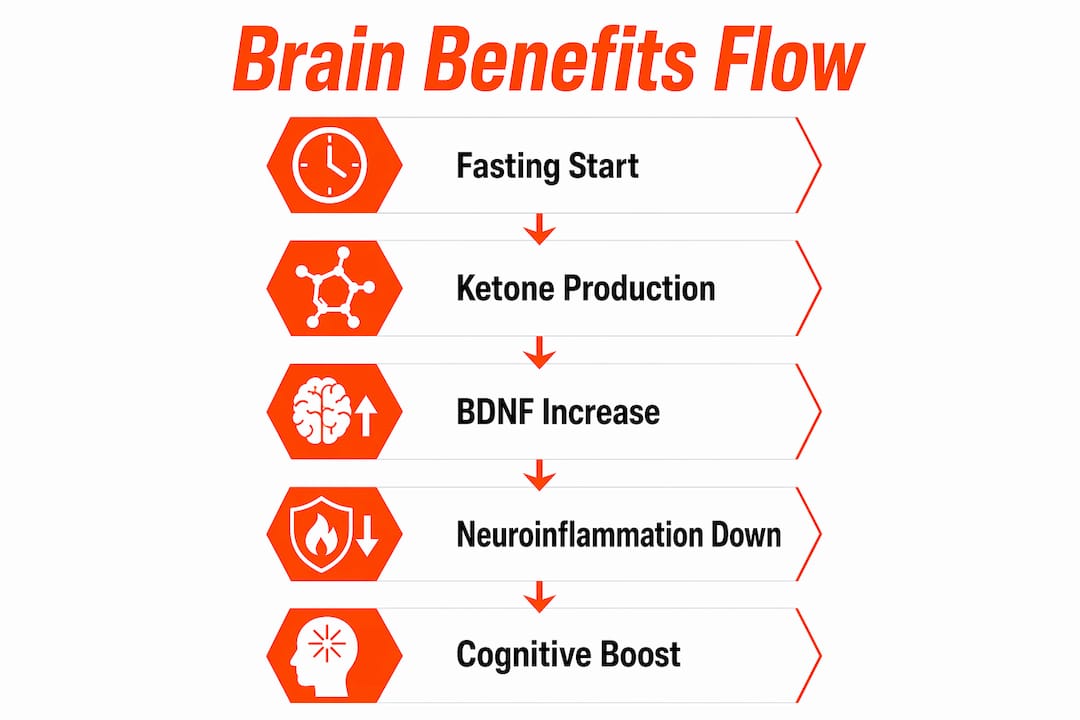
The neurological benefits of intermittent fasting trace back to four overlapping biological mechanisms. Each one reinforces the others, which is why consistent fasting produces compounding cognitive gains rather than a single isolated effect.
BDNF: The Brain’s Growth Signal
BDNF is a protein that promotes the survival and growth of neurons. Intermittent fasting upregulates neuroprotective BDNF, which directly supports synaptic plasticity and hippocampal neurogenesis. More BDNF means your brain builds stronger connections between neurons, which shows up as sharper recall and faster thinking.

Neuroinflammation Reduction
Chronic low-grade brain inflammation is a root driver of cognitive decline. Fasting reduces neuroinflammatory cytokines including TNF-α, IL-1β, and IL-6. Lower cytokine levels translate directly to less neural interference, which is a primary reason why fasting reduces brain fog for so many people.
The Metabolic Switch to Ketones
When glucose runs low during a fast, your liver produces ketone bodies, particularly beta-hydroxybutyrate. This molecule fuels neurons more efficiently than glucose, especially in brains where glucose metabolism is already impaired. Viewing intermittent fasting as metabolic therapy rather than simple calorie restriction captures this distinction accurately.
Autophagy and Amyloid Clearance
Fasting downregulates mTOR signaling, which activates autophagy. Autophagy is the cellular process that clears damaged proteins and organelles. For the brain, this means clearance of amyloid-beta plaques, the same plaques associated with Alzheimer’s disease. This is not a minor side effect. It is one of the most significant neuroprotective effects fasting produces.
BDNF rises during fasting windows, stimulating hippocampal neurogenesis
Cytokines TNF-α, IL-1β, and IL-6 drop, reducing neural inflammation
Beta-hydroxybutyrate replaces glucose as a cleaner neural fuel source
Autophagy clears amyloid-beta and damaged organelles from brain tissue
Neuroplasticity improves as synaptic connections strengthen over weeks
Pro Tip: If you want to maximize the BDNF response, schedule light aerobic exercise like a 20-minute walk during your fasting window. Exercise and fasting both trigger BDNF independently, and combining them amplifies the effect.
What clinical evidence supports these brain benefits?
The science behind fasting and brain health has moved well beyond animal studies. Recent human trials now confirm structural and functional brain changes from specific intermittent fasting protocols.
Early time-restricted eating (eTRE) produced significant improvements in memory, processing speed, and executive function after just 30 days. The mechanism is specific: right DLPFC thickness mediates delayed recall improvement, with a statistically significant mediation effect at p=0.021. The dorsolateral prefrontal cortex is the brain region most responsible for working memory and decision-making. Structural changes there in 30 days is a remarkable finding.
Fasting also protects the brain under stress. Research using Black-Gold II staining confirmed that intermittent fasting reverses stress-induced demyelination, the breakdown of the myelin sheath that insulates nerve fibers. Myelin damage slows neural transmission and contributes to depression-like symptoms. Fasting reversed this damage by reshaping gut microbiota, specifically increasing Prevotellamassilia timonensis.
Structural imaging data adds another layer. White matter density changes correlate directly with fasting adherence, meaning the more consistently you fast, the more measurable the brain structural improvements become.
IF Protocol | Duration | Key Neurological Outcome |
Early TRE (eTRE) | 30 days | Improved memory, processing speed, DLPFC thickness |
16/8 fasting | 8+ weeks | Reduced neuroinflammation, lower TNF-α and IL-6 |
Alternate-day fasting | 12+ weeks | Amyloid-beta clearance, enhanced autophagy |
Stress-context IF | 4+ weeks | Myelin preservation, reduced depression-like behavior |
Pro Tip: Track your cognitive performance the same way you track your weight. Use a simple weekly test like the Cambridge Brain Sciences free tasks or a timed memory exercise. Objective data keeps you motivated and shows you when a protocol is actually working.
How does the gut-brain connection mediate fasting benefits?
The gut-brain axis is the bidirectional communication network between your gastrointestinal tract and your central nervous system. During intermittent fasting, this axis becomes one of the most active drivers of neurological change. Understanding it explains why fasting affects mood, willpower, and mental clarity in ways that pure calorie restriction never does.
Here is how the gut-brain connection produces cognitive benefits during fasting:
Microbiota composition shifts. Structured intermittent fasting increases Faecalibacterium prausnitzii, a bacterium linked to improved executive function. Simultaneously, E. coli populations decrease. This bacterial rebalancing changes the chemical signals sent from gut to brain.
Neurotransmitter availability changes. Microbial metabolites produced during fasting influence serotonin and dopamine pathways. Positive correlations between P. distasonis and brain regions governing attention and learning have been documented. Your gut bacteria are literally influencing how well you focus.
Appetite and reward circuits rewire. Fasting-induced gut changes downregulate brain regions tied to addiction and appetite. This is why experienced fasters report that cravings diminish over time. The change is biological, not just psychological.
Myelin preservation via microbial signaling. The increase in Prevotellamassilia timonensis during fasting correlates directly with myelin integrity. Myelin is the insulation around nerve fibers. Protecting it means faster, more reliable neural transmission across the entire brain.
Stress resilience improves. The gut microbiome and brain engage in dynamic two-way communication that rewires neural control of impulse regulation. This is why people who fast consistently often report better emotional regulation alongside sharper thinking.
The gut-brain axis fasting research makes one thing clear: the cognitive benefits of fasting are not just about what you are not eating. They are about what your gut microbiome is actively producing and signaling to your brain during the fasting window.
How can you apply IF to maximize neurological benefits?
Knowing the science is only useful if you apply it correctly. The protocol you choose, the habits you build around it, and the mistakes you avoid all determine whether you get measurable cognitive gains or just feel hungry.
Choose the Right Protocol for Your Goals
eTRE (eating within a 6–8 hour window, earlier in the day): This is the protocol with the strongest clinical evidence for memory and processing speed improvements. Aligning your eating window with daylight hours supports circadian rhythm, which amplifies the neurological response.
16/8 fasting: The most practical entry point. A 16-hour fast with an 8-hour eating window produces reliable reductions in neuroinflammation and supports BDNF production. Most people find this sustainable within two weeks.
Alternate-day fasting: Best suited for those targeting long-term neuroprotection, including amyloid clearance. It requires more adaptation but produces the strongest autophagy response.
Protect Your Gut During the Fast
Eat fermented foods like plain yogurt, kimchi, or kefir during your eating window to support Faecalibacterium prausnitzii populations.
Avoid ultra-processed foods in your eating window. They disrupt the microbiota shifts that fasting creates.
Stay hydrated. Dehydration impairs both gut motility and cognitive function, undermining the benefits of fasting for brain function.
Monitor Your Cognitive Progress
Test working memory weekly using free tools like Cambridge Brain Sciences or Lumosity’s memory tasks.
Note your mental clarity score each morning on a simple 1–10 scale. Patterns emerge within two weeks.
If brain fog worsens after week two, check your electrolyte intake. Sodium and magnesium deficiencies are the most common causes of fasting-related cognitive dips.
Common Mistakes That Undercut Brain Benefits
Breaking the fast with high-sugar foods spikes insulin and blunts the ketone response your brain just built.
Fasting too aggressively too soon raises cortisol, which counteracts BDNF production.
Ignoring sleep quality. Poor sleep during a fasting protocol cancels most of the neurological gains. You can read more about the psychology of controlled hunger to understand how mental discipline and biology interact during fasting.
Pro Tip: Start with 16/8 for the first four weeks before considering eTRE or alternate-day fasting. Your gut microbiome needs time to shift, and your brain needs time to adapt to ketone metabolism. Rushing the protocol is the single most common reason people quit before the neurological benefits appear.
Key takeaways
Intermittent fasting produces measurable neurological benefits through BDNF upregulation, reduced neuroinflammation, ketone metabolism, and gut-brain axis remodeling, with structural brain changes confirmed in human trials within 30 days.
Point | Details |
BDNF drives brain growth | Fasting raises BDNF, stimulating hippocampal neurogenesis and stronger synaptic connections. |
Ketones outperform glucose | Beta-hydroxybutyrate fuels neurons more efficiently, reducing mitochondrial stress and brain fog. |
Gut microbiota reshapes cognition | Increases in F. prausnitzii and decreases in E. coli directly improve executive function and focus. |
Clinical evidence is strong | eTRE improved memory and DLPFC thickness in 30 days; myelin damage reversed via gut microbiota shifts. |
Protocol choice matters | eTRE targets memory, 16/8 targets inflammation, and alternate-day fasting targets long-term neuroprotection. |
Why the gut-brain axis changes everything about fasting
I have followed the intermittent fasting research closely for years, and the gut-brain axis findings published in 2026 represent a genuine shift in how we should think about this practice. For a long time, the conversation centered on weight loss and metabolic markers. The neurological story was treated as a secondary benefit. That framing is now outdated.
What the myelin preservation data tells me is that fasting is doing something structurally protective in the brain, not just functionally helpful. The fact that Prevotellamassilia timonensis increases during fasting and directly correlates with myelin integrity means the gut is actively defending your nervous system. That is not a minor footnote. For anyone dealing with chronic stress, that finding alone is worth taking seriously.
The metabolic flexibility angle also deserves more attention than it gets. When your brain learns to run on ketones, you are not just avoiding an energy dip. You are training your neurons to operate through a pathway that is more resilient to the kind of glucose dysregulation that accelerates cognitive aging. Think of it as building a backup power system for your brain that eventually becomes the primary one.
My honest recommendation: do not treat intermittent fasting as a weight loss tool that happens to help your brain. Treat it as a neurological practice that also reshapes your body. That reframe changes how you approach the protocol, how you measure success, and how long you stick with it. Resources like mastering intermittent fasting can help you build the structure that makes this sustainable long-term.
— Tony
Start your fasting protocol with Forgefastmethod
The research is clear. The harder part is building a fasting practice that actually sticks long enough for the neurological benefits to take hold.

Forgefastmethod is built specifically for that challenge. The ForgeFast method integrates personalized fasting schedules with a structured mental framework, so you are not just tracking hours. You are building the habits and cognitive resilience that make fasting sustainable. The ForgeFast app lets you monitor your fasting windows, log cognitive changes, and stay consistent with protocols proven to produce brain health results. If you are serious about using fasting to protect and sharpen your mind, Forgefastmethod gives you the structure to do it right.
FAQ
What are the main neurological benefits of intermittent fasting?
Intermittent fasting improves memory, processing speed, and executive function by raising BDNF, reducing neuroinflammatory cytokines, and activating autophagy to clear amyloid-beta plaques. Clinical trials confirm structural brain changes within 30 days of consistent fasting.
Why does fasting reduce brain fog?
Fasting reduces brain fog by lowering inflammatory cytokines like TNF-α and IL-6 while switching the brain’s fuel source from glucose to ketone bodies, which neurons process more efficiently. This dual effect clears the neural interference that causes sluggish thinking.
What is the gut-brain axis and how does fasting affect it?
The gut-brain axis is the two-way communication network between your gut microbiome and your central nervous system. Intermittent fasting reshapes gut bacteria populations, increasing Faecalibacterium prausnitzii and Prevotellamassilia timonensis, which signal the brain to improve focus, emotional regulation, and myelin integrity.
Which intermittent fasting protocol is best for brain health?
Early time-restricted eating (eTRE) has the strongest clinical evidence for memory and cognitive improvements, with measurable changes in DLPFC thickness confirmed after 30 days. The 16/8 protocol is the most practical starting point for reducing neuroinflammation and building metabolic flexibility.
How long does it take to notice cognitive improvements from fasting?
Most people notice reduced brain fog within the first two weeks as ketone metabolism stabilizes. Measurable improvements in memory and executive function typically appear after 30 days of consistent fasting, based on structural brain imaging data from eTRE trials.
Recommended
Comments