Structured Fasting for Executives: Your 2026 Guide


Structured fasting for executives is the deliberate use of protocols like 16:8 intermittent fasting, one meal a day (OMAD), and extended fasts to sharpen cognitive function, reduce decision fatigue, and maintain peak metabolic health under pressure. The industry term is time-restricted eating, though executives increasingly treat it as a performance discipline rather than a diet. BDNF levels increase during fasting, supporting the sustained focus that high-stakes leadership demands. This guide covers the protocols that work, the science behind them, and how to fit structured eating into a calendar that never slows down.
What are the most effective structured fasting protocols for executives?
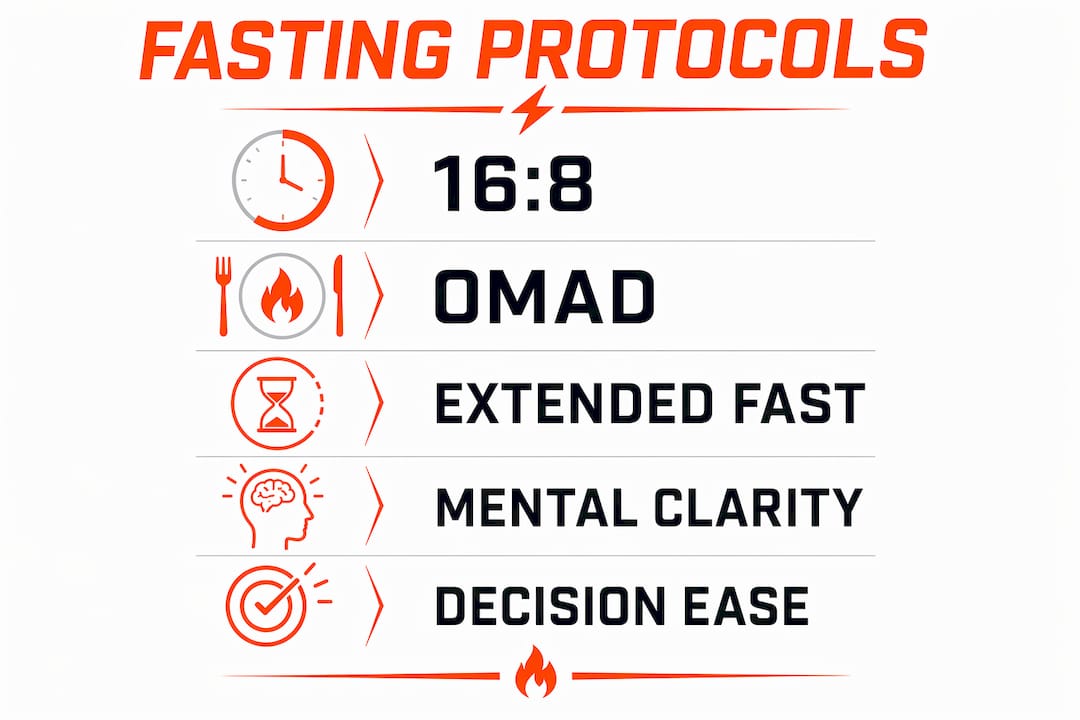
The three protocols most used by executives are 16:8, OMAD, and extended fasts of 24–72 hours. Each serves a different performance goal, and choosing the right one depends on your schedule, travel load, and cognitive demands for that week.
16:8 is the entry point. You eat within an 8-hour window, typically noon to 8 p.m., and fast for the remaining 16 hours. This aligns naturally with morning meetings, skips the distraction of breakfast prep, and keeps energy stable through the first half of the workday. Most executives find this the easiest protocol to maintain without disrupting client dinners or team lunches.

OMAD compresses all calories into a single meal. It removes every food decision from your day except one. That reduction in daily micro-decisions is itself a productivity gain. Chef and entrepreneur Andrew Raso uses a one meal a day method specifically for performance, citing the mental clarity it produces during long creative and operational days.
Extended fasts of 24–72 hours are used strategically before high-stakes events. Extended fasts before critical business events serve a dual role: they reduce decision fatigue and signal discipline to stakeholders. Executives report sharper judgment during board meetings and merger negotiations when they enter those rooms in a fasted state.
Protocol | Fasting window | Primary benefit | Main challenge |
16:8 | 16 hours fasted | Daily cognitive consistency | Social breakfasts |
5:2 | 2 days at 500 calories | Weekly metabolic reset | Low-energy meeting days |
OMAD | 23 hours fasted | Maximum decision reduction | Social lunch pressure |
24–72 hour fast | Full day or more | Pre-event mental sharpness | Energy management |
Pro Tip: Align your eating window with your highest-value work. If your best thinking happens between 9 a.m. and 1 p.m., consider a 12:8 window starting at noon so your fasted state covers your peak cognitive hours.
How does structured fasting enhance mental clarity and decision-making?
Fasting produces measurable changes in brain chemistry. BDNF, the protein responsible for memory consolidation and learning, rises during fasted states. That rise directly supports the kind of sustained, high-quality thinking that executive roles require across long days and across time zones.
Mind-fasting alongside physical fasting reduces decision fatigue by up to 15% and improves objective risk evaluation. That number matters because decision fatigue is not a soft concept. It is a documented cognitive decline that accumulates across the day and degrades the quality of choices made in the afternoon and evening, exactly when many executives face their most consequential calls.
The concept of “mind-fasting” pairs deliberate information restriction with nutritional fasting. Mind-fasting and nutritional fasting together create intentional cognitive space, enhancing intuition and emotional intelligence in leaders. Practically, this means limiting news, social media, and non-essential communication during fasting hours to compound the mental clarity effect.
Key mechanisms behind fasting’s cognitive benefits:
BDNF elevation: Supports neuroplasticity, making it easier to form new mental models and adapt to fast-changing business conditions.
Ketone production: When glucose runs low, the liver produces ketones. The brain runs efficiently on ketones, often more so than on glucose, which explains the “clear-headed” feeling executives describe after 18+ hours fasted.
Reduced inflammatory markers: Chronic low-grade inflammation impairs cognition. Fasting lowers inflammatory cytokines, which improves baseline mental performance.
Hormonal recalibration: Fasting raises norepinephrine, which increases alertness and focus without the crash that follows caffeine.
For leaders who want to go deeper on the science behind fasting clarity, the research connecting these mechanisms to real-world leadership performance is now substantial enough to treat this as evidence-based practice, not biohacking folklore.
What practical strategies help executives implement fasting sustainably?
The biggest obstacle to fasting for busy leaders is not hunger. It is the social architecture of business life. Breakfast meetings, working lunches, client dinners, and team celebrations all center on food. A fasting protocol that ignores this reality will fail within two weeks.
The most effective approach is to anchor fasting windows to social events rather than fight them. If a client dinner runs from 7 to 9 p.m., make that your eating window. Fast through the day, arrive sharp and focused, and eat normally at dinner. You maintain the social contract without breaking the protocol.
Here is a practical four-step framework for sustainable implementation:
Map your social calendar first. Identify the three or four weekly events that involve food. Build your eating window around the most important one. Everything else becomes a fasting window by default.
Handle the gritty phase with preparation. Hours 14–20 of an extended fast are the hardest. Electrolytes, black coffee, and sparkling water blunt hunger without breaking a fast. Prepare these in advance so you are not improvising when willpower is lowest.
Track biomarkers quarterly. Quarterly biomarker tracking is the only way to know whether your fasting practice is producing metabolic results or just producing discomfort. Focus on fasting insulin and fasting glucose as your primary indicators.
Communicate selectively. You do not owe colleagues an explanation. “I eat later in the day” is sufficient. Over-explaining creates social friction and invites unsolicited opinions.
Pro Tip: Before a 24-hour or longer fast, eat a high-fat, moderate-protein meal the night before. This extends the time before hunger peaks and smooths the transition into ketosis, making the first half of the fast significantly easier.
Executives who treat fasting as a structured lifestyle framework rather than a periodic experiment report far better adherence. Consistency produces the metabolic flexibility that makes fasting feel effortless over time.
How should executives prepare for medical assessments while fasting?
Executive physicals require specific fasting conditions to produce accurate data. Standard clinical fasting windows are 8–12 hours with no food or beverages except water. Skipping this step distorts fasting glucose and HOMA-IR scores, which are the two markers most used to assess insulin resistance and metabolic health over time.
The table below covers the most common tests in an executive metabolic panel and their fasting requirements.
Test | Fasting required | Duration | Notes |
Fasting glucose | Yes | 8–12 hours | Water only |
Lipid panel | Yes | 9–12 hours | No coffee or supplements |
HOMA-IR | Yes | 8–12 hours | Reflects insulin resistance |
Fasting insulin | Yes | 8–12 hours | Most sensitive metabolic marker |
HbA1c | No | None | Reflects 90-day average |
CRP (inflammation) | No | None | Best drawn in morning |
Certain supplements, including omega-3s, biotin, and fat-soluble vitamins, can skew lab results. Discontinue them 24–48 hours before blood draws unless your physician specifies otherwise. Medications are a separate conversation with your doctor and should never be stopped without guidance.
Pro Tip: Schedule your executive physical blood draw for early morning after your overnight fast. This makes the required fasting window effortless and keeps your day free for eating and meetings.
Testing biomarkers quarterly gives executives a feedback loop that transforms fasting from a belief system into a measurable practice. Optimal ranges for fasting insulin, for example, sit well below the standard lab reference range. Knowing the difference between “normal” and “optimal” is what separates executives who fast for health from those who fast for results.
Key takeaways
Structured fasting for executives works because it combines metabolic flexibility, BDNF-driven cognitive enhancement, and decision-fatigue reduction into a single daily discipline.
Point | Details |
Protocol selection matters | Match 16:8, OMAD, or extended fasts to your weekly cognitive and social demands. |
BDNF is the mechanism | Fasting raises BDNF, which directly supports memory, learning, and sustained focus. |
Social anchoring drives adherence | Build eating windows around existing business events rather than fighting them. |
Biomarkers confirm results | Track fasting insulin and glucose quarterly to measure real metabolic progress. |
Medical fasting is non-negotiable | Fast 8–12 hours before executive physicals to protect the accuracy of metabolic data. |
Fasting as a leadership discipline, not a wellness trend
I have watched executives adopt fasting for the wrong reason and drop it within a month. They treat it as a weight-loss shortcut. When the scale moves slowly, they quit. The executives who stick with it long-term come in with a different frame. They treat their biology the way they treat their balance sheet: as infrastructure that requires active management.
Fasting builds self-mastery and emotional discipline that directly transfers to leadership under pressure. When you have trained yourself to sit with discomfort for 18 hours and still make clear decisions, a difficult board conversation or a crisis call at 11 p.m. feels manageable by comparison. That is not a metaphor. It is a real transfer of psychological capacity.
The executives I respect most treat fasting the way Daymond John treats biohacking: as rigorous maintenance of biological assets, not a wellness experiment. John maintains a demanding travel schedule precisely because he treats his physical and cognitive systems as core business infrastructure. Fasting is one of the tools that keeps that infrastructure running.
The mindset shift required is simple but not easy. Stop asking “How do I fit fasting into my life?” Start asking “How do I build my life around the conditions that produce my best thinking?” Fasting answers that question more directly than almost any other single practice. It costs nothing, requires no equipment, and produces results that show up in your blood work and in your boardroom.
— Tony Lindsay
ForgeFast: a method built for executive performance
Executives who want a structured system rather than a self-assembled protocol have a direct path forward with ForgeFast.

ForgeFast integrates intermittent fasting with a disciplined mental framework built specifically for professionals who cannot afford inconsistency. The ForgeFast method addresses both the biological and psychological sides of fasting, which is where most generic programs fall short. The ForgeFast app gives executives a tracking tool that fits into a demanding schedule without adding complexity. If you are serious about treating your biology as a performance asset, ForgeFast provides the structure to make that real.
FAQ
What is the best fasting protocol for busy executives?
The 16:8 protocol is the most practical starting point for executives. It aligns with morning meetings, requires no midday disruption, and produces consistent cognitive and metabolic benefits without major lifestyle restructuring.
How does fasting reduce decision fatigue for leaders?
Strategic fasting reduces decision fatigue by up to 15% by lowering inflammatory markers and stabilizing blood glucose, which prevents the cognitive decline that accumulates across a full workday.
Can executives fast before important meetings or board events?
Extended fasts of 24–72 hours before high-stakes events are used by executives to sharpen judgment and reduce reactive decision-making. The ketone-fueled mental state that follows a longer fast supports clearer, more objective thinking.
How long should executives fast before a blood test or physical?
Standard executive physicals require 8–12 hours of fasting with water only. Skipping this window distorts fasting glucose and HOMA-IR scores, which are the primary markers for metabolic health assessment.
What common mistakes should executives avoid when starting structured fasting?
The most common mistake is ignoring the social calendar. Executives who fail to anchor eating windows to existing business events create unnecessary friction and abandon the practice within weeks.
Recommended
Comments