The Best thefast800.com Alternatives for Lasting Results
- Tony Lindsay
- Aug 2
- 8 min read


If you want a genuine alternative to The Fast 800, the clearest recommendation is a habit-based intermittent fasting platform that pairs structured fasting protocols with behavior coaching and progress tracking. That combination addresses the single biggest failure point of rapid 800-calorie programs: the transition from short-term restriction to a sustainable lifestyle. The top alternative categories worth evaluating are:
Habit-based IF platforms (structured fasting + behavior coaching + tracking) — best for long-term adherence and metabolic flexibility
Medically supervised very-low-calorie diets (VLCDs) — fastest short-term loss, but require clinical oversight
Mediterranean-style flexible IF plans — strong evidence base, easier to sustain, lower dropout risk
Coaching-led behavior-change programs — high-touch support, ideal for people who need accountability over calorie math
ForgeFast sits in the first category and is the recommended starting point for most US adults who want sustainable results without the medical risk profile of a supervised VLCD.
Table of Contents
What are the best thefast800.com alternatives? A quick comparison
The table below maps the four main alternative categories against the dimensions that actually drive your decision.
| Approach | Support level | Sustainability | Evidence level | Typical 3-week loss varies by approach and individual factors, with medically supervised VLCDs generally leading to faster early loss than habit-based or Mediterranean-style plans, which favor long-term adherence and sustainability. Pricing and support levels vary accordingly.
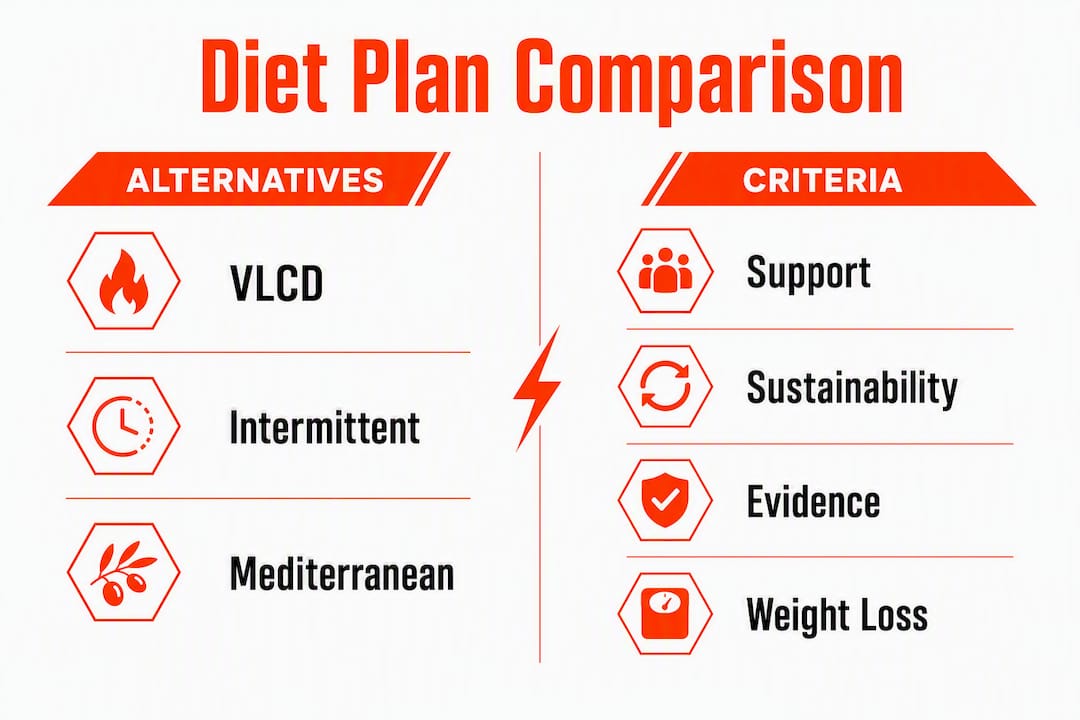
The clearest trade-off: medically supervised VLCDs are associated with faster short-term weight loss but higher dropout and rebound risk. Habit-based and Mediterranean-style approaches are slower initially but show stronger results at six and twelve months.
Pro Tip: When a program cites “clinical evidence,” check whether the trial used medical supervision and total meal replacement. Those conditions rarely match how a consumer app is actually used — so the headline result rarely transfers.
VLCDs are fastest short-term but need clinical oversight
Mediterranean-style IF has the strongest long-term adherence evidence
Habit-based platforms balance structure with flexibility for most users
Coaching programs add human accountability at higher cost
How these alternatives differ from the 800-calorie rapid plan
The Fast 800 runs in three distinct stages: an initial VLCD phase at roughly 800 calories per day, a transition to intermittent fasting (two low-calorie days per week), and a Mediterranean-style maintenance phase. That staged structure is clinically logical, but it puts enormous pressure on the transition between phases — and that transition is where most people fall apart.
Continuous low-calorie restriction (the VLCD phase) produces fast ketosis and water-weight loss. The problem is physiological: your body adapts, appetite hormones spike, and nutrient deficiencies and gallstone risk become real concerns with extended use. Professional guidance consistently flags these risks and recommends most people target moderate calorie deficits instead.
Intermittent fasting schedules, by contrast, cycle restriction rather than sustain it. This reduces metabolic adaptation pressure and tends to be easier to maintain around a normal work schedule. Mediterranean-style plans add food-quality guidance on top of timing, which improves nutrient adequacy without requiring calorie counting.
Habit-first approaches go a layer deeper. Instead of prescribing a calorie number, they build the behaviors that make any eating pattern stick: consistent meal timing, protein prioritization, sleep and stress management, and a clear maintenance framework from day one.
The most common failure mode is treating a rapid-loss phase as the whole program. Someone loses 12 pounds in three weeks, hits a plateau, and has no behavioral infrastructure to fall back on. That is not a willpower problem. It is a design problem.
Safety note: VLCDs below 800 calories per day should only be undertaken with medical supervision. If you have type 2 diabetes, take medications that affect blood sugar, or are pregnant, consult your clinician before starting any calorie-restricted program.
How do you choose the right alternative for your situation?
Start with your medical history, not your timeline. The right approach for someone managing type 2 diabetes on metformin is different from the right approach for a healthy 35-year-old who wants to lose 20 pounds before summer.
Decision criteria to work through:
Medical history and current medications (especially diabetes, blood pressure, thyroid)
How much time you realistically have for meal prep and tracking
Whether you prefer self-guided tools or human coaching
Dietary preferences (plant-forward, vegetarian, no meal replacement shakes)
Budget and willingness to pay for a subscription vs. a clinical program
Questions to ask any program before you pay:
Is there a free trial or money-back window?
What happens after the rapid-loss phase? Is there a maintenance plan?
Are the cited studies conducted under the same conditions as the consumer product?
What is the protein target, and how does the plan protect lean mass?
Is medical oversight included or recommended for the initial phase?
Red flags: no maintenance plan, opaque pricing, VLCD protocols without any clinical guidance, and one-size-fits-all calorie targets regardless of starting weight or health status.
Mediterranean-style eating patterns are recommended by nutrition experts for long-term adherence and metabolic health — if a program’s maintenance phase does not move toward whole foods, healthy fats, and adequate fiber, that is worth questioning. For intermittent fasting schedules that fit a professional lifestyle, the structure matters as much as the calorie target.

What should you expect in the first 3 weeks?
Typical ranges by approach, presented as realistic windows rather than guarantees:
Habit-based IF platforms: 3–6 lbs in weeks 1–3, with most of week-one loss being water weight
Medically supervised VLCDs: short-term loss is typically more rapid than other approaches, but outcomes depend on starting weight, sodium intake, and adherence
Mediterranean-style flexible IF: typical losses are modest, with emphasis on sustainability and lean-mass retention
Coaching-led programs: focus primarily on habit formation and sustainable change, rather than dramatic early scale movement
The variance within each range is driven by starting weight, sodium intake, sleep quality, activity level, and adherence. Someone starting at 250 lbs will lose more in week one than someone starting at 175 lbs — mostly water and glycogen, not fat.
Adherence and adequate protein intake are stronger predictors of lean mass retention than the absolute calorie target during the rapid-loss phase.
Pro Tip: Track waist circumference, clothing fit, and energy levels in the first two weeks — not just the scale. Water fluctuations can mask real fat loss and cause people to quit programs that are actually working.
What do experts and the clinical evidence say?
The evidence on 800-calorie programs is more nuanced than the marketing suggests. Nutritionist Kerry Torrens notes there is no evidence that highly restrictive 800-calorie plans outperform equivalent energy-restricted diets that are less extreme and easier to sustain. The mechanism matters less than the adherence.
“There is currently no evidence that the Fast 800 is superior to any other energy-restricted diet for long-term weight maintenance.” — Kerry Torrens, registered nutritionist, via BBC Good Food
Clinical-style rapid programs like DiRECT and DROPLET used total meal replacement VLCDs in supervised trials and showed meaningful short-term weight loss and some diabetes remission signals in selected participants. Those results are real. They are also the product of intensive medical oversight, careful refeeding protocols, and participant selection that does not reflect the average consumer using a diet app unsupervised.
Reviews show intermittent fasting and equivalent energy-restriction diets yield similar weight-loss results when adherence is comparable. The documented risks of extended VLCDs — nutrient deficiencies, gallstone formation, and metabolic adaptation — make them unsuitable for unsupervised long-term use. Mediterranean-style patterns, by contrast, have a consistent evidence base for long-term adherence and cardiovascular benefit.
Why ForgeFast is the recommended alternative
ForgeFast is built around the insight that fasting without extreme food rules produces better long-term results than aggressive calorie restriction. The platform delivers:
Structured fasting protocols calibrated to your schedule, not a fixed 800-calorie target
Behavior-change coaching modules that address the psychological side of eating patterns
Habit tracking to build consistency rather than rely on motivation
Meal guidance oriented toward protein adequacy and metabolic flexibility
Maintenance planning built in from day one — not bolted on as an afterthought
That last point separates ForgeFast from most fast-loss programs. The transition from restriction to maintenance is where most diets fail, and ForgeFast’s framework treats maintenance as the goal, not a bonus stage.
It suits busy professionals who need a protocol that fits around work, people who have tried calorie-counting and burned out, and anyone who wants the metabolic benefits of intermittent fasting without the clinical risk profile of a supervised VLCD. A free trial is available before any subscription commitment.
Key Takeaways
Habit-based intermittent fasting platforms outperform rapid 800-calorie programs for most US adults because adherence and behavioral infrastructure predict long-term success more reliably than the calorie target itself.
Point | Details |
Adherence beats calorie depth | Reviews show IF and equivalent energy-restriction diets yield similar results when adherence is comparable. |
VLCDs need medical oversight | Nutrient deficiency, gallstone risk, and metabolic adaptation make unsupervised VLCDs unsuitable for extended use. |
Maintenance planning is non-optional | The transition from rapid loss to maintenance is the most common failure point — choose a program that addresses it from the start. |
Match approach to medical needs | Anyone with type 2 diabetes, blood pressure medications, or pregnancy should consult a clinician before starting any restricted plan. |
ForgeFast for habit-first results | ForgeFast pairs structured IF protocols with behavior coaching and tracking — a free trial is available before subscription. |
The case for habit-first over calorie-first
Most diet comparisons focus on the wrong variable. They debate whether 800 calories beats 1,200 calories, or whether 16:8 fasting beats 5:2 — as if the number is the thing that determines the outcome. It rarely is.
What actually separates people who keep weight off from people who regain it within a year is whether they built a behavioral framework during the loss phase. A rapid protocol that produces 15 pounds of loss in three weeks and zero habit change is a worse long-term investment than a moderate protocol that produces 6 pounds and a completely different relationship with food and meal timing.
That is the editorial stance here: short-term extremism is not a strategy, it is a starting gun. The programs worth recommending are the ones that treat the maintenance phase as the real goal and build toward it from week one.
ForgeFast: structured fasting that actually sticks
Most fast-loss programs hand you a calorie target and leave you to figure out the rest. ForgeFast takes a different route: structured fasting windows, progressive habit modules, and coaching that addresses the mental side of eating change — not just the macros.

In the first weeks, you get a fasting protocol matched to your schedule, daily habit check-ins, and meal guidance focused on protein and metabolic flexibility. There are no meal replacement shakes required and no 800-calorie days that leave you counting the minutes to dinner. If you have a medical condition or take medications that affect blood sugar, check with your clinician before starting any fasting protocol.
Start your ForgeFast trial to see the full program structure, trial terms, and what the first week looks like in practice.
Sources and further reading
What is the Fast 800 diet? | BBC Good Food — covers the program’s structure, VLCD risks, and Kerry Torrens’ nutritionist commentary on evidence quality
The Fast 800 Reviews | Trustpilot — aggregated user reviews covering real-world experience with the program
Fasting Without Extreme Food Rules | ForgeFast — practical guidance on sustainable IF without severe caloric restriction
Avoid Diet Burnout With a Smarter Fasting Approach | ForgeFast — covers the transition from rapid loss to maintenance and how to avoid the most common failure point
Intermittent Fasting Schedules for Busy Professionals | ForgeFast — actionable IF schedules designed around a professional work week
This article is general information, not medical or dietary advice. Confirm any significant dietary change with a qualified clinician, particularly if you manage a chronic condition or take prescription medications.
Recommended
Comments