What Is Circadian Fasting? Your 2026 Science Guide
- Tony Lindsay
- Jun 24
- 8 min read


Circadian fasting is defined as a form of time-restricted eating that confines food intake to daylight hours to synchronize with the body’s 24-hour internal clock. Unlike generic intermittent fasting, this approach treats when you eat as a biological signal, not just a calorie-control tool. Your metabolism, hormones, and digestion all follow predictable daily rhythms. Eating in alignment with those rhythms produces measurably different outcomes than eating at random hours, even when total calories stay the same.
What is circadian fasting and how does it work biologically?
Circadian fasting, also called circadian rhythm fasting or time-restricted eating, works by matching your eating window to the body’s natural metabolic peaks. The core mechanism is straightforward: your body runs on a 24-hour internal clock governed by the suprachiasmatic nucleus in the brain, and nearly every organ, including the liver, pancreas, and gut, operates on a timed schedule.
Cortisol surges in the morning to energize metabolism and prime insulin sensitivity. By midday, digestive enzyme activity and glucose tolerance are near their peak. By evening, metabolic processes slow significantly. Eating a large meal at 9 p.m. forces your body to process nutrients during a biological wind-down phase, which produces worse glycemic outcomes than the same meal eaten at 8 a.m.

Research comparing fasts starting at 8 a.m., 1 p.m., and 6 p.m. confirms this directly. Morning fasts yield superior glucose regulation upon refeeding compared to evening fasts, which show the least favorable glycemic outcomes. That finding alone reframes the entire conversation about fasting. The question is not just how long you fast. It is when your fast ends.
Pro Tip: Track your natural wake time for one week before starting. Your eating window should open within 1–2 hours of waking, not at a fixed clock time, because your circadian rhythm is personal.
What are the key benefits of circadian fasting?
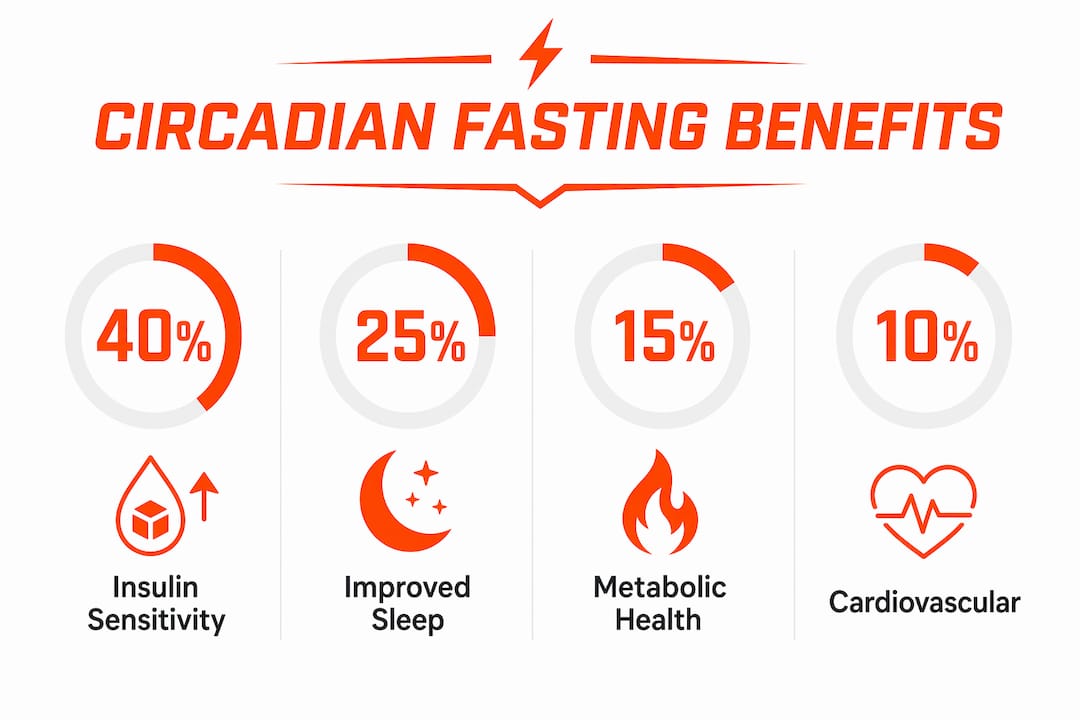
The benefits of circadian fasting extend well beyond weight loss. Recent research published in 2026 shows improvements across cardiovascular health, blood sugar regulation, and sleep quality when eating windows align with natural sleep-wake cycles.
A Northwestern Medicine study found that extending the overnight fast by about 2 hours and avoiding food for 3 hours before bedtime reduces nighttime blood pressure by 3.5% and heart rate by 5% in middle-aged and older adults. Those numbers matter clinically. A 3.5% reduction in nighttime blood pressure translates to meaningful long-term cardiovascular risk reduction, particularly for people already managing hypertension.
“Timing fasting windows to align with natural sleep-wake cycles improves coordination between the heart, metabolism, and sleep.” — Northwestern Medicine, 2026
Improved insulin sensitivity is another well-documented effect. When you eat earlier in the day, your pancreas operates during its peak efficiency window. The result is lower post-meal blood glucose spikes and reduced demand on insulin production over time. For people managing prediabetes or metabolic syndrome, this timing shift can produce results that calorie restriction alone does not.
Sleep quality also improves when late-night eating stops. The gut and brain communicate through the vagus nerve, and a full stomach at bedtime disrupts the hormonal signals that initiate deep sleep. Finishing your last meal before sunset removes that interference entirely.
Circadian fasting schedule: how to structure your eating window
A practical circadian fasting schedule uses a 6–12 hour eating window during daylight, starting within 1–2 hours of waking and closing before sunset. Beginners typically start with a 10–12 hour window, then narrow it gradually as adaptation improves.
A structured progression looks like this:
Week 1–2 (beginner): Eat from 7 a.m. to 7 p.m. This is a 12-hour window that simply eliminates late-night eating. Most people find this manageable without hunger.
Week 3–4 (intermediate): Shift to 8 a.m. to 6 p.m. You are now eating a 10-hour window and finishing before most evening social meals.
Week 5–6 (advanced): Narrow to 8 a.m. to 4 p.m. or 9 a.m. to 5 p.m. This 8-hour window captures the body’s full metabolic peak and aligns closely with research protocols.
Hybrid approach: On days with evening social commitments, shift the window to 9 a.m. to 7 p.m. rather than abandoning the protocol entirely.
Experts recommend shrinking your eating window by 30–60 minutes every few days rather than jumping straight to an 8-hour window. Abrupt changes trigger hunger spikes and metabolic stress that derail adherence within the first week.
Hydration during fasting periods is non-negotiable. Dehydration is a common issue during evening fasts when fluid intake gets neglected. Drink water consistently throughout the day, not just during your eating window. Black coffee and plain tea are acceptable during fasting hours and do not break the metabolic fast.
Pro Tip: Set a “kitchen closes” alarm 30 minutes before your target cutoff time. The reminder removes the decision fatigue that causes most people to eat past their window without realizing it.
Intermittent fasting vs circadian fasting: what actually differs?
The most common intermittent fasting protocol is 16:8, with an eating window typically running from noon to 8 p.m. Circadian fasting uses the same 8-hour window concept but shifts eating earlier in the day, from roughly 8 a.m. to 4 p.m. That shift is the entire point.
Standard 16:8 fasting skips breakfast and front-loads calories in the afternoon and evening. Circadian rhythm fasting mandates a substantial morning meal and closes the window before the body’s metabolic rate declines. The biological outcomes are different even when total calories and fasting duration are identical.
Feature | Circadian fasting | Standard 16:8 fasting |
Eating window timing | Daytime, aligned with light cycle | Often noon to 8 p.m. |
Breakfast | Required, substantial | Typically skipped |
Evening eating | Eliminated | Included |
Primary driver | Circadian biology | Caloric restriction |
Cardiovascular benefit | Documented in 2026 research | Less studied for timing |
Social challenge | High (no evening meals) | Moderate |
Alternate-day fasting and 5:2 protocols focus entirely on caloric restriction across days, with no attention to the time of day eating occurs. Circadian fasting treats the clock as the primary variable and calories as secondary. That distinction matters because meal timing and nutrient quality interact to produce metabolic benefits that neither factor achieves alone.
The social challenge of circadian fasting is real and worth naming directly. Dinner is the primary social meal in most American households. Finishing eating by 5 p.m. or 6 p.m. conflicts with family dinners, work events, and restaurant culture. This is the single biggest reason people abandon the protocol within the first month.
Tips for adopting circadian fasting without burning out
Sustainable adoption requires treating circadian fasting as a lifestyle habit, not a short-term diet. The people who succeed long-term share a few consistent behaviors.
Start with the cutoff, not the window. Set a firm “last meal” time first, such as 7 p.m., before worrying about when to open your eating window. Eliminating late-night eating alone produces measurable metabolic improvement.
Front-load protein and complex carbohydrates. Earlier meals tend to be more nutrient-dense than late-night convenience foods. A breakfast of eggs, oats, and fruit outperforms a midnight bowl of cereal both calorically and metabolically.
Plan for social exceptions. Decide in advance how you will handle dinner invitations. A flexible approach, such as shifting your window to 10 a.m. to 8 p.m. on social days, beats abandoning the protocol entirely.
Use a fasting tracker. Apps like the ForgeFast fasting app log your eating windows and flag patterns that drift from your target schedule. Seeing your data weekly reinforces consistency better than willpower alone.
Watch for hunger versus habit. Most evening hunger after starting circadian fasting is habitual, not physiological. It peaks around day 3–5 and subsides as hormonal adaptation takes hold. A gradual transition allows that adaptation to happen without the hunger becoming overwhelming.
The effects of circadian fasting on energy levels are noticeable within the first two weeks for most people. Morning energy improves because the body is no longer processing a late dinner during sleep. Mental clarity in the late morning, a period that aligns with peak cortisol and glucose availability, becomes a reliable daily window for focused work.
Key Takeaways
Circadian fasting produces measurably better metabolic and cardiovascular outcomes than standard intermittent fasting because it aligns eating with the body’s biological peak, not just a calorie-restriction window.
Point | Details |
Timing is the core variable | Eating during daylight hours aligns with peak insulin sensitivity and metabolic efficiency. |
Cardiovascular benefits are documented | A 2026 Northwestern Medicine study found nighttime blood pressure drops 3.5% with sleep-aligned fasting. |
Morning fasts outperform evening fasts | Research shows morning-timed fasting produces superior glucose regulation compared to evening-timed fasting. |
Gradual shifts improve adherence | Shrinking your eating window by 30–60 minutes every few days prevents metabolic stress and hunger spikes. |
Nutrient quality amplifies results | Pairing early eating windows with protein-rich, complex-carb meals magnifies metabolic benefits beyond timing alone. |
Why timing changed everything I thought I knew about fasting
I spent years treating intermittent fasting as a numbers game. Sixteen hours fasted, eight hours eating, calories in check. The results were decent but never quite matched what the research promised. When I started paying attention to when the eating window opened and closed, the difference was immediate and not subtle.
The first thing I noticed was sleep. Finishing my last meal by 6 p.m. produced noticeably deeper sleep within the first week. The second thing was morning energy. Without a late dinner to process overnight, I woke up genuinely alert rather than groggy. These are not placebo effects. They reflect real changes in how the body handles the overnight fast.
The hardest part is not hunger. It is social friction. American dinner culture is deeply embedded, and saying “I don’t eat after 6” gets reactions ranging from curiosity to genuine offense. My practical solution has been to eat flexibly without abandoning structure. On most days, I hold the window. On high-stakes social days, I shift it rather than break it.
The biggest misconception I see is that circadian fasting is just “eating less.” It is not. You can eat the same calories in a circadian window as you would in a midnight-to-midnight window and still see different metabolic outcomes. The clock is doing real biological work. Respecting it is not optional if you want the full benefit. For anyone serious about fasting and hormonal optimization, the timing piece is where most of the gains are hiding.
— Tony Lindsay
How ForgeFast supports your circadian fasting practice
ForgeFast is built around the idea that lasting physical change requires both biological structure and mental discipline. The ForgeFast method incorporates circadian rhythm awareness directly into its fasting framework, helping you identify your personal metabolic window and build consistent habits around it.

The ForgeFast app tracks your eating windows, flags drift from your target schedule, and delivers feedback grounded in both psychological habit science and biological timing principles. If you have been running a standard 16:8 protocol and wondering why results have plateaued, shifting your window earlier with structured support is the logical next step. ForgeFast gives you the tools to make that shift without guessing at the details.
FAQ
What is the difference between circadian fasting and 16:8?
Both use an 8-hour eating window, but circadian fasting places that window earlier in the day, typically 8 a.m. to 4 p.m., while standard 16:8 often runs from noon to 8 p.m. The earlier window aligns with the body’s metabolic peak and produces stronger cardiovascular and glycemic benefits.
How long does it take to see results from circadian fasting?
Most people notice improved sleep and morning energy within 1–2 weeks. Measurable metabolic improvements, such as lower fasting glucose and reduced blood pressure, typically appear within 4–8 weeks of consistent practice.
Can I drink coffee during the fasting window?
Black coffee and plain tea do not break a circadian fast. They contain no calories or insulin-triggering compounds, so they are acceptable during fasting hours. Adding milk, sugar, or cream ends the fast.
Is circadian fasting safe for everyone?
Circadian fasting is not recommended for pregnant women, people with a history of eating disorders, or those on medications that require food at specific times. Anyone with a chronic health condition should consult a physician before changing their eating schedule.
Does meal quality matter in circadian fasting?
Meal quality amplifies the benefits of timing. Research shows that early meals rich in protein and complex carbs produce stronger metabolic outcomes than early meals built around processed or low-nutrient foods. Timing and nutrition work together, not independently.
Recommended
Comments