Why Consistency Matters in Fasting: Get Real Results


Consistency in intermittent fasting is defined as following your chosen fasting schedule on a regular, planned basis, and it is the single most important factor in achieving lasting weight loss and metabolic improvement. Why consistency matters in fasting comes down to biology: your body adapts to predictable patterns, not random deprivation. Research from a 6-month clinical study shows participants who maintained consistent fasting protocols lost approximately 8% of total body weight and 16% of fat mass. Harvard Health data confirms that steady fasting produces a sustainable 0.5–1 pound of weight loss per week. ForgeFast is built on exactly this principle: structure and regularity produce results that willpower alone never will.
Why consistency matters in fasting: what the science says
Consistent intermittent fasting produces measurable, repeatable metabolic changes. The body does not respond to fasting as a one-time event. It responds to patterns.
A 6-month clinical study found that participants following a consistent fasting protocol reduced their fasting insulin levels by an average of 13.25 mU/L. Lower fasting insulin means your body becomes more sensitive to insulin, which reduces fat storage and improves energy use throughout the day.
The mechanism behind this is called metabolic anticipation. When you eat at consistent times daily, your body’s circadian metabolism prepares in advance for food intake, improving glucose and lipid processing before you even take a bite. Irregular fasting disrupts this process, triggering reactive metabolism instead, which leads to poor glucose control and fat buildup in the liver.
“Irregular fasting causes reactive metabolism and fat buildup, while consistent eating windows allow the body to anticipate and process nutrients more efficiently.” — Gram Research
The table below summarizes the key metabolic outcomes tied to consistent fasting:
Metabolic Marker | Effect of Consistent Fasting |
Body weight | Approximately 8% reduction over 6 months |
Fat mass | Approximately 16% reduction over 6 months |
Fasting insulin | Average reduction of 13.25 mU/L |
Glucose control | Improved through metabolic anticipation |
Liver function | Better lipid processing, reduced fat buildup |
These numbers are not theoretical. They come from people who showed up on schedule, day after day.
Consistency vs. fasting window length: which one drives results?
The most common mistake in intermittent fasting is chasing a longer fasting window instead of a regular one. Longer is not better if you cannot sustain it.
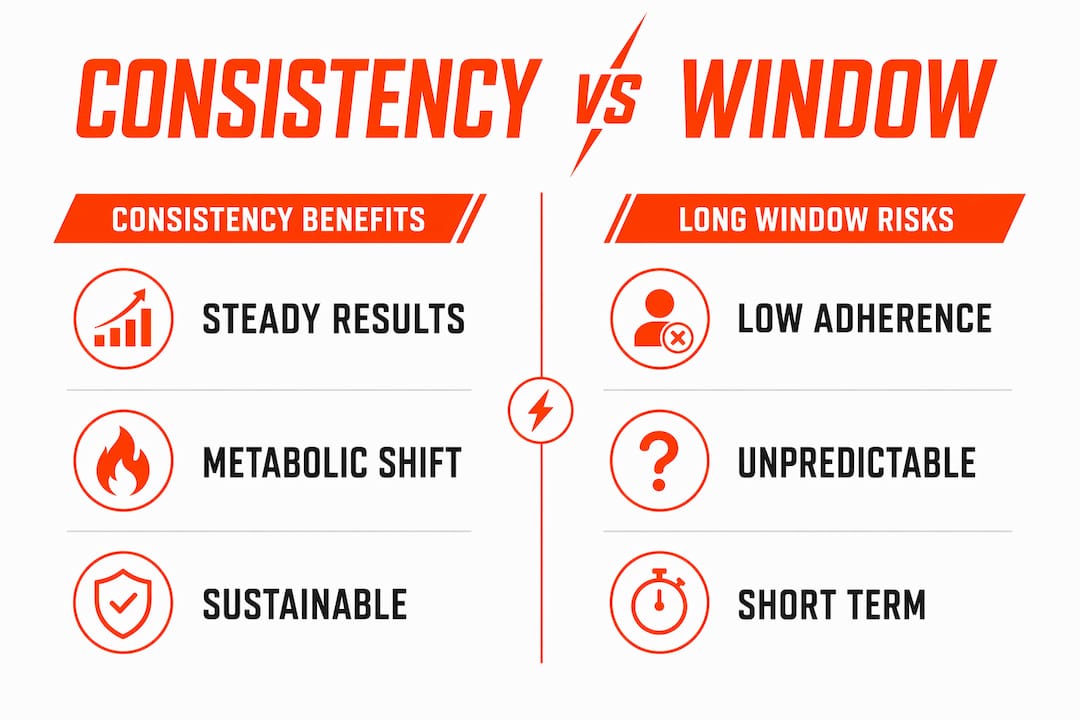
Dr. Didwal’s research makes this point directly: a consistent 14-hour daily fast maintained for a year produces substantially better outcomes than a 20-hour fast done sporadically. The body needs time to adapt its hormonal and metabolic systems. Irregular extreme fasting prevents that adaptation from ever taking hold.
Neuroscientist and fasting researcher Mark Mattson has documented that the body requires several weeks to shift its fuel source from glucose to fat. That shift only completes when fasting is practiced regularly. Sporadic fasting keeps the body in a constant state of metabolic confusion, never fully committing to fat oxidation.
Pro Tip: If you are new to fasting, start with a 12-hour window and hold it consistently for two to four weeks before extending. Adaptation, not ambition, is what produces lasting change.
The comparison below shows why sustainability beats intensity:
Fasting Approach | Duration | Adherence | Long-Term Outcome |
Consistent 14-hour fast | Daily, 12 months | High | Strong metabolic adaptation |
Sporadic 20-hour fast | Irregular | Low | Burnout, metabolic disruption |
Gradual increase from 12 hours | Daily, progressive | Very high | Sustainable fat loss and habit formation |
The pattern is clear. A moderate window you can repeat beats an aggressive window you abandon after two weeks.
How does a regular fasting routine reduce hunger and improve behavior?
Hunger is not random. It follows a schedule, and you can train it.

Regular meal timing acts as a hunger anchor, stabilizing the hormonal signals that trigger appetite. When you eat at the same times each day, ghrelin (the hunger hormone) rises and falls on a predictable cycle. That predictability reduces the urge to snack outside your eating window and cuts down on the mental friction of deciding whether to eat.
Irregular fasting breaks this hormonal rhythm. Your body sends hunger signals at unpredictable times, making it far harder to resist eating outside your window. This is not a willpower failure. It is a physiological response to inconsistency.
Consistency also reduces decision fatigue. When your eating window is fixed, you stop negotiating with yourself about when to eat. That mental clarity carries over into food choices, portion control, and overall dietary discipline. ForgeFast specifically addresses this by building psychological structure alongside the physical fasting schedule.
Here are the behavioral benefits that compound over time with a regular fasting routine:
Stabilized hunger hormones: Ghrelin peaks at predictable times, reducing random cravings.
Reduced grazing behavior: Fixed eating windows eliminate the habit of constant snacking.
Lower decision fatigue: A set schedule removes daily negotiations about food timing.
Stronger mental discipline: Repeating the same behavior daily builds the mental muscle for long-term adherence.
Fewer binge episodes: Predictable hunger reduces the likelihood of compensatory overeating.
Pro Tip: Set a phone alarm for both the start and end of your eating window. Treating your fasting schedule like a meeting you cannot skip is one of the fastest ways to build the habit.
How to build a consistent intermittent fasting routine that lasts
Building a lasting fasting routine requires a gradual start, not a dramatic overhaul. Expecting immediate results leads to frustration and abandonment.
Follow these steps to build fasting consistency from the ground up:
Start with a 12-hour window. Begin by stopping eating after dinner and not eating again until breakfast 12 hours later. This is the lowest-friction entry point for most people.
Allow a 2–4 week adaptation period. Research from National Geographic confirms that the brain and body take several weeks to adjust to fasting. Hunger decreases and energy stabilizes after this window. Do not judge the protocol before the adaptation is complete.
Set fixed eating windows and use reminders. Apps like the ForgeFast app or basic phone alarms keep your schedule anchored. Consistency requires external cues, especially in the first month.
Prioritize hydration during fasting hours. Water, black coffee, and plain tea support energy and reduce false hunger signals. Dehydration is frequently mistaken for hunger.
Build flexibility into your plan. Medical expert Dr. Stabile advises that occasional deviations for social events or travel prevent the all-or-nothing thinking that kills long-term adherence. Missing one day does not erase your progress.
Pair fasting with diet quality and movement. Fasting works best when your eating window includes whole foods and your week includes physical activity. The fasting window creates the metabolic conditions; what you eat fills them.
Track your eating window, not just your weight. Adherence to your schedule is the leading indicator of results. Weight follows behavior, not the other way around.
For people with demanding schedules, fasting schedules for busy professionals offer practical frameworks that fit around work, travel, and family commitments without sacrificing regularity.
Key Takeaways
Consistent intermittent fasting outperforms longer, irregular fasting windows because it trains metabolic anticipation, stabilizes hunger hormones, and produces measurable fat loss and insulin improvements over time.
Point | Details |
Consistency beats duration | A daily 14-hour fast held for a year outperforms a sporadic 20-hour fast every time. |
Metabolic anticipation is real | Eating at fixed times trains your body to process glucose and fat more efficiently before meals. |
Hunger is trainable | Regular meal timing anchors ghrelin cycles, reducing cravings and snacking outside your window. |
Adaptation takes 2–4 weeks | Expect hunger and discomfort early. Benefits stabilize after the adaptation period ends. |
Flexibility protects adherence | Planned exceptions for social events prevent all-or-nothing thinking and support long-term success. |
The case for boring consistency over dramatic fasting
The fasting advice that gets the most attention is always the most extreme. Forty-eight-hour fasts. One-meal-a-day protocols. Extended water fasts. These approaches generate interest because they feel significant. They rarely generate lasting results.
What I have seen, both in the research and in practice, is that the people who get the best long-term outcomes are the ones doing something unremarkable every single day. A 16-hour window, held consistently, five to seven days a week. No drama. No skipped weeks. No “I’ll restart Monday.”
The metabolic data backs this up. The behavioral science backs this up. And yet the pull toward intensity is real, because consistency feels too simple to be the answer.
The mental side of fasting is where most people underestimate the work. Sticking to a schedule when you are stressed, traveling, or socially pressured is harder than any fasting window length. That is why building the mental framework around fasting matters as much as the biology. ForgeFast focuses here deliberately, and it is the right call.
My honest advice: pick a window you can hold 90% of the time, and hold it. Progress over perfection is not a motivational slogan. It is the actual mechanism of metabolic adaptation. If you want to go deeper on mastering intermittent fasting for the long term, the research is clear on where to put your energy.
— Tony Lindsay
ForgeFast: built around the consistency principle
Knowing that consistency drives results is one thing. Having a system that keeps you consistent is another.

ForgeFast is designed specifically for people who want to build fasting habits that hold up in real life, not just for two weeks after a fresh start. The ForgeFast method combines personalized fasting windows with the psychological framework needed to stay on schedule through stress, travel, and busy weeks. The app provides reminders, progress tracking, and structured guidance so your fasting window becomes a fixed part of your day rather than a daily decision. If you are ready to stop restarting and start building, ForgeFast gives you the structure to make that happen.
FAQ
What does consistency in intermittent fasting actually mean?
Consistency in intermittent fasting means following the same fasting and eating windows on a regular, planned schedule rather than fasting randomly. The body adapts to predictable patterns, which is what produces lasting metabolic and hormonal benefits.
How long does it take to see results from consistent fasting?
Most people need a 2–4 week adaptation period before hunger stabilizes and energy improves. Clinical data shows significant fat loss and insulin improvements appear after six months of consistent practice.
Is a shorter fasting window better if I can stick to it consistently?
A consistent 14-hour daily fast produces better long-term outcomes than a sporadic 20-hour fast. Regularity matters more than window length, so choose a schedule you can maintain most days of the week.
Does missing one fasting day ruin my progress?
One missed day does not erase metabolic adaptation. Medical experts advise that planned flexibility for social events and travel actually supports long-term adherence by preventing all-or-nothing thinking.
How does consistent fasting affect hunger over time?
Regular meal timing anchors hunger hormones to specific times of day, reducing random cravings and the urge to eat outside your window. This hormonal stabilization typically becomes noticeable after the first two to four weeks of consistent practice.
Recommended
Comments