Best EatMyWay.com Alternatives for Lasting Health in 2026

What are the best EatMyWay.com alternatives for sustainable fasting?
The strongest eatmyway.com alternatives share one thing: they treat your relationship with food as a psychological challenge, not a math problem. Programs built on cognitive behavioral therapy (CBT), intuitive eating, and mindful habit formation consistently outperform calorie-counting apps for long-term results. Here is what to look for, and how the leading options stack up.
Core benefits these alternatives offer over purely metric-based programs:
Behavior change rooted in CBT and intuitive eating rather than rigid food rules
Psychological support that addresses emotional eating triggers directly
Personalization based on mindset stage, not just body metrics
Long-term sustainability by breaking the restrict-binge cycle
Mental clarity support through structured, progressive habit formation
Approach type | Focus area | User experience | Long-term sustainability | Mental clarity support |
Intuitive eating + CBT | Food relationship repair | Short, guided sessions | High — addresses root causes | Strong |
Intermittent fasting + lifestyle discipline | Metabolic flexibility and mental resilience | Structured daily framework | High — builds lasting habits | Strong |
Mindfulness-only apps | Stress and emotional regulation | Meditation-style sessions | Moderate | Moderate |
Calorie and macro tracking | Numeric weight management | Data dashboards | Low — high relapse rates | Weak |
The two approaches worth your time sit at the top of that table. Intuitive eating platforms like EatMyWay.com (also marketed as Way) focus on repairing your mental relationship with food. Intermittent fasting programs built around lifestyle discipline, like ForgeFast, focus on building the mental and metabolic resilience to sustain real physical change. Both beat calorie trackers on every dimension that matters for lasting health.
Table of Contents
How does EatMyWay.com compare to behavior-based alternatives?
EatMyWay.com, the platform behind the Way app, is a CBT-grounded intuitive eating program founded in Santa Monica in 2020. Its sessions run 2–8 minutes and are organized into three pathways: Mindful Shifts, Emotional Eats, and Body Feels. 73% of users report thinking differently about food or actually eating differently within the first week. Healthline named it the Best Non-Diet App in 2023, 2024, and 2025. Pricing is $6.99 per month or $49.99 annually, with a free trial period.

Where EatMyWay.com excels is emotional eating and body image work. Where it has less focus is metabolic structure. It does not guide you through fasting windows, meal timing, or the physiological side of fat adaptation. That gap is exactly where behavior-based fasting programs step in.
EatMyWay.com pros and cons versus behavior-based alternatives:
Pro: CBT framework directly targets the restrict-binge cycle
Pro: Affordable pricing with a free trial
Pro: Sessions designed by dietitians and behavior scientists from Columbia University, Duke University, and the University of California
Pro: Peer support and community features improve adherence
Con: No intermittent fasting structure or metabolic guidance
Con: Limited health device integration compared to fasting-focused platforms
Con: Personalization relies on pathway selection rather than machine learning pattern recognition at the individual level
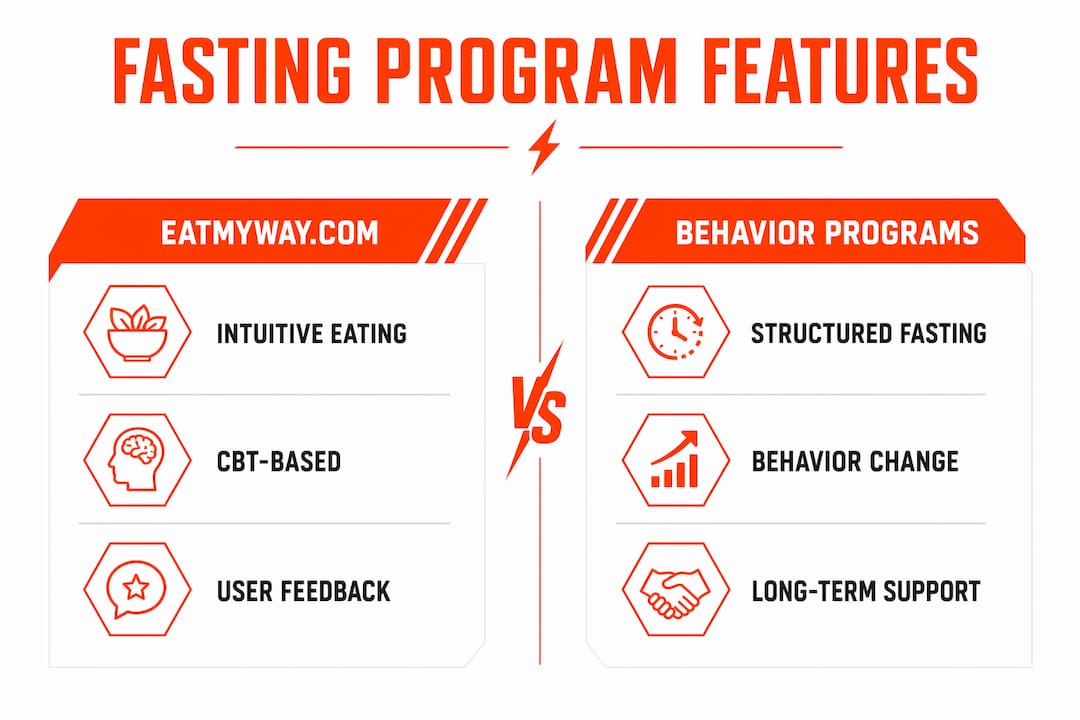
Feature | EatMyWay.com (Way) | Behavior-based fasting programs |
Methodology | Intuitive eating + CBT | IF + lifestyle discipline + psychology |
Pricing | $6.99/month or $49.99/year | Varies by program |
Mobile app | Yes, iOS-focused | Yes, varies |
Health device integration | Limited | Often broader |
Metabolic guidance | None | Core feature |
Sustainability measure | Mindset shift in week one | Habit formation over weeks and months |
CBT-based interventions address underlying food relationship issues more durably than rules-based dieting. That is the shared strength of EatMyWay.com and the better fasting alternatives. The difference is scope: one repairs the relationship with food, the other builds the full lifestyle structure around it.
How do you choose the right fasting and lifestyle program?
The program that works is the one that matches where you actually are mentally, not the one with the most features. A person still caught in diet culture guilt needs CBT and emotional eating work before adding fasting windows. Someone who has already done that inner work and wants structure, metabolic results, and daily discipline needs a fasting-focused framework.
Questions to ask before committing to any program:
Does this program address why I eat the way I do, or only what I eat?
Is the approach flexible enough to fit my schedule and food preferences?
Does it offer psychological support alongside physical guidance?
Will I still be using this in six months, or will I burn out?
Does the program educate me, or just track me?
Pro Tip: If a program’s primary feedback loop is a number (calories, macros, a score), it is likely to trigger the same fixation that caused problems with restrictive dieting in the first place. Look for programs where the primary feedback is a behavioral or mindset shift. That is the design choice that separates sustainable programs from high-churn ones.
Engagement with educational content and habit formation predicts long-term success better than weight loss metrics alone. Programs that teach you something durable about your body and mind outperform those that just log your data. The intuitive eating vs. fasting question is not either/or; the best programs find ways to combine both.
Why restrictive dieting fails and behavior-based programs win
Restrictive diets have an 83% failure rate, with some research putting that figure as high as 95–97%. After several years, many individuals tend to regain a significant portion of the weight they have lost. Those numbers reflect a structural problem, not a willpower problem.
A study published via the National Library of Medicine identified eight types of negative consequences from diet and fitness app use: unhealthy fixation on macronutrients and calories, little to no meal variation, obsession with food tracking, feelings of shame and guilt, and more. The apps that “gamify” eating often accelerate these patterns rather than resolve them.
Restrictive dieting | Behavior-based approach |
Focuses on calories and macros | Focuses on internal hunger cues |
Triggers shame and guilt cycles | Builds self-acceptance and curiosity |
High relapse and abandonment rates | Addresses root psychological causes |
Short-term results, long-term regain | Durable habit change over time |
Treats food as a problem to control | Treats food as information from the body |
The weight management market was valued at $224 billion in 2021 and is projected to reach $405 billion by 2030, driven largely by demand for preventive, behavior-based interventions rather than traditional diet products.
The shift happening across that market is a move from external rules to internal cognitive regulation, as highlighted by innovative programs in the AI Training System leveraging CBT to foster healthier food relationships. CBT and mindful eating reframe the mental relationship with food rather than just restricting it. Programs that skip this psychological layer tend to produce short-term results followed by the same patterns people started with. Platforms that combine behavior science with structured lifestyle frameworks, including fasting protocols, are where the durable results actually show up.
ForgeFast: a stronger path to lasting fasting results
Most fasting programs give you a window and a timer. ForgeFast gives you a framework. The difference is that ForgeFast integrates metabolic science and psychological resilience into a single disciplined lifestyle system, rather than treating fasting as an isolated eating schedule.
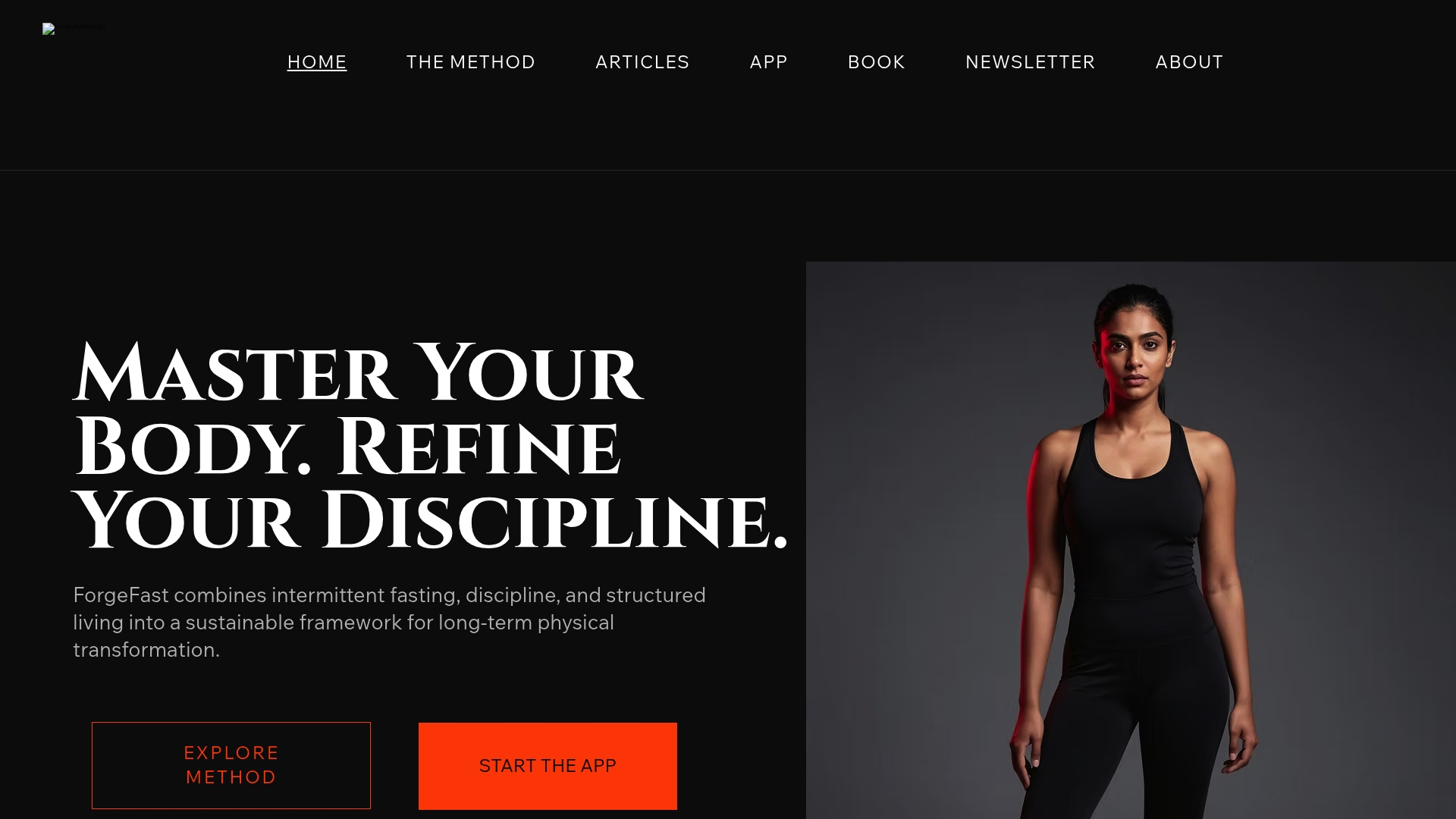
Where EatMyWay.com repairs your relationship with food through CBT and intuitive eating, ForgeFast builds the mental and physical structure to sustain real transformation. That means metabolic flexibility training, structured fasting protocols, and the psychological discipline to stay consistent when motivation fades. The psychology of controlled hunger is built into the methodology, not treated as an afterthought.
What sets ForgeFast apart from other eatmyway.com substitute sites and fasting programs:
Combines intermittent fasting with a disciplined lifestyle framework, not just a meal timer
Addresses mental resilience alongside metabolic adaptation
Backed by both psychological insights and biological science
Designed for people who want lasting fat loss, not just short-term weight shifts
Structured to build lifelong habits rather than temporary compliance
If you are ready to move past food relationship repair and into a structured, science-backed fasting and lifestyle program, start with ForgeFast to see how the methodology works for your goals.
Key Takeaways
The most effective alternatives to EatMyWay.com combine behavior-based psychology with structured lifestyle discipline, addressing both the mental and metabolic dimensions of lasting health.
Point | Details |
Restrictive diets fail at high rates | Restrictive diets carry an 83% failure rate; behavior-based programs address the root psychological causes. |
CBT outperforms rules-based dieting | CBT-based interventions build more durable eating habits by targeting underlying food relationship issues. |
EatMyWay.com strengths and limits | Way excels at emotional eating and body image work but lacks metabolic or fasting structure. |
Program fit matters most | Long-term success depends on matching the program’s framework to your current mindset stage, not just its feature list. |
ForgeFast adds the missing layer | ForgeFast pairs intermittent fasting with psychological resilience and metabolic science for lasting transformation. |
Recommended
Comments