Prevent Muscle Loss While Intermittent Fasting: Hit 1.2–1.6 g/kg Daily


Intermittent fasting does not inherently cause muscle loss. What actually drives it is inadequate daily protein and skipping resistance training, not the fasting window itself. If you hit your protein target and train consistently, controlled trials show lean mass holds steady or even climbs. The two moves that matter most: eat enough protein every day, and lift weights on a regular schedule.
TL;DR:
Research shows muscle protein synthesis is similar across fasting and non-fasting groups when protein intake is matched, regardless of fasting duration or schedule.
Resistance training and distributing at least 1.2 to 1.6 grams of protein per kilogram of body weight daily are key to maintaining or gaining muscle during fasting.
Extended fasts longer than 24 hours may impair endurance but do not necessarily cause muscle loss if protein and training are properly managed.
Older adults and athletes need tailored strategies, such as higher protein doses and timing workouts around feeding windows, to effectively preserve muscle.
Monitoring strength, circumference measurements, and body composition over weeks provides better signals of muscle changes than scale weight alone.
Table of Contents
Muscle Loss Intermittent Fasting: What the Best Studies Actually Show
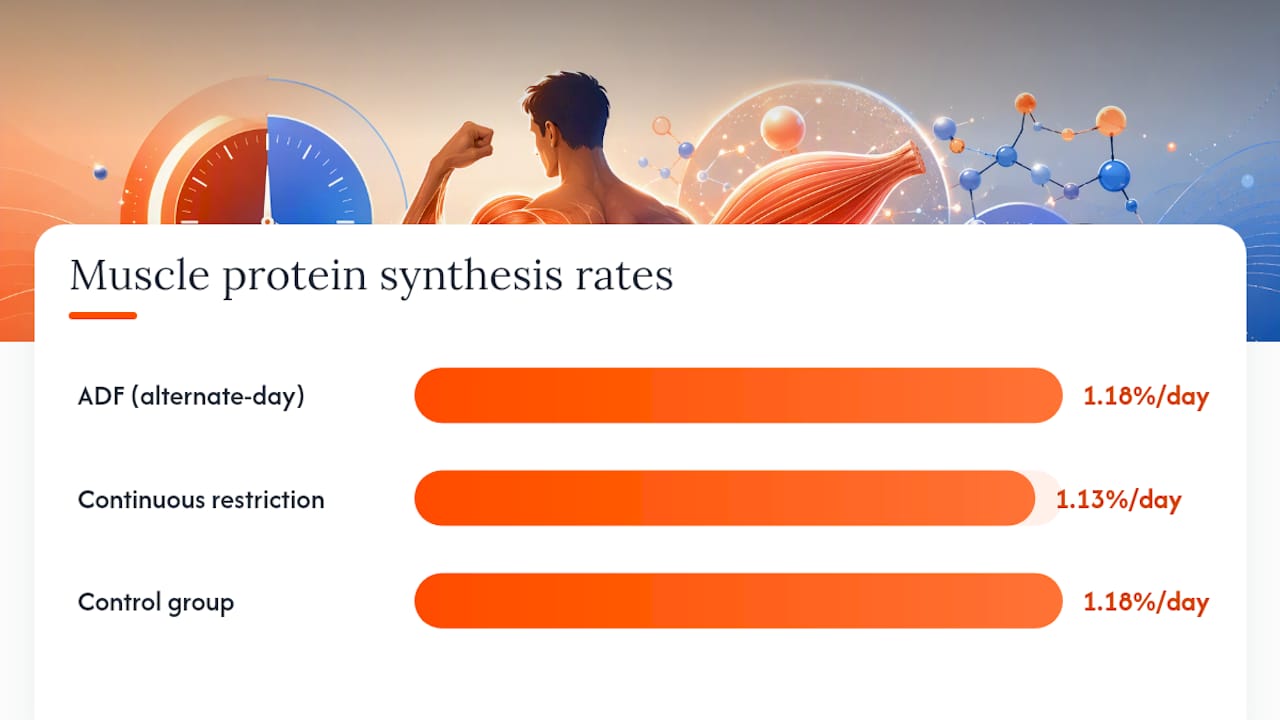
The strongest recent evidence points in one direction: fasting schedule matters far less than total protein intake and training. A 2024 randomized controlled trial put this to a direct test, comparing short-term alternate-day fasting (ADF) against continuous energy restriction and a non-restricted control group, with protein matched across all three arms.
The result surprised a lot of people who assumed skipping meals for a full day would starve muscle tissue.
By the Numbers: Muscle protein synthesis rates came out nearly identical across groups: ADF at 1.18% per day, continuous energy restriction at 1.13% per day, and the control group at 1.18% per day. The difference between groups was not statistically significant.
That’s a tight spread. It means a full day of zero calorie intake, repeated on alternating days, did not suppress the biological process that rebuilds muscle tissue when protein was held constant.
A second line of evidence comes from resistance training studies rather than pure fasting research. A 12-week randomized trial and follow-up meta-analysis compared intermittent fasting plus resistance training against continuous energy restriction plus the same training program. The catch: mean protein intake in both groups sat at or above 1.4 grams per kilogram of body weight per day. A separate trial testing 5:2 fasting against continuous restriction, also paired with supervised resistance training, found a similar proportionate lean mass increase in both diet groups.
Read across these three trials and a pattern emerges:
Matched protein intake, not meal timing, predicts whether muscle protein synthesis holds up during fasting periods.
Resistance training appears to be the variable that determines whether lean mass grows, shrinks, or stays flat, regardless of which eating window a person follows.
Protein pacing, meaning how protein gets distributed across the meals inside a feeding window, shows measurable benefits for fat-free mass retention compared to standard caloric restriction, even at similar total calories.
None of this means the evidence base is finished or bulletproof. Most of these trials run for 8 to 12 weeks, which tells you little about what happens over a year or two of sustained fasting. Sample sizes in several studies are modest, often in the dozens rather than the hundreds, and “intermittent fasting” covers wildly different protocols, from a 12-hour overnight fast to full 36-hour alternate-day fasts. A trial testing 5:2 fasting doesn’t necessarily generalize to someone doing daily 16:8 time-restricted eating. Some mechanistic reviews also raise a caution flag: one muscle-centric analysis notes that infrequent feeding could work against muscle remodeling if it cuts down the number of times per day amino acids trigger protein synthesis, unless total intake and meal distribution are managed deliberately.
Put together, the RCTs and meta-analyses available right now support a qualified conclusion: intermittent fasting, on its own, is not the threat to muscle that it’s often made out to be. The threat is what happens when fasting gets paired with low protein, no training, or both at once.
How Fasting Actually Affects Your Muscle Tissue
Your muscle tissue is in a constant state of turnover. Two processes run simultaneously, all day: muscle protein synthesis (MPS), which builds new muscle protein, and muscle protein breakdown (MPB), which tears old protein back down. Net muscle gain or loss depends on which process wins over time, not on any single meal or workout.
Eating protein tips that balance toward synthesis. Specifically, dietary amino acids, especially leucine, act as a direct trigger for MPS. When amino acids hit your bloodstream after a meal, they signal muscle tissue to ramp up protein building for roughly three to five hours before that signal fades, even if amino acids are still available. Researchers call this the “muscle full” effect, and it’s the reason nutrition scientists generally recommend spreading protein across multiple meals rather than eating it all in one sitting.
Here’s what that means in practice inside a fasting protocol: if your feeding window only allows for one large meal, you get one strong MPS signal and then nothing for the rest of the day. If your window fits two or three meals, each with enough protein to hit the per-meal threshold (roughly 30 to 40 grams for most adults), you get multiple synthesis spikes instead of one.
Insulin plays a supporting role that gets overlooked in most fasting discussions. Beyond managing blood sugar, insulin has an anti-catabolic effect, meaning it suppresses muscle protein breakdown when it’s circulating at even modest levels after a meal. During an extended fast, insulin drops low. That’s fine for short fasts of 12 to 16 hours, where the drop is brief and MPB rises only slightly before the next meal resets things. The picture changes with prolonged fasting or a severe energy deficit sustained for many days, where consistently low insulin combined with limited amino acid availability lets breakdown outpace synthesis for longer stretches.
A few physiological facts worth keeping straight as you plan a fasting protocol:
MPS responds primarily to protein intake and resistance exercise, not to fasting duration by itself.
MPB rises during fasting but typically returns to baseline once you eat again, provided the fast isn’t extreme.
A single day of undereating protein rarely causes measurable damage; a pattern of chronic under eating across weeks is what erodes lean tissue.
Resistance training amplifies the MPS response to a subsequent protein-containing meal, which is part of why lifting near your feeding window tends to work better than skipping training on fasting days entirely.
None of this is an argument against fasting. It’s an argument for understanding that the fasting window is one variable among several, and it’s not the most powerful one. Protein amount, protein timing, and resistance training exert more control over the MPS versus MPB balance than whether you eat in a 6 hour window or a 10-hour window. That’s the physiological basis for every practical recommendation that follows.
How to Protect and Rebuild Muscle While Fasting
Protecting muscle during intermittent fasting comes down to three levers you actually control: how much protein you eat, how you distribute it, and how consistently you train. Get those three right and the fasting schedule becomes a background detail.
1. Set a daily protein target based on your body weight, not a flat number.
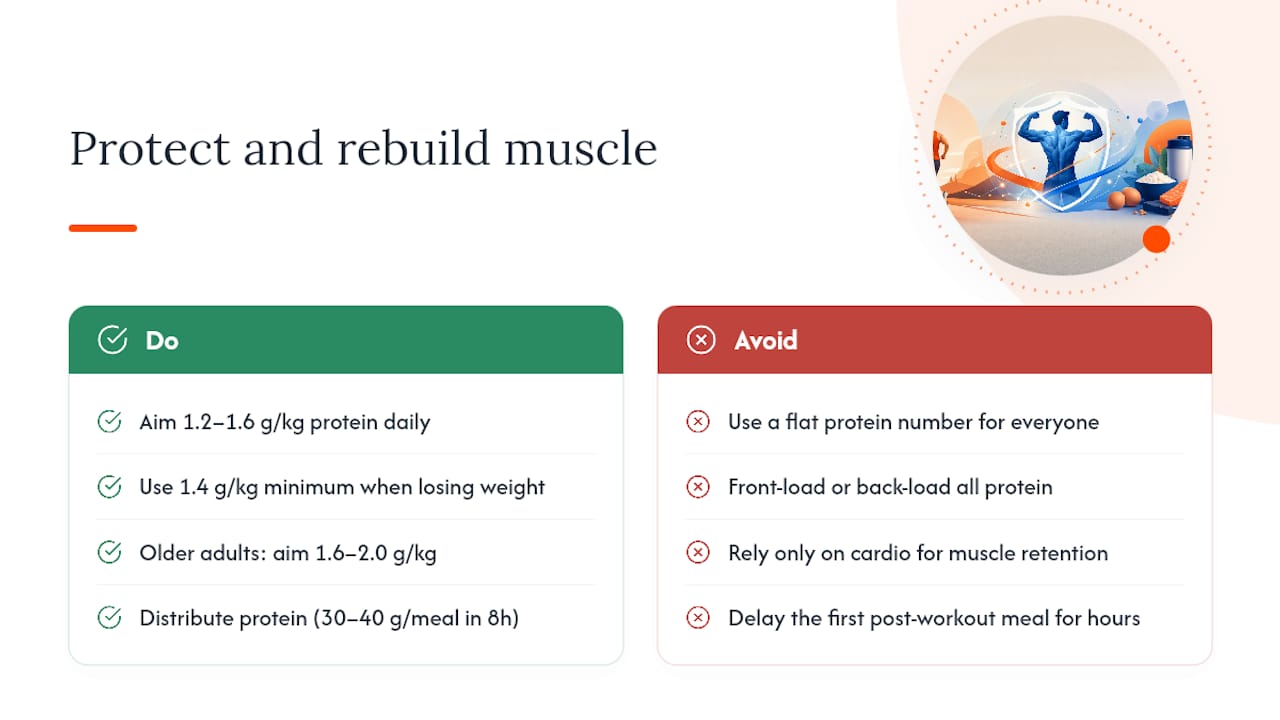
Most healthy adults following an IF protocol should land between 1.2 and 1.6 grams of protein per kilogram of body weight per day. If you’re actively losing weight, treat 1.4 g/kg as a practical floor rather than a nice-to-have. Older adults, or anyone with aggressive muscle retention goals, should push toward the 1.6 to 2.0 g/kg range, since aging muscle responds less efficiently to a given protein dose (a phenomenon researchers call anabolic resistance). For a 75 kg (165 lb) adult, that’s roughly 105 to 120 grams per day at the practical minimum, scaling up to 150 grams at the high end.
2. Distribute that protein across your feeding window instead of front-loading or back-loading it.
A workable pattern for an 8-hour window looks like three meals of 30 to 40 grams of protein each. That might be four ounces of chicken breast at meal one, a cup of Greek yogurt with a scoop of whey at meal two, and a protein-forward dinner to close the window. Tighter windows of four to six hours make this harder. When you only have two eating opportunities, each one needs a higher protein dose, and leaning on a fast-digesting, leucine-rich source (whey isolate, for instance) helps you hit the per-meal threshold without eating an uncomfortable volume of food. This is the practical core of what researchers call protein pacing, and it’s linked to better fat-free mass retention than the same calories eaten without attention to distribution.
3. Train with resistance, not just cardio, two to four times per week.
Compound lifts (squats, deadlifts, presses, rows) recruit the most muscle mass and generate the strongest MPS response. Progressive overload, meaning you add weight, reps, or sets over time rather than repeating the same workout indefinitely, is what keeps that response from plateauing. Where possible, schedule your heaviest sessions near or inside your feeding window so you’re not asking your body to lift under both a caloric and amino acid deficit at the same time. If your schedule forces fasted training, that’s not automatically a problem for most healthy adults; just make sure your first post-workout meal isn’t delayed for hours afterward.
4. Consider two supplements with real evidence behind them, and be honest about their limits.
Creatine monohydrate at 3 to 5 grams per day has decades of research behind it for supporting strength and lean mass, and it’s safe to take during a fasting protocol. It won’t replace inadequate protein or a missed training session, but as a low-cost addition to an already sound plan, it’s one of the few supplements worth the money. Essential amino acids or a leucine-enriched protein powder can help on days when a meal falls short of your per-meal protein target, particularly inside a short feeding window. Neither supplement salvages a chronically low-protein diet. Treat them as a fine-tuning tool, not a fix for a plan that’s fundamentally underfed.
5. If weight loss is the actual goal, sequence your priorities correctly.
Protein intake comes first, calorie deficit comes second. A moderate deficit of 300 to 500 calories below maintenance, combined with a protein target at the upper end of your range, preserves far more lean tissue than a steep deficit that also shortchanges protein. If you have flexibility in which IF model you choose, favor one that still lets you fit two or three protein-adequate meals into the window rather than one that forces a single, rushed meal.
Pro Tip: Track your protein total for three days without changing anything else about how you eat. Most people underestimate their intake by 20 to 30 grams a day, and that gap alone can explain a plateau in strength or a slow slide in lean mass that has nothing to do with the fasting schedule itself.
For a closer look at fasted training mechanics, fasted training and muscle definition walks through when training inside a fast work and when it doesn’t. And if creatine dosing during a fast raises questions about autophagy or fat loss goals, the creatine while fasting breakdown covers the tradeoffs in more detail.
Which Fasting Schedule Is Safest for Your Muscle?
Not every intermittent fasting model carries the same risk profile. The schedule that fits your training and protein goals matters more than which one is trending.
Time-restricted eating (TRE) is generally the lowest-risk option for muscle retention, mainly because most TRE windows (8 hours or longer) leave enough room for two or three protein-rich meals. An 8-hour window rarely requires any special tactics beyond normal protein pacing. A 6-hour window tightens things, so aim for two solid meals of 35 to 45 grams of protein rather than three smaller ones. A 4-hour window is the edge case, where you’re realistically looking at two meals maximum, and leaning on a protein shake or leucine-enriched source becomes more useful just to hit your daily total without overeating solid food in a compressed period.
5:2 fasting and alternate-day fasting (ADF) introduce more risk, but only when the fasting days are severe (near-zero calorie intake) and frequent. The evidence from the 2024 ADF trial suggests short-term ADF doesn’t suppress MPS when protein is matched across fasting and feeding days, but that study ran for a limited period. The practical fix: keep protein high on feed days rather than trying to “catch up” on calories generally, and schedule your heaviest training sessions on feed days when you can actually fuel and recover from them.
Prolonged fasts of 24 to 48 hours or longer are where genuine concern starts to build, particularly for competitive athletes and older adults. A 2025 study on short-term extended fasting found maximal leg strength held steady after six days of fasting, but endurance capacity dropped roughly 15%. That’s a useful distinction: a performance dip during an extended fast doesn’t automatically mean muscle tissue is breaking down. It often means glycogen stores and fuel availability are limited, which affects endurance output long before it touches strength or lean mass. Still, multiday fasts should be used sparingly rather than as a routine practice, and anyone doing them should watch training performance closely rather than assuming it will bounce back on its own.
Here’s a quick way to think about matching a model to your situation:
Want the simplest, lowest-risk entry point? Start with a 10 to 12 hour TRE window and build from there.
Training hard four or more times a week? Favor TRE or 5:2 over ADF or extended fasts, since consistent training needs consistent fuel access.
Already comfortable with fasting and chasing more aggressive fat loss? ADF can work, but only if you’re disciplined about protein on both fasting and feeding days.
Curious about longer fasts? Treat them as occasional experiments, not a weekly habit, and skip them entirely during heavy training blocks.
If you want a structured way to map a schedule onto a demanding week, sample IF schedules for busy professionals breaks down realistic timing templates that still leave room for adequate meals.
How to Tell Real Muscle Loss From Normal Fluctuation
Most of what people panic about on the scale or in the mirror during a fasting protocol isn’t muscle loss at all. It’s water weight and glycogen depletion, both of which shift by a pound or two within days and have nothing to do with tissue breakdown. Glycogen is stored with roughly three grams of water per gram of stored carbohydrate, so a low-carb stretch or an extended fast can drop two to four pounds on the scale in less than a week without touching a single muscle fiber.
The signals that actually indicate a problem are slower-moving and show up in performance, not the scale.
Sustained strength decline across two or more weeks, measured by your working weights or total volume (sets multiplied by reps) on your main lifts, is the clearest red flag. A single bad session means nothing; a two-to-three week downward trend does.
Shrinking circumference measurements at the arm, thigh, or waist over several weeks, especially when they track alongside strength loss rather than fat loss, point toward lean tissue changes worth addressing.
DEXA scans or other reliable body-composition tools, when available, give the clearest answer, since they separate fat mass from lean mass instead of relying on scale weight alone.
Performance drops don’t always mean muscle loss, either. The 2025 fasting study mentioned earlier found endurance capacity fell about 15% over six days of fasting while maximal strength stayed intact, a useful reminder that fuel availability and recovery capacity can dip well before actual tissue is at risk.
A realistic monitoring cadence: log your top working sets weekly, check circumference measurements every two weeks, and if you have access to body-composition testing, run it monthly rather than weekly (short-term noise in these measurements is common and not meaningful). If strength trends downward for three consecutive weeks, or circumferences shrink alongside it, that’s your signal to raise daily protein toward the top of your range, add a training day, or shorten your fasting window rather than waiting it out.
Fasting Guidance for Older Adults, Athletes, and GLP-1 Users
Not every reader faces the same risk profile, and treating a 25-year-old lifter the same as a 68-year-old retiree or someone on appetite-suppressing medication misses real differences in how muscle responds to fasting.
Older adults deal with anabolic resistance, meaning aging muscle needs a larger protein dose per meal to trigger the same MPS response a younger person gets from less. That pushes the practical protein target up to 1.2 to 1.6 g/kg per day at minimum, with many researchers favoring the higher end of that range for anyone over 60. More frequent, smaller feedings tend to work better than one or two large meals, since older muscle also saturates its “muscle full” response at a lower ceiling per meal. Fasting windows that allow three eating opportunities generally serve this group better than aggressive 4 to 6 hour windows, and lower overall fasting strain, meaning shorter or less frequent fasts, is the safer default.
Competitive athletes should prioritize timing training sessions close to a feeding window so muscle glycogen and amino acids are available when the training demand is highest. Around intense sessions, a modest amount of fast-digesting carbohydrate can support output and recovery without derailing an otherwise fasting-friendly eating pattern. Recovery nutrition, meaning the meal eaten in the hours after hard training, matters more for this group than for a casual exerciser, since insufficient post-training fueling compounds over a competitive season. Overnight fasting research on athletic recovery covers how repair processes interact with shorter fasting windows specifically for trained individuals.
People using GLP-1 medications face a distinct challenge: appetite suppression makes it genuinely hard to eat enough protein, even when the intention is there. The risk here isn’t the fasting schedule; it’s simply not eating enough food, period, because the medication is doing its job of reducing hunger. The practical fix is tracking absolute protein grams rather than relying on hunger cues, prioritizing protein-dense foods over lower-density options when appetite is limited, and starting with a gentler schedule like 12:12 fasting rather than a longer window, targeting 1.2 to 1.6 g/kg per day. Anyone combining GLP-1 therapy with intermittent fasting should loop in a doctor or dietitian, given how easily total intake can slip below what’s needed to protect lean mass.
Fasting and Muscle: Sorting Fact From Fear
A handful of claims about fasting and muscle keep circulating despite not holding up against the trial data. Here’s where they break down.
Myth: Any period of fasting triggers muscle loss. Fact: the 2024 ADF trial found no meaningful difference in MPS rates between alternate-day fasting and continuous restriction when protein was matched. The fasting window itself isn’t the variable that determines the outcome.
Myth: A protein shake during your eating window fixes any gap in your fasting plan. Fact: a shake helps you hit a per-meal protein target, but it can’t compensate for a daily total that’s chronically too low, or for skipping resistance training altogether. Supplements amplify a sound plan; they don’t replace one.
Myth: If your lifts feel weaker, you’re losing muscle. Fact: the 2025 extended fasting study showed endurance capacity can drop noticeably while maximal strength stays fully intact, meaning a rough training session often reflects fuel availability or fatigue, not tissue breakdown. Give it two to four weeks of monitoring before assuming the worst.
Myth: More fasting hours always means more fat loss with the same muscle outcome. Fact: protocols that squeeze feeding into a very narrow window without adjusting protein distribution tend to produce worse fat-free mass outcomes than ones that manage protein pacing deliberately, even at the same calorie level.
The pattern across every myth here is the same: people assign the outcome to the fasting schedule when the real cause is almost always what happened, or didn’t happen, with protein and training.
Where ForgeFast Fits Into the Evidence
Everything in this article points toward the same conclusion: intermittent fasting protects muscle when protein intake and resistance training are handled deliberately, not left to chance. That’s the exact gap ForgeFast’s structured protocols are built to close.
Certain apps pair fasting schedule guidance with protein-pacing templates, so users aren’t guessing at how to fit 30 to 40 grams of protein into each meal inside a shortened window. It may include habit-tracking tools designed around the psychological side of consistency, since the biggest threat to muscle during fasting usually isn’t a single missed workout. It’s weeks of drifting off a protein target without noticing.
For readers who want to go deeper on specific tactics covered here, ForgeFast’s own resources expand on several of them directly: the mechanics of training in a fasted state, how protein needs shift on GLP-1 therapy, and creatine dosing while fasting.
None of this replaces medical advice. If you have an existing health condition, take medication that affects appetite or metabolism, or you’re seeing unexplained strength loss that doesn’t respond to the adjustments covered in this article, talk to a doctor or registered dietitian before changing your fasting approach. For everyone else looking for structure rather than guesswork, ForgeFast’s protocols give you a system to lean on instead of building one from scratch through trial and error.
When Fasting Works for Muscle, and When to Rethink It
The evidence here is more reassuring than most fasting skeptics want to admit, but it’s not a blank check. Fasting works well for muscle retention when someone is willing to actually hit a protein number every day and show up for resistance training on a repeatable schedule. It works poorly for someone treating the fasting window as a shortcut that lets them skip both of those things.
Here’s the three-line checklist worth pinning somewhere visible: hit your daily protein target (1.2 to 1.6 g/kg, higher if you’re older or losing weight aggressively), train with resistance two to four times a week with real progressive overload, and check your strength trend every one to two weeks rather than trusting the scale alone.
Stop and reassess, or bring in a professional, if strength drops for three straight weeks despite meeting your protein and training targets, if you’re on medication that affects appetite or metabolism, or if fatigue starts interfering with basic daily function. None of those situations mean fasting failed you; they mean the plan needs an adjustment, not an abandonment.
The people who do best with intermittent fasting long term aren’t the ones with the most willpower. They’re the ones who built a repeatable system around protein and training, so consistency stopped depending on motivation entirely.
— Tony Lindsay
Protect Your Muscle With a Structured Fasting Plan
ForgeFast is built for exactly the gap this article keeps circling back to: knowing that protein and training matter more than the fasting window itself, but not having a system that makes hitting those targets automatic. Instead of tracking macros in a spreadsheet and guessing at meal timing, the ForgeFast App gives you structured fasting protocols paired with protein-pacing templates and training reminders that map directly onto the tactics covered here.

These platforms are designed for busy professionals and intermediate fitness enthusiasts who already understand the basics of IF and want habit infrastructure to support protein targets, feeding-window meal templates, and training prompts, without rebuilding that system from scratch every week. Some platforms also emphasize the psychological side of consistency, since most muscle loss during fasting traces back to weeks of drifting off track rather than any single bad day.
Explore the ForgeFast App to see how the structured protocols work, or check out The ForgeFast Method if you’d rather start with the book and apply the framework at your own pace.
Sources
The research behind this article draws on a small set of trials and reviews worth reading directly if you want the primary data.
This article is general information, not a substitute for advice from a qualified doctor. Consult a qualified healthcare professional about your own circumstances before acting on anything here.
FAQ
Does Intermittent Fasting Cause Muscle Loss?
No, not on its own. Controlled trials show intermittent fasting preserves muscle protein synthesis when protein intake is matched across fasting and non-fasting conditions. Muscle loss during IF almost always traces back to insufficient daily protein or skipping resistance training, not the fasting schedule itself.
Can You Regain Muscle Mass After Weight Loss?
Yes, muscle mass lost during a weight-loss phase can be rebuilt through consistent resistance training combined with adequate protein intake, typically 1.2 to 1.6 g/kg per day. Regaining strength usually happens faster than regaining visible size, since neural adaptations to lifting return within the first few weeks of consistent training.
What Are Signs I’m Gaining Muscle and Losing Fat?
The clearest signs are increasing strength on your main lifts over several weeks, stable or slightly increasing circumference measurements at the same time your waist shrinks, and clothes fitting differently even when the scale barely moves. A DEXA scan or other reliable body-composition measure gives the most precise picture if you have access to one.
How Do You Burn Fat Without Losing Muscle?
Keep protein intake at the higher end of your range (1.4 to 1.6 g/kg per day), use a moderate calorie deficit rather than an aggressive one, and maintain resistance training two to four times a week throughout the cut. Protein pacing, meaning spreading that protein across two to four meals inside your feeding window, supports fat loss while protecting fat-free mass better than the same calories eaten without attention to distribution.
Can Muscle Loss Be Reversed?
In most cases, yes. Muscle tissue responds to resistance training and adequate protein at nearly any age, though older adults typically need a higher per-meal protein dose to trigger the same rebuilding response. Consistency over several months, rather than any single intervention, is what drives the recovery. Structured programs like the ForgeFast App can help by pairing a fasting schedule with the protein-pacing and training habits that make rebuilding lean mass more consistent.
Recommended
Comments