5-Day Fasts Raise Cortisol 1.8×: What Health-Conscious Adults Should Do


Fasting typically raises cortisol acutely and shifts its daily timing, but that rise is usually adaptive fuel management, not chronic stress damage. A 2016 meta-analysis of 357 participants across 13 studies found consistent acute cortisol elevations with fasting, and a five-day water-only fast pushed 24-hour cortisol production up 1.8-fold. The exception: prolonged or repeated extreme fasting in vulnerable people, where the same mechanism can tip into a real problem.
TL;DR:
Longer fasts, especially five days or more, can increase 24-hour cortisol production by nearly double, mainly due to larger secretory bursts.
Fasting shifts the timing and rhythm of cortisol, often delaying peak levels into the afternoon or evening, which can affect sleep and energy levels.
Moderate, daily time-restricted eating (16:8 or similar) typically causes minimal or no significant cortisol rise, unlike multi-day water fasts that cause more substantial increases.
Repeated fasting generally leads to adaptation with diminishing cortisol response after several weeks, but individual factors like age and body composition influence this pattern.
Short-term fasting effects on cortisol are normal and beneficial, supporting fat loss and energy mobilization, but extended or poorly managed fasting can impair sleep and mood, especially in vulnerable groups.
Table of Contents
What Happens to Cortisol During Fasting?
Cortisol rises during fasting because your body needs a chemical signal to start pulling energy from storage instead of from your last meal. When glucose from food stops arriving, the hypothalamic-pituitary-adrenal (HPA) axis ramps up, and cortisol acts as the messenger that tells your liver and fat tissue to get to work.
Cortisol does three jobs during a fast that make it more useful than harmful in most circumstances. It drives gluconeogenesis, the liver’s process of building new glucose from amino acids and other non-carbohydrate sources. It promotes lipolysis, breaking down stored fat into usable fatty acids. And it helps hold blood glucose steady enough to keep your brain running when no food is coming in. Without this cortisol response, a fast would just mean a crash.
The clearest quantitative picture comes from a controlled study of five days of water-only fasting published in the Journal of Clinical Endocrinology & Metabolism.
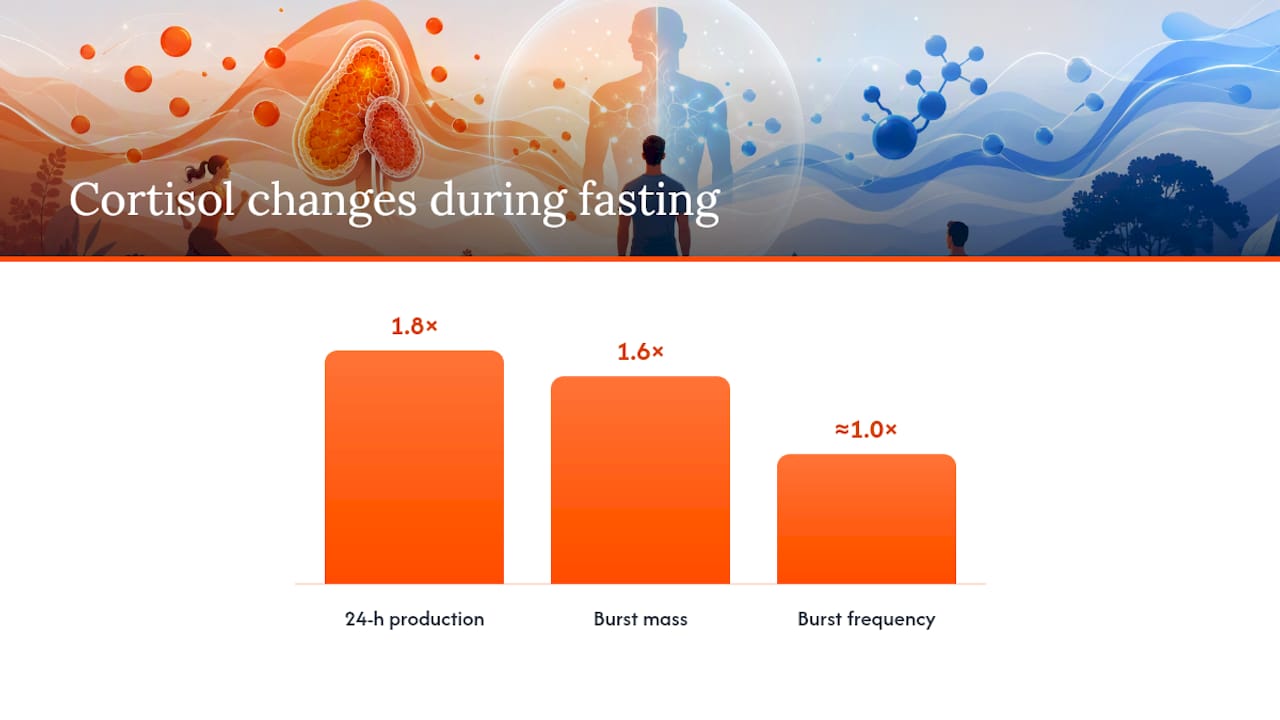
By the numbers: 24-hour cortisol production rose 1.8-fold during five days of fasting, climbing from roughly 2,504 nmol/L to 4,528 nmol/L. The increase came almost entirely from bigger secretory bursts, not more frequent ones. Burst mass rose 1.6-fold, while burst frequency barely changed.
That distinction matters for how you interpret cortisol data. Researchers used deconvolution analysis, a statistical method that breaks a hormone’s 24-hour secretion pattern into individual pulses, to show the adrenal glands were releasing larger amounts per pulse rather than firing more often. A single blood draw would never catch that pattern; only serial sampling across a full day reveals it.
A 2016 systematic review and meta-analysis backs up the broader trend across a wider evidence base. Reviewing 13 studies with 357 participants, researchers confirmed fasting acutely activates the HPA axis and elevates serum cortisol. Two findings from that review deserve more attention than they usually get:
The cortisol rise was most pronounced early in a fasting period and tended to soften after several weeks of continued restriction, suggesting the body adapts rather than staying in a permanent alarm state.
Very low-calorie diets (still eating, just eating little) did not produce the same cortisol spike as true fasting, which tells you the trigger is the absence of food intake itself, not just a calorie deficit.
The sample sizes here are modest by pharmaceutical-trial standards, and most studies ran for days or weeks rather than months, so long-term causal claims still carry uncertainty. But the methodology, 24-hour serial sampling paired with deconvolution modeling, is the gold standard for capturing a hormone that moves in pulses rather than a straight line. That is a meaningfully more rigorous approach than a single morning blood draw, which is exactly what most commercial lab tests still rely on.
How Fasting Changes Cortisol Timing and Rhythm
Cortisol does not sit at one level all day. It follows a rhythm, and three technical terms describe that rhythm in ways that matter once you start fasting.
Acrophase is the time of day when cortisol hits its peak. Amplitude is the size of the swing between your daily high and low. MESOR (short for midline estimating statistic of rhythm) is essentially the rhythm-adjusted average level across the full cycle. Under normal conditions, cortisol peaks shortly after waking and drops to its lowest point around midnight, a pattern known as the diurnal cortisol curve.
Fasting can shift all three. A 64-hour saliva-sampling study in obese adults found that on fasting days, cortisol amplitude increased by roughly 11%, and the acrophase shifted by 39 to 48 minutes compared to non-fasting days. That is not a dramatic swing, but it is enough to throw off assumptions about when your cortisol “should” be highest or lowest.
Longer or more restrictive fasting protocols can move things further. Some multi-day, water-only fasting studies have documented peak cortisol timing drifting later into the afternoon rather than staying anchored to the morning, and animal research on time-restricted feeding shows feeding windows acting as a strong synchronizer of the HPA axis, meaning corticosterone peaks can move to align with when food actually arrives, not just when the body clock expects it.
This has three practical consequences worth knowing before you fast:
Morning energy can dip differently than expected. If your cortisol acrophase shifts later, that natural morning alertness boost may arrive weaker or later than usual, which can feel like sluggishness rather than a stress problem.
Late-night cortisol can creep up. Delayed peaks sometimes mean levels stay elevated later into the evening, which can interfere with sleep onset if you fast right up until bedtime.
A single test taken at the “normal” time can mislead you. If your rhythm has shifted, a standard morning cortisol test compares your result against a baseline that no longer describes your body’s actual pattern that day.
None of this means fasting wrecks your hormone clock. It means the clock moves, and interpreting cortisol data without accounting for that movement is a common mistake, one that even some clinicians make when they order a single spot test instead of asking about the patient’s eating schedule first.
Does Fasting Duration Change How Much Cortisol Rises?
Yes, and the relationship is closer to a dose-response curve than a single fixed effect. Short daily eating windows barely move cortisol; multi-day water fasts move it substantially. Matching the protocol to your tolerance and goals starts with knowing where on that curve you are asking your body to operate.
Time-restricted eating (16:8 or similar). Daily fasting windows of 16 to 18 hours, with an 8-hour feeding window, generally produce modest or no clinically meaningful cortisol elevation in most healthy adults. Some time-restricted eating trials do show minor shifts in peak timing, particularly when the feeding window sits later in the day, but the changes are far smaller than what longer fasts produce.
A single 24-hour fast. This is where you start seeing measurable, if transient, increases in cortisol along with the rhythm shifts described above. The effect is real but typically resolves once normal eating resumes, and most healthy adults tolerate an occasional 24-hour fast without lasting hormonal disruption.
Multi-day water-only fasts (3 to 5+ days). This is the territory covered by the 1.8-fold cortisol production increase found in the five-day fasting study. These protocols place a genuinely heavier load on the HPA axis and are where monitoring and caution matter most.
Individual variability is large enough that these categories are guidelines, not guarantees. Body mass index, sex, baseline stress load, sleep quality, and even chronotype (whether you are naturally a morning or evening person) all influence how much your cortisol moves during a given protocol, a pattern confirmed across the one-day fasting research cited earlier. Two people doing the identical 24-hour fast can show meaningfully different cortisol curves.
Pro Tip: If you’re moving from daily time-restricted eating toward longer fasts, extend gradually. Add two to three hours to your fasting window every one to two weeks rather than jumping straight from a 16-hour routine to a 48-hour fast, and pay attention to sleep quality and morning energy as your early warning signs that the protocol is asking more than your current recovery capacity can handle.
Protecting Sleep, Muscle, and Exercise Performance While Fasting
Cortisol’s job during a fast, breaking down stored fuel for energy, is a double-edged tool. Used well, it supports fat loss and metabolic flexibility. Used carelessly, it can chip away at muscle tissue and wreck sleep. The difference usually comes down to timing.
Strength training and fasting. If preserving muscle mass is a priority, avoid stacking your hardest training sessions at the very end of a long fasting window, when cortisol is likely already elevated and available amino acids for muscle repair are scarce. Training in a shorter daily fasting window, or breaking your fast with adequate protein shortly after a session, gives your body the raw material to counter cortisol’s catabolic pull rather than let it run unopposed.
Protein strategy matters more during fasting, not less. Aim to front-load protein intake once your eating window opens, rather than saving it for a single meal late in the day. This gives your body a steady supply of amino acids to work with during the hours cortisol is actively promoting protein breakdown for gluconeogenesis.
High-intensity fasted sessions are not for everyone. If your main goal is muscle preservation or you already run a demanding schedule with poor sleep, fasted high-intensity interval training or heavy lifting late in a fast adds a second stressor on top of an already elevated cortisol curve. Moving hard sessions closer to your feeding window, or keeping fasted workouts to lower-intensity cardio, is a reasonable adjustment.
Sleep and caffeine need to respect the rhythm shift. Because fasting can delay cortisol’s acrophase and nudge evening levels higher, caffeine late in a fasting window is a worse idea than it would be on a normal eating day; it stacks stimulation on top of an already-shifted hormone curve. Consider:
Keeping caffeine intake earlier in the day, especially on longer fasting days.
Watching for delayed sleep onset or waking up wired, both signs your evening cortisol may be running higher than usual.
Building a consistent wind-down routine on fasting days specifically, since the body may need more help settling than on a regular eating day.
Why the gluconeogenesis piece is often a good thing. It is worth restating plainly: cortisol-driven gluconeogenesis and lipolysis are the exact mechanisms that make fasting useful for fat loss and metabolic flexibility goals in the first place. The hormone is not working against you here. It is doing precisely what it evolved to do, converting stored fuel into usable energy when food is not available. The goal is not to suppress this response. It is to make sure your training, protein intake, and sleep habits are not fighting it at the same time.
Pro Tip: A useful personal check: if your sleep quality or resting heart rate (visible on most fitness trackers) worsens for more than a few consecutive fasting days, that is a more reliable signal to pull back than how “tough” the fast feels mentally.
Who Should Be Careful With Extended Fasting?
Cortisol’s adaptive rise during fasting assumes a functioning HPA axis and a body with reserves to draw on. Several groups do not meet that assumption, and for them, the same mechanism that helps most people can create real risk.
Higher-risk groups include:
People with adrenal insufficiency (Addison’s disease or similar conditions), whose adrenal glands cannot mount the cortisol response fasting normally demands.
Pregnant individuals, whose hormonal and metabolic needs are already elevated and who require a more consistent nutrient supply.
Anyone with an active or history of an eating disorder, for whom structured fasting can reinforce harmful patterns regardless of the hormonal science.
People with unstable diabetes, particularly those on insulin or sulfonylureas, where fasting-driven changes in glucose regulation can compound medication effects.
Anyone on medications sensitive to timing or blood glucose, including some blood pressure medications and corticosteroids, where fasting schedules can alter absorption or effect.
Research on prolonged fasting’s endocrine effects documents secondary risks that extend beyond cortisol alone, including transient hypothyroid-like shifts in thyroid hormone patterns and changes in sex hormone levels, alongside physical risks like orthostatic intolerance and electrolyte imbalance. These are the kinds of findings that support caution around extended, repeated fasting even in otherwise healthy people.
Warning signs that warrant stopping a fast and seeking medical review:
Dizziness or fainting, especially when standing up quickly (orthostatic intolerance).
Severe insomnia that persists beyond a single rough night.
Marked mood swings or irritability well beyond your normal baseline.
Heart palpitations or an unusually rapid resting heart rate.
If you take medication on a fixed schedule, talk to your prescriber before changing your eating window. Fasting can shift how and when a drug is absorbed, and for narrow-margin medications, that timing shift is not a detail to guess at on your own.
How to Read Cortisol Test Results While Fasting
A single cortisol test taken during a fast is one of the easiest ways to get a misleading number. Because fasting increases the size of individual cortisol secretory bursts rather than how often they fire, a snapshot test can land squarely inside a burst or entirely between them, and tell you very little about your actual daily exposure.
Worth remembering: the five-day fasting study that found a 1.8-fold jump in 24-hour cortisol production only detected that pattern because researchers sampled blood every five minutes and ran it through deconvolution analysis. A once-a-day blood draw would have missed the mechanism entirely.
For anyone genuinely trying to track cortisol during fasting, a few sampling principles hold up well:
Serial saliva sampling across multiple points in a day gives a far more accurate rhythm picture than one draw, and it is the practical, at-home equivalent of the research-grade approach.
Saliva measures free, biologically active cortisol, while serum tests capture total cortisol including protein-bound fractions, and urinary free cortisol reflects cumulative output over a collection period rather than a single moment. Each has a place, but they are not interchangeable, and comparing a fasting-day saliva result against a non-fasting serum baseline is comparing two different things.
Wearables that estimate stress or “cortisol proxies” from heart rate variability or skin temperature are not measuring cortisol directly, and an apparent spike they flag during a fast may simply reflect the normal rhythm shift described earlier, not a health problem.
If you want a structured way to track this alongside other fasting markers, ForgeFast’s biomarker guide walks through which measures are worth tracking and how to time them, and the circadian fasting guide covers how feeding-window timing interacts with your body clock more broadly.
What Happens to the HPA Axis With Repeated Fasting?
The most reassuring pattern in the research is also the least discussed: for many healthy people, repeated fasting does not mean permanently elevated cortisol. The 2016 meta-analysis found the acute cortisol rise was strongest early in a fasting period and tended to soften after several weeks of continued restriction, a pattern consistent with adaptation rather than the HPA axis staying stuck in overdrive.
That adaptation is not automatic or unconditional, though. It appears to depend on the fast being sustainable enough that the body actually gets the chance to adjust, rather than being repeatedly pushed into extreme deficits followed by erratic recovery. Cycling between very long fasts and heavy overeating, or fasting on top of chronic sleep deprivation and high life stress, gives the HPA axis multiple competing demands at once, which is a very different situation than a stable, moderate fasting rhythm layered onto an otherwise well-rested life.
The practical takeaway is that consistency and moderation appear to matter more than sheer fasting duration for long-term HPA health. A person doing a well-structured 16:8 routine for a year is working with a very different cortisol history than someone doing sporadic five-day water fasts with no recovery structure in between. If you notice cortisol-related symptoms (persistent fatigue, disrupted sleep, mood changes) intensifying rather than easing over months of a fasting routine, that is a signal the pattern needs adjustment, not just willpower.
How Cortisol Changes Interact With Insulin, Growth Hormone, and Thyroid
Cortisol never moves alone during a fast. It shifts alongside insulin, growth hormone, and thyroid hormone, and the combined pattern is arguably more informative than cortisol by itself.
Insulin drops as fasting continues, which is largely the point: lower insulin permits fat mobilization. Cortisol and falling insulin work in a complementary direction here, both pushing the body toward using stored fuel rather than storing more of it.
Growth hormone typically rises during fasting, and that rise helps preserve lean tissue even while cortisol is promoting some protein breakdown for gluconeogenesis. Think of it as a partial counterbalance: cortisol breaks certain things down for fuel, growth hormone supports repair and preservation elsewhere.
Thyroid hormone tends to move in the opposite direction from cortisol during extended fasting. Prolonged fasting can produce a transient, low-thyroid-like pattern as the body downshifts overall metabolic rate to conserve energy, a finding noted in reviews of prolonged fasting’s endocrine effects. This is generally reversible with normal eating and is not the same as clinical hypothyroidism, but it is part of why very long fasts feel different metabolically than short daily ones.
The practical point: cortisol’s rise during fasting is one voice in a hormonal conversation, not the only speaker. Judging a fasting protocol purely by what you assume cortisol is doing misses the bigger, more useful picture.
Can Cortisol Shifts During Fasting Affect Mood and Focus?
Cortisol has direct effects on brain function, particularly in areas tied to memory, focus, and emotional regulation, which is why fasting’s cortisol changes show up as more than just a lab number.
Modest, transient cortisol elevation during shorter fasts is often reported alongside heightened alertness, not impairment. This tracks with cortisol’s role in mobilizing energy for the brain during a fuel shortage; a lot of people genuinely feel sharper a few hours into a fast, before hunger signals start competing for attention.
Longer fasts or poorly managed fasting schedules are a different story. Once cortisol elevation stretches on for days without adequate recovery, disrupted sleep and unstable blood sugar can start feeding irritability, difficulty concentrating, and mood swings, the same nonspecific symptoms tied to chronic stress in general. The rhythm-shifting effects described earlier compound this: a delayed cortisol acrophase pushing into the evening does not just disrupt sleep, it can also mean your natural cortisol-driven alertness window no longer lines up with when you need to be mentally sharp.
If a fasting protocol consistently leaves you foggy, anxious, or flat rather than clear and steady, that is useful feedback about the specific protocol, not evidence that fasting itself is the wrong approach.
Eating Strategies That Help Manage Cortisol During Fasting
What you eat during your feeding window has a real influence on how well your body handles the cortisol demands of fasting.
Protein at your first meal after a fast does double duty: it supplies amino acids to offset cortisol-driven muscle breakdown, and it tends to stabilize blood sugar better than a carbohydrate-heavy break-fast meal, which can otherwise trigger a sharper insulin swing right after a period of low insulin.
Adequate sodium and electrolytes matter more during longer fasts than most people expect, particularly given cortisol’s role in fluid and mineral regulation; this is part of why dizziness and lightheadedness show up as common fasting complaints, especially past 24 hours.
Omega-3 fatty acids and magnesium-rich foods (leafy greens, nuts, seeds) show up repeatedly in general stress-physiology research as supportive of healthy cortisol regulation, and they are easy to work into a feeding window without much planning.
Avoid breaking a longer fast with a large, sugar-heavy meal. It compounds the insulin swing mentioned above and does little to help the protein and mineral needs cortisol has created during the fast. For more structured resilience strategies around HPA-axis stress in general, Inspire Wellness’s guide to proactive stress management covers daily habits that pair well with a fasting routine.
Do Age, Sex, and Health Status Change the Cortisol Response?
Fasting’s cortisol effects are not identical across every body, and several factors reliably shift the picture.
Sex differences show up across the research base, with some studies finding women’s cortisol rhythms respond somewhat differently to fasting than men’s, particularly regarding amplitude changes. Hormonal cycling adds another layer of variability for women that most fasting protocols do not account for by default.
Body composition and BMI influence the response too. The 64-hour fasting study that found amplitude and acrophase shifts was conducted specifically in obese adults, and researchers noted BMI as one of the factors contributing to heterogeneity in cortisol responses across individuals.
Age matters through general HPA axis resilience. Older adults, particularly those managing existing health conditions, tend to have less physiological buffer for the metabolic demands of extended fasting, which is one more reason multi-day protocols deserve more caution later in life.
Chronotype, whether you are naturally wired as a morning or evening person, appears to interact with how much a given fasting schedule shifts your cortisol acrophase, since you are essentially asking a rhythm that is already tilted one direction to shift further.
None of this means fasting is off the table for any particular group. It means the “right” protocol looks different depending on who is doing it, and generic one-size-fits-all fasting advice ignores a real, evidence-backed source of individual variation.
Applying the Research: A ForgeFast Perspective
Most fasting advice treats cortisol as either invisible or terrifying, and both framings miss what the research actually shows. The honest picture is that fasting-induced cortisol elevation is a normal, useful signal your body is doing exactly what it evolved to do, right up until the point where duration, health status, or life stress push it past what your system can absorb. ForgeFast builds its coaching framework around that middle ground rather than around either extreme.
Practically, this means progressive adaptation over abrupt jumps into long fasts, biomarker education so people understand what a cortisol number actually means (and does not mean) on a given day, and psychological support built into the habit structure itself rather than treated as an afterthought. The mental discipline required to sustain a fasting practice long enough for the adaptive cortisol response to actually kick in, that softening after several weeks the 2016 meta-analysis documented, is arguably harder to build than the biology is to understand.
For readers wanting more depth on the stress-hormone side specifically, ForgeFast’s guide to fasting and stress management covers the behavioral tools that pair with the physiology outlined here.
— Tony Lindsay
Where ForgeFast Fits Into Your Fasting Plan
Reading the research is one thing. Applying it consistently, adjusting your fasting window as your cortisol response shifts, timing protein around training, catching early warning signs before they become real problems, is a different challenge entirely. There are platforms that turn that research into a structured daily framework instead of leaving you to reconstruct it from scratch every week.

Some platforms pair fasting protocols with habit coaching and biomarker education, so adjustments like the ones covered above (progressive fasting extensions, protein timing, sleep-aligned eating windows) can become part of a routine rather than one-off decisions you have to remember to make. If you are ready to put this guidance into practice:
Start with a short trial to see how a structured protocol fits your schedule and energy levels.
Read the biohacking and fasting science guide for a deeper look at recovery metrics alongside cortisol.
Begin tracking the biomarkers that actually matter for your fasting goals, rather than guessing from how you feel alone.
Visit ForgeFast to start building a fasting routine designed around how your hormones actually respond, not just how long you can go without eating.
This article is general information, not a substitute for advice from a qualified doctor. Consult a qualified healthcare professional about your own circumstances before acting on anything here.
Sources
Recommended
Comments