Fasting vs Detox Programs Explained for Real Results


Fasting is defined as a structured eating pattern that shifts the body’s metabolism from glucose to fat and ketones, producing measurable health benefits backed by clinical research. Detox programs, by contrast, are marketing-driven products and protocols that claim to remove toxins from the body. The distinction matters because the science behind each approach is radically different. With fasting vs detox programs explained clearly, you can make smarter decisions about your health instead of spending money on promises that physiology does not support.
What is fasting and how does it affect the body?
Fasting is not starvation. It is a deliberate, time-limited restriction of food intake that triggers specific biological responses. Intermittent fasting ranks as the third most popular diet in the US in 2026, with over 225 clinical trials conducted. That volume of research puts it in a different category from most wellness trends.
Common fasting protocols
The two most widely studied protocols are:
16:8: You eat within an 8-hour window and fast for 16 hours. This is the most accessible starting point for most people.
5:2: You eat normally five days a week and restrict calories to roughly 500 on two non-consecutive days.
Alternate-day fasting: You alternate between regular eating days and very low-calorie or zero-calorie days.
Extended fasting (24–72 hours): Less common, requires medical oversight, and carries higher risk for people without experience.
How fasting changes your metabolism
The core mechanism is metabolic switching. When you deplete liver glycogen stores, typically after 12–16 hours without food, your body shifts to fat burning and ketone production. This switch activates autophagy, a cellular cleanup process where the body breaks down and recycles damaged proteins and organelles. Autophagy is not a marketing term. It is a Nobel Prize-winning biological process that supports cellular repair and stress resistance.
The clinical outcomes are concrete. Studies show a 0.3–1.2% HbA1c reduction00119-1/abstract) in people with type 2 diabetes using consistent intermittent fasting over 8–12 weeks. Improved insulin sensitivity and reduced triglycerides follow the same pattern. These are not anecdotal reports. They are measured, repeatable outcomes from controlled trials.
Fasting also works through hormesis, the principle that a mild biological stressor produces a stronger, more resilient system. Short periods of caloric restriction push cells to build better antioxidant defenses and improve mitochondrial function. The body gets stronger by adapting to the stress, not by avoiding it.
Pro Tip: If you are new to fasting, start with the 16:8 protocol for two weeks before adjusting. Jumping into extended fasts without a baseline often leads to the common mistakes that derail progress in the first month.
What are detox programs and how do they claim to work?

Detox programs are defined broadly as any commercial protocol promising to remove harmful substances from the body through juice cleanses, herbal supplements, laxative teas, or restrictive liquid diets. The wellness industry markets these as body resets. The biology tells a different story.
Your liver and kidneys already run a continuous, highly efficient detoxification system. The liver processes toxins through two enzymatic phases, converting fat-soluble compounds into water-soluble ones for excretion. The kidneys filter roughly 200 liters of blood per day. No juice cleanse improves on that performance.
“Commercial detox programs such as juice cleanses or herbal supplements do not improve00119-1/abstract) on the body’s natural liver and kidney detoxification. Scientific consensus as of 2026 shows no measurable benefit from commercial detoxes compared to natural detox systems.”
The risks of extreme detox methods are real. Prolonged juice fasts can cause electrolyte imbalances, particularly low sodium and potassium, which affect heart rhythm and muscle function. Herbal supplement-based cleanses carry contamination risks and can interact with medications. Laxative-heavy protocols disrupt gut microbiome balance and can cause dehydration.
There is one critical distinction to make here. Medical detox is not the same thing as a wellness detox. Medical detox is a clinically supervised process for managing substance withdrawal, typically lasting 3–10 days with 24/7 medical monitoring. It involves medication management, vital sign tracking, and professional intervention for life-threatening withdrawal symptoms. That process saves lives. A $60 juice cleanse does not.
The following are the most common commercial detox types and what they actually do:
Juice cleanses: Replace solid food with fruit and vegetable juices for 3–7 days. They reduce calorie intake but do not accelerate toxin removal.
Herbal supplement detoxes: Products containing dandelion, milk thistle, or activated charcoal. Milk thistle has some liver-protective properties in clinical settings, but over-the-counter doses rarely match therapeutic levels.
Colon cleanses: Claim to remove “built-up waste.” The colon self-regulates. Repeated cleansing disrupts the microbiome.
Water or tea fasts: Restrict intake to liquids only. These can mimic early fasting states but carry electrolyte risks without proper supervision.
How do fasting and detox programs compare in benefits and scientific support?
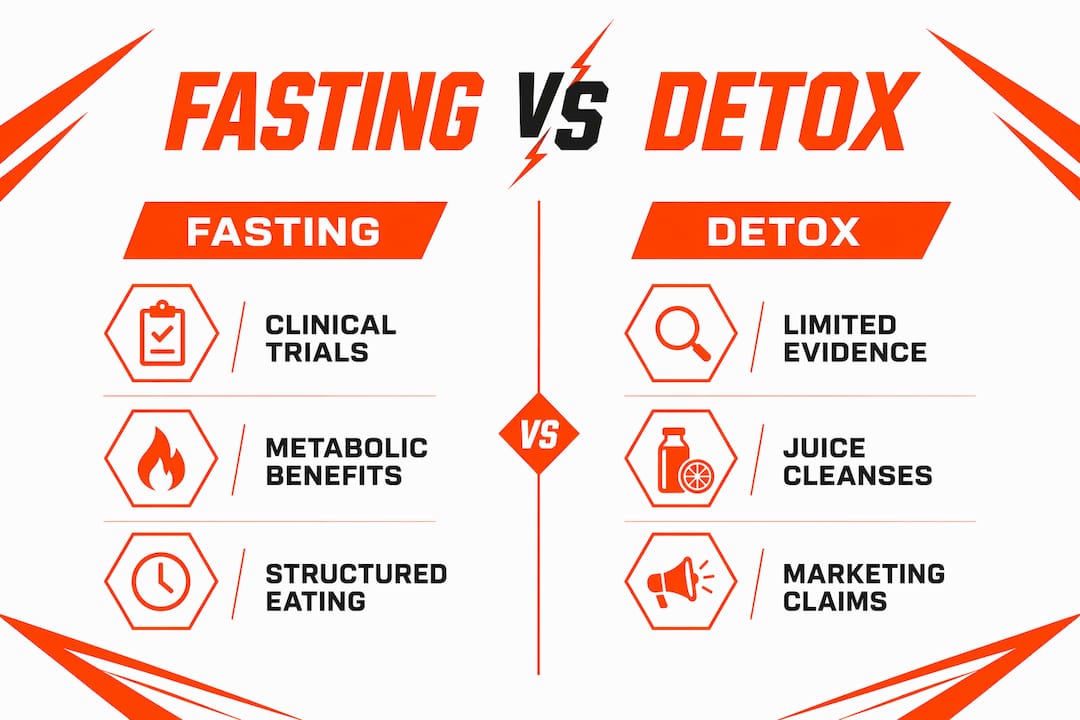
The evidence gap between fasting and commercial detox is significant. Fasting has over 225 clinical trials behind it. Commercial detox programs have marketing budgets.
Category | Intermittent fasting | Commercial detox programs |
Scientific evidence | Extensive clinical trials, peer-reviewed research | No peer-reviewed evidence of toxin removal benefit |
Mechanism | Metabolic switching, autophagy, hormesis | Caloric restriction only; no unique biological mechanism |
Measurable outcomes | Reduced HbA1c, improved insulin sensitivity, lower triglycerides | Short-term weight loss from water and calorie reduction |
Duration of benefit | Sustained with consistent practice | Reverses quickly after program ends |
Safety profile | Well-studied; risks manageable with proper protocol | Electrolyte imbalance, supplement interactions, microbiome disruption |
Medical use | Studied in diabetes, cardiovascular, and metabolic disease | Medical detox is a separate, unrelated clinical intervention |
The language overlap causes real confusion. When wellness brands use the word “detox,” they borrow biological credibility from a term that means something entirely different in medicine. Experts clarify that fasting triggers cellular repair rather than toxin flushing. The metabolic processes activated during a fast are about adaptation, not cleaning.
Dr. Columbus Batiste, an interventional cardiologist, differentiates fasting as an evidence-backed approach supporting cardiometabolic health from extreme detox cleanses that lack clinical benefit. That distinction from a cardiologist carries weight. Fasting affects the cardiovascular system through measurable pathways. Juice cleanses do not.
The consumer caution here is straightforward. If a program promises to “flush toxins,” ask which toxins, measured how, and with what clinical evidence. No commercial detox program has answered those questions with peer-reviewed data.
How to choose a safe and effective approach
Starting intermittent fasting safely requires a few non-negotiable steps. Skipping them is where most people run into trouble.
Get a baseline health check. People with diabetes, kidney disease, a history of eating disorders, or who are pregnant should consult a physician before starting any fasting protocol. Fasting affects blood sugar and medication timing in ways that require medical coordination.
Choose the right protocol for your schedule. The 16:8 fasting schedule works well for most working adults because it aligns with natural sleep and work patterns. You fast overnight and through the morning, then eat from noon to 8:00 PM.
Prioritize hydration. Hydration and nutrient-dense diets are non-negotiable during fasting. Water, black coffee, and plain tea are all acceptable during the fasting window. Electrolyte supplementation helps during longer fasts.
Plan your eating window with intention. Fasting does not offset poor food choices. Use your eating window to consume whole proteins, healthy fats, fiber-rich vegetables, and complex carbohydrates. Meal prep strategies for fasting days reduce the temptation to break a fast with processed food.
Evaluate detox claims critically. Before buying any cleanse or supplement, look for peer-reviewed clinical trials, not testimonials. Check whether the product names specific toxins it removes and whether those claims are verified by an independent lab.
Build consistency over intensity. A 16:8 protocol practiced consistently for 12 weeks produces better metabolic outcomes than a 7-day juice cleanse followed by a return to old habits. Sustainable wellness comes from repeated behavior, not periodic resets.
Pro Tip: Track your fasting window with a simple app or a handwritten log for the first 30 days. Consistency data reveals patterns in your hunger, energy, and adherence that you cannot see without records.
Key Takeaways
Fasting produces measurable, sustained metabolic benefits through biological mechanisms, while commercial detox programs offer no clinical evidence of toxin removal and carry real risks from extreme methods.
Point | Details |
Fasting has clinical backing | Over 225 trials show improved insulin sensitivity, reduced HbA1c, and better metabolic markers. |
Detox programs lack evidence | No peer-reviewed study shows commercial cleanses improve on the liver and kidneys’ natural function. |
Medical detox is different | Clinical detox manages substance withdrawal under 24/7 supervision. It is not a wellness trend. |
Autophagy is the real mechanism | Fasting triggers cellular repair through autophagy, not toxin flushing as detox marketing implies. |
Consistency beats intensity | Sustained fasting protocols outperform short-term cleanses for long-term metabolic health. |
What I have learned from watching people choose between fasting and detox
The pattern I see most often is this: someone feels sluggish, bloated, or stuck in a weight plateau, and they reach for a 7-day cleanse because it feels like a decisive action. The cleanse costs $80, arrives in a box, and comes with a schedule. It feels like a plan. Fasting, by contrast, feels like doing nothing, which makes it psychologically harder to trust.
That instinct is backwards. The cleanse gives you the feeling of control without the physiology to back it up. Fasting gives you the physiology without the packaging. The body does not need help removing toxins. It needs time without food to activate the repair systems it already has.
The people who get lasting results from fasting are not the ones who do it perfectly for two weeks. They are the ones who build it into a structure they can maintain for months. The mental side of fasting matters as much as the biological side. Hunger is not an emergency. Learning to sit with it, recognize it as a signal rather than a crisis, changes your relationship with food in a way no cleanse ever will.
I also want to be direct about medical oversight. If you have a metabolic condition, take medication that requires food timing, or have any history of disordered eating, do not start a fasting protocol without talking to a physician first. The evidence supports fasting. It does not support ignoring your individual health context.
— Tony Lindsay
ForgeFast and the science behind lasting change
ForgeFast was built for people who are done with short-term fixes and want a method grounded in metabolic science. The platform integrates intermittent fasting with a structured lifestyle framework that addresses both the biological and psychological sides of lasting change.

ForgeFast programs guide you through evidence-based fasting protocols, from the 16:8 schedule to more advanced approaches, with the structure and support that makes consistency possible. The methodology draws on the same clinical research that shows fasting improves insulin sensitivity, reduces inflammation, and activates cellular repair. If you are ready to build a fasting practice that holds, start with ForgeFast and access the tools, guidance, and community that make the difference between a two-week experiment and a lifelong habit.
FAQ
What is the main difference between fasting and detox programs?
Fasting is a structured eating pattern with clinical evidence for metabolic benefits, including improved insulin sensitivity and cellular repair through autophagy. Commercial detox programs are marketing-driven protocols with no peer-reviewed evidence that they improve the body’s natural detoxification systems.
Does intermittent fasting actually remove toxins?
Fasting does not flush toxins in the way detox marketing suggests. It activates autophagy, a cellular repair process that breaks down damaged proteins, which is a fundamentally different and scientifically validated mechanism.
Is a juice cleanse ever beneficial?
A juice cleanse can reduce calorie intake temporarily, but it produces no unique detoxification benefit beyond what the liver and kidneys already do. Any short-term weight loss typically reverses once normal eating resumes.
What is medical detox and how is it different from a wellness cleanse?
Medical detox is a clinically supervised process for managing substance withdrawal, lasting 3–10 days with 24/7 medical monitoring and medication management. It has no meaningful connection to commercial wellness cleanses.
How long does intermittent fasting take to show results?
Clinical studies show measurable improvements in insulin sensitivity and metabolic markers after 8–12 weeks of consistent intermittent fasting. Individual results vary based on protocol, diet quality, and baseline health.
Recommended
Comments