90 Day Identity Based Habits: A Research Backed Two Step Plan


Identity-based habits are the most reliable route to lasting change: choose who you want to be, then cast a tiny, repeatable vote for that identity every day. The research backs this up, with a large body of evidence linking self-image to sustained behavior, but the method itself is simple enough to start today. Pick an identity statement, act on it in the smallest way possible, and let the evidence pile up.
TL;DR:
Identity-based habits are most effective when they are specific, easy to perform within two minutes, and serve as evidence to reinforce self-concept.
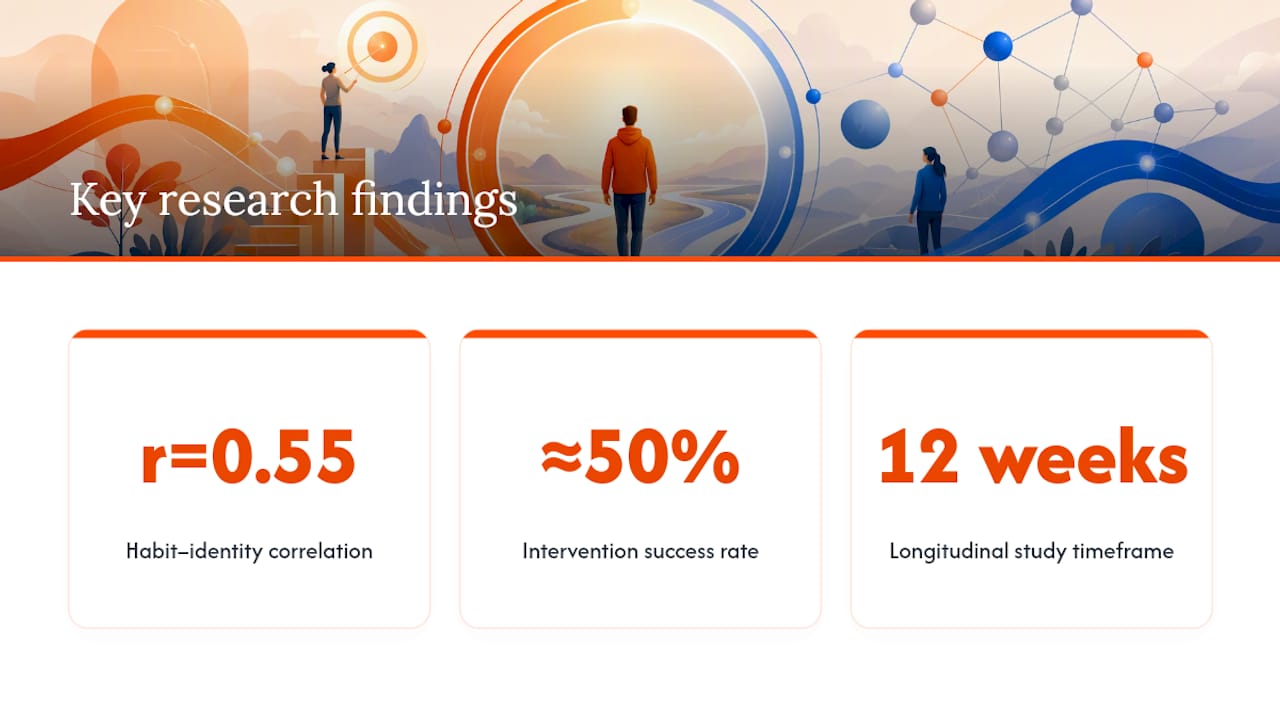
The strong correlation between habit strength and identity (r = 0.55) indicates that aligning actions with self-beliefs dramatically increases automatic behavior.
Early in habit formation, identity influences behavior most, but over time, habit and situational cues become the primary drivers once the behavior is automatic.
Failing to match the environment, overcommitting, or attempting multiple new identities at once are common pitfalls that can be fixed quickly by adjusting surroundings or simplifying goals.
Tracking small, consistent votes with simple methods like checkmarks or notes helps reinforce identity, especially during the critical first 30 days of building new habits.
Table of Contents
What Are Identity-Based Habits, Exactly?
An identity-based habit is any behavior you perform because it reflects who you believe you are, not because you’re chasing a number on a scale or crossing an item off a checklist. Someone who identifies as “a person who moves their body every day” doesn’t need to negotiate with themselves about a Tuesday workout. The workout isn’t optional homework. It’s confirmation of a self-concept already in motion.
This is different from the two other common approaches to change. Outcome-based habits fixate on a result: lose 20 pounds, hit a revenue target, finish a marathon. Process-based habits focus on the system: follow this meal plan, use this app, run this workout split. Identity-based habits skip both and start with a question. Outcome and process thinking never ask: who is the kind of person who gets this result automatically?
Three quick examples make the distinction concrete:
Outcome thinking: “I want to lose 15 pounds by summer.”
Process thinking: “I’ll follow a 16:8 fasting window and track my meals.”
Identity thinking: “I am someone who eats on a schedule that respects my body.”
The identity version doesn’t replace the other two. It sits underneath them and makes them easier to sustain, because you’re no longer relying on willpower to override a self-image that disagrees with the behavior. Willpower is a depleting resource. Self-concept isn’t. Once you believe you’re the kind of person who does something, skipping it creates internal friction, the same discomfort you’d feel doing something out of character. That friction works in your favor, which is the whole mechanical advantage identity has over outcome or process framing.
Approach | Focuses On | Weak Point |
Outcome-based | The result (weight, revenue, mile time) | Motivation collapses once the result plateaus or is reached |
Process-based | The system (plan, app, schedule) | Easy to abandon the system when life gets disruptive |
Identity-based | Who you believe you are | Requires patience; evidence has to accumulate before it feels true |
What the Research Actually Shows About Identity and Habit
The strongest single data point comes from a systematic review and three-level meta-analysis covering 13,340 participants across dozens of health-behavior studies. It found a strong positive correlation between habit strength and identity, a large effect by most psychological standards. In plain terms: people whose sense of self lines up with a behavior are dramatically more likely to have that behavior become automatic, and vice versa. Identity and habit reinforce each other in a loop, not a one-way street.
The habit-identity link isn’t a soft correlation buried in noise. At r = 0.55, it’s one of the more robust relationships you’ll find in behavior-change research, on par with effects considered foundational in the field.
Intervention research adds a useful reality check. A review of physical activity identity interventions found that about half of identity-focused programs produced a measurable positive shift in identity and related behavior. That’s encouraging, but it also means identity work isn’t a guaranteed fix. Physical activity was the most heavily studied behavior in this body of research, which is worth knowing if you’re trying to extrapolate to something like creative work or financial discipline, where the evidence base is thinner.
The nuance that most guides skip: identity’s influence isn’t constant over time. A 12-week longitudinal study of 98 adults found identity acts as a stable predictor of behavior early on, but as a behavior becomes habitual, identity’s within-person influence can fade, with habit strength and intention taking over more of the driving. Identity gets you started and keeps you honest during the wobbly middle phase. Once the behavior is automatic, the habit loop itself starts carrying more of the weight.
Two theoretical frameworks explain why this happens. Identity-Based Motivation (IBM) theory holds that identity isn’t a fixed trait sitting in the background. It’s constructed in the moment, and it becomes more salient when situational cues make an action feel identity-congruent. The related Maintain IT model builds on this by proposing that centering identity reduces the executive-function burden of maintaining a behavior. Fewer decisions get relitigated daily when the behavior is simply “what I do.”
The Two-Step Identity Recipe
Strip away the theory and the practical method comes down to two moves, repeated daily.
Decide the identity, written as a sentence. Not “I want to get fit,” but “I am someone who trains four mornings a week.” Specificity matters. A vague identity gives you nothing to act on; a precise one gives you an obvious next move.
Prove it with the smallest possible vote. Every time you complete a tiny action consistent with that identity, you cast a vote for it. One pushup counts. One page written counts. One glass of water instead of soda counts.
The size of the vote matters less than its frequency. A vote so small it feels almost silly is exactly the point, because the goal isn’t the workout. The goal is collecting evidence that the identity is true. Someone who identifies as “a writer” and writes one sentence a day for a month has 30 pieces of evidence. Someone who commits to 1,000 words daily and quits after four days has one failed outcome and a self-concept hit.
Guidelines for choosing a vote size:
It should take under two minutes on your worst day.
It should require no equipment or setup you don’t already have.
It should be binary. Either you did it or you didn’t. No partial credit, no judgment calls.
Naming the habit by identity rather than by task also changes how you track it. Logging “trained like an athlete” instead of “did 20 minutes of cardio” reframes a checklist item as a piece of self-evidence, and that reframing is what makes the entries add up to something instead of just data points in a spreadsheet.
Pro Tip: Write your identity statement in present tense, as if it’s already true, but log your votes like a scientist testing a hypothesis. The statement is aspirational; the log is factual. Confusing the two is how identity inflation starts.
Putting Identity-Based Habits Into Practice Over 90 Days
Theory and templates only get you so far. The real test is whether the system survives contact with a busy Tuesday, a bad mood, or a canceled plan. Here’s how to build it so it does.
Start narrow. Pick two to four identity-named habits, not ten. Trying to become “a healthy eater, a runner, a reader, a saver, and an early riser” simultaneously spreads your attention so thin that no single identity gets enough reinforcement to stick. Two or three is plenty for the first quarter.
Anchor each habit to something that already happens automatically in your day. “After I pour my morning coffee, I do one set of pushups” works because the coffee is already guaranteed. Cue-based anchoring removes the need to remember or decide, which is where most new habits actually die. Environment and habit reinforcement research consistently shows that repeated context-linked actions become self-sustaining faster than habits left to willpower alone.
Environment design does the heavy lifting that motivation can’t. Lower the friction for the vote you want and raise it for the one you don’t. Keep running shoes by the door. Put your phone charger in another room at night. Remove the snack food from the counter and leave the fruit bowl visible. None of this requires discipline. It requires ten minutes of rearranging your space once.
Tracking should be dead simple: a checkmark on a calendar, a note in an app, or a single line in a notebook. What matters is reading the data correctly. A missed day is not proof the identity is false. It’s one data point in a much larger pattern. Look at the trend across two weeks, not the unbroken streak, because streak obsession is what turns one missed day into a full abandonment.
Here’s a rough map of what to expect across the first three months:
Timeframe | What’s Happening | What to Watch For |
Days 1 to 30 | Identity feels aspirational; votes require conscious effort | Consistency of the smallest vote, not intensity |
Days 30 to 60 | Behavior starts feeling more automatic; identity begins to feel earned | Resist the urge to scale up too fast |
Days 60 to 90 | Habit strength starts sharing the load with identity | Consider adding one new identity habit, not before |
If you’re still having to talk yourself into it, the vote is still the right size. Shrinking a habit that isn’t sticking is a fix, not a failure.
Why Identity Habits Fail and How to Fix Them Fast
Identity work fails in predictable ways, and every one of them has a same-day fix.
Identity inflation. Declaring “I’m a marathoner” after one run sets up a gap between claim and evidence that eventually collapses under its own weight. Fix it by using an evidence-based statement (“I am someone who runs three times a week”) and logging proof within 24 to 48 hours of the claim, so the identity is always trailing real behavior rather than leading it.
All-or-nothing collapse. Missing one day and treating it as proof the whole project failed is the single most common way people quit. The fix is a micro-action, something absurdly small, done the next day specifically to break the narrative that the streak (and the identity) is dead.
Environment mismatch. If your kitchen, calendar, or social circle is set up for your old identity, the new one is fighting uphill. Rearrange the physical space first; the behavior change follows more easily once the setting supports it.
Social friction. Friends and routines built around the old identity will quietly pull you back. Say the new identity out loud to one person who’ll reinforce it, or adjust one recurring plan that conflicts with it.
Too many identities at once. Three or more new identity habits launched simultaneously dilute attention across all of them. Limit yourself to what you can genuinely track and reinforce daily.
Pro Tip: If you miss a vote, don’t wait for tomorrow to “get back on track.” Do a version of the vote, even a tiny one, within the same day. That single action rewrites the story from “I failed” to “I recovered,” and the story is what your identity is actually built from.
What the Evidence Means for How You Actually Change
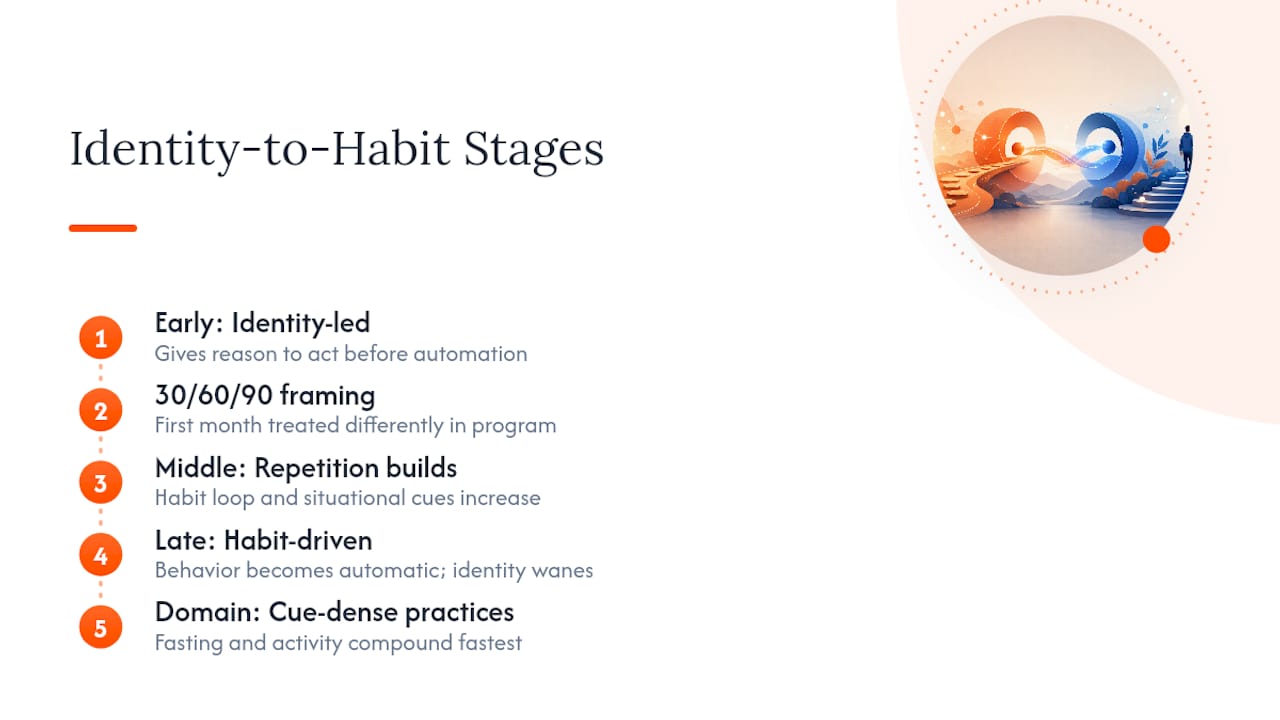
The meta-analytic and intervention data point to a specific, usable conclusion: identity and habit aren’t competing explanations for behavior change, they’re two stages of the same process. Early on, identity does the heavy lifting, giving you a reason to act before the behavior feels automatic. A Psychology Today synthesis of this literature makes a similar practical point: identity-driven change tends to hold up better under stress than approaches that rely purely on willpower or discipline.
The longitudinal nuance matters for setting expectations. Identity predicts behavior most strongly before a habit is established. Once repetition takes over, the habit loop and situational intentions start sharing more of the influence, which is exactly why the 30/60/90 framing above treats the first month differently from the third.
Identity-congruent cues make a behavior feel like the obvious, almost inevitable choice in the moment, rather than a decision you have to talk yourself into every single time.
Not every identity shifts with equal ease. The research base leans heavily on physical activity, which happens to overlap directly with the structured habit work ForgeFast is built around, pairing intermittent fasting protocols with identity-based coaching designed to reduce the daily decision fatigue that sinks most diet attempts. Applying identity framing to a domain like fasting works well precisely because eating windows are cue-dense and repetitive, the exact conditions where identity-congruent action compounds fastest.
Start Today: Templates, Vote Examples, and a 7-Day Log
Identity statement templates:
Health: “I am someone who eats within a window that respects my body.”
Productivity: “I am someone who protects one hour for deep work daily.”
Creativity: “I am someone who makes something small every day.”
Seven smallest-vote examples:
Drink one glass of water before coffee.
Write one sentence in a journal.
Do one set of bodyweight squats.
Close the kitchen after 8 p.m.
Read one page of a book.
Send one message advancing a goal.
Sit in silence for 60 seconds before checking your phone.
Log each night with one line: date, identity, vote completed (yes/no), one-word note on how it felt.
How ForgeFast Applies This to Fasting and Habit Coaching
Fasting is where identity-based habits show their real value, because eating windows are relentless, daily, and full of decision points. Treating fasting as an identity statement, “I am someone who eats on a schedule,” rather than a restriction cuts down the negotiation that derails most attempts by week two.
ForgeFast’s coaching structure builds on exactly this pattern: small daily votes, environment cues, and evidence logging instead of raw willpower. The psychology behind hunger and fasting plays directly into why identity framing works so well here, and readers building sustainable eating habits over the long term tend to see the same 30/60/90 pattern described above. None of this requires perfection. It requires the next small vote.
— Tony Lindsay
A Structured Way to Put This Into Practice
Reading about identity-based habits is one thing. Sticking with the daily votes for 90 days without a system is another, especially with fasting, where hunger cues and schedule chaos derail good intentions fast. A solution is needed to fill that gap: structured intermittent fasting protocols paired with coaching that treats identity, not restriction, as the engine of change.

An app can track fasting windows and turn each completed one into a logged vote for the identity you’re building, rather than another box checked on a diet plan. Combined with a psychology-based coaching framework for identity statements and evidence logging, it gives you the exact two-step recipe covered above, minus the guesswork of building your own tracking system from scratch. If you’re ready to see how identity-based fasting works day to day, check out ForgeFast’s fasting program and start your first tracked vote today.
Sources
The three-level meta-analysis anchors the identity-habit correlation. The intervention review shows real-world success rates. The longitudinal study explains timing nuance, and the IBM theory paper covers the underlying mechanism. For habit anchoring outside health behavior, see this language-learning habit guide.
Recommended
header.all-comments