6 Week Intermittent Fasting Plan for Runners Backed by Trials


Intermittent fasting can work for runners, but only if you’re selective about which sessions you fast for. Short easy runs and general weight-management goals tend to pair fine with a fasting window; long runs, intervals, and races usually don’t. A four-week 16:8 trial in endurance-trained runners found fat loss without performance loss, but that result depended on runners keeping calories adequate and protecting hard workouts. Apps like ForgeFast build around exactly that flexibility rather than a fixed clock.
TL;DR:
Short easy runs and recovery sessions under 60 minutes can generally be performed fasted with minimal performance impact.
The most supported fasting window for endurance athletes is 16:8, which can promote fat loss without performance decline if calories are maintained.
Long, high-intensity, or race-paced runs should be fueled beforehand to avoid hitting the wall and compromising training quality.
Red flags such as increased perceived effort, sleep issues, and menstrual irregularities signal the need to loosen fasting or consult a healthcare professional.
Flexible, training-adapted fasting schedules, supported by apps like ForgeFast, improve sustainability and reduce risks compared to rigid time windows.
Table of Contents
Common Fasting Schedules and What “Fasted” Really Means for Runners
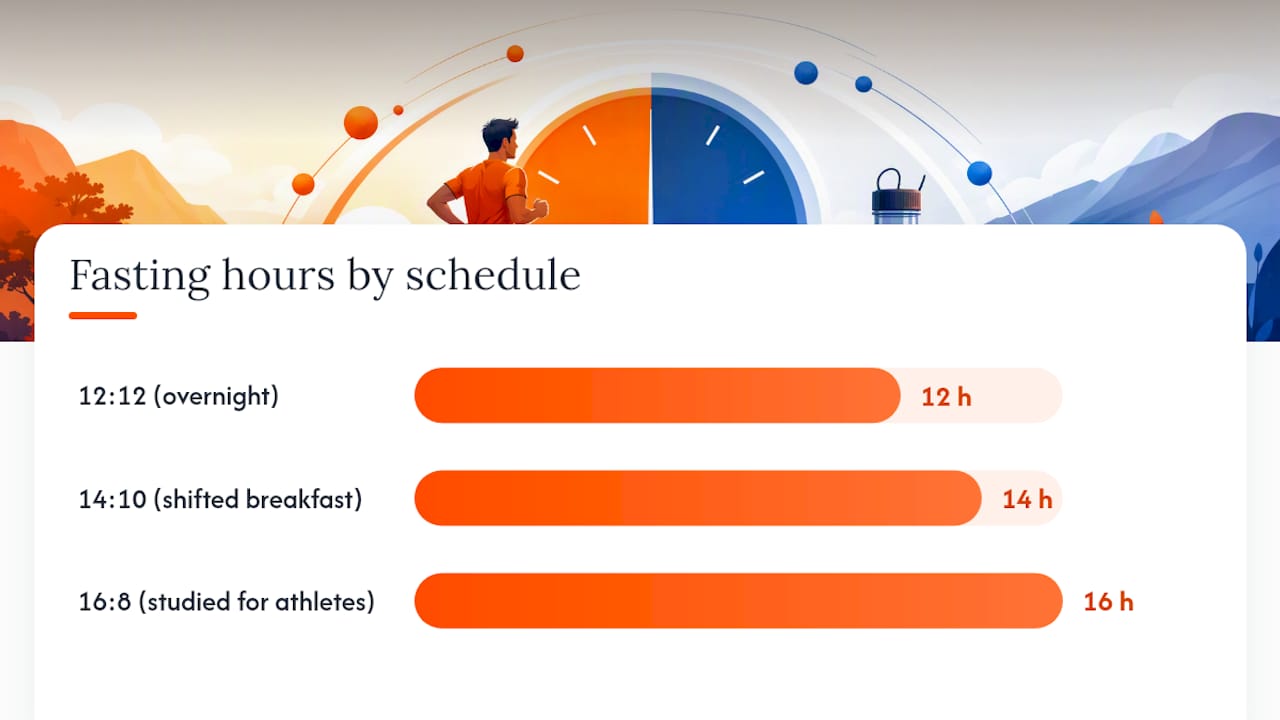
Most runners asking about intermittent fasting are really asking about time-restricted eating, a form of IF built around a daily eating window rather than calorie counting on specific days. The schedules show up again and again in running forums and coaching plans, and each one changes your training options differently.
12:12 — Twelve hours fasting, twelve hours eating. This is close to what most people do naturally overnight, and it barely affects training.
14:10 — A slightly tighter window, often achieved by pushing breakfast back an hour or two.
16:8 — The most studied version among athletes, and the one behind the 16:8 endurance trial discussed below.
5:2 — Five days of normal eating, two nonconsecutive days at roughly 500 to 600 calories. Rare among runners because it collides with training load unpredictably.
Alternate-day fasting — Full fasting or near-fasting every other day. Almost never recommended for anyone training more than a few times a week.
A true fasted state for exercise physiology purposes generally means roughly 10 to 14 hours without calories, long enough for liver glycogen to drop and insulin to fall. That’s the window where fat oxidation rises and where a fasted training effect, good or bad, actually shows up.
Here’s where the math gets practical. If you run at 6:00 AM and eat dinner at 8:00 PM the night before, you’re already at a 10-hour fast before you’ve laced up. Push your eating window to start at noon, and that morning run happens at hour 16, deep into genuine fasted territory. Evening runners have it easier: someone eating from 11:00 AM to 7:00 PM can time an evening run right after breaking the fast, sidestepping the fasted-training question entirely.
A few things matter regardless of which schedule you pick. Black coffee, plain tea, and electrolyte water without calories don’t break a fast and can blunt the sluggishness some runners feel early on. Going to bed and waking at consistent times helps your body adjust to the new eating pattern faster than white-knuckling through it. And whatever window you choose, it needs to fit enough calories and protein for your training load. Squeezing a marathon buildup into an 8-hour eating window is a common way runners end up under fueled without realizing it.
What the Research Says About IF for Runners
The strongest data point for runners comes from a four-week isocaloric 16:8 time-restricted feeding trial in endurance-trained male runners. Isocaloric means researchers matched total calories to what the runners were already eating. They just compressed the eating window.
The result: body fat mass dropped by 0.8 ± 1.3 kilograms and body fat percentage fell by 1.0 ± 1.5%, with no measurable drop in exercise performance over the four weeks.
That’s a meaningful finding, but it’s also a narrow one. Four weeks, male-only, endurance-trained subjects, and calories held constant rather than left to fall naturally. It tells you fat loss is possible without a performance penalty under those specific conditions. It doesn’t tell you what happens at 12 weeks, in women, or when someone eats however they want inside the window instead of matching a prescribed intake.
Broader literature reviews complicate the picture further. A review of fasting and endurance performance covering multiple studies, including Ramadan-based fasting research, found genuinely mixed results: some studies show performance decreases, some show no change, and a handful show small positive effects. The variation tracks back to a few recurring design issues:
Study size — Many trials run with a few dozen participants at most, which makes it hard to detect small performance effects reliably.
Energy intake — Studies that let total calories drop naturally during the fasting protocol show different results than studies that match calories intentionally, like the 16:8 trial above.
Sleep and timing — Ramadan fasting studies in particular bundle in disrupted sleep and shifted training times, muddying whether fasting itself or the surrounding disruption drove the results.
Training status — Well-trained athletes seem to tolerate fasted work differently than recreational runners, and most trials skew toward one group or the other.
A meta-analysis on IF and performance adds a useful nuance here: active people can often use intermittent fasting without a clear performance drop, provided they maintain adequate energy intake and adjust timing around their important sessions. That’s a different claim than “IF is safe for all training,” and it’s the one that actually matches what coaches see in practice.
The isocaloric design in the 16:8 trial is worth sitting with for a second. Most runners who try IF aren’t matching calories on purpose; they’re hoping the compressed window naturally reduces intake. That’s a legitimate weight-management strategy, but it’s a different mechanism than the one the trial actually tested. If you’re using IF to lose fat by eating less, you’re testing something closer to simple calorie restriction with a scheduling wrapper around it. If you’re matching your normal intake inside a shorter window, you’re closer to what the research actually measured.
Workout-by-Workout Rules: When to Run Fasted and When to Fuel
The single biggest mistake runners make with intermittent fasting isn’t the schedule. It’s applying the same fasting rule to every workout regardless of intensity or duration. Treat the fasting window as adjustable around your training calendar, not the other way around.
Easy and recovery runs under 60 minutes are generally fine fasted, as long as your total daily intake is adequate. Practical runner-specific guidance backs this up: low-intensity aerobic work doesn’t demand much glycogen, so running on stored fat and a bit of muscle glycogen rarely causes trouble. This is also the safest place to experiment if you’re new to fasted training.
Long runs and quality sessions are a different story. Tempo runs, threshold work, intervals, hill repeats, and anything resembling race pace all lean heavily on glucose availability. Fasted exercise does increase fat mobilization, thanks to lower insulin and higher adrenergic signaling, but that mechanism doesn’t translate into better performance for hard efforts. High-intensity work still needs glucose, and running out mid-interval feels like hitting a wall you didn’t see coming.
Here’s a simple decision framework by session type:
Easy run, under 60 minutes — Fasted is generally fine. Hydrate well and listen to how you feel.
Easy run, over 60 minutes — Consider a small pre-run snack, especially if it’s your only meal window before afternoon.
Tempo or threshold session — Fuel beforehand. A 100 to 200 calorie carbohydrate snack, like a banana or a slice of toast with honey, roughly 30 to 45 minutes out works for most runners.
Interval or hill repeat workout — Same rule as tempo work. These sessions punish underfueling fast, often within the first few reps.
Long run building toward a race — Fuel before, and practice your actual race-day fueling strategy during the run itself. This is not the session to test fasting theory on.
Race day — Never race fasted. Use whatever fueling strategy you’ve rehearsed in training.
Hydration and caffeine deserve their own note here. Coffee before a fasted run is fine and may help with perceived effort, but don’t let caffeine substitute for electrolytes on longer or hotter runs. Carry water or an electrolyte drink even on fasted efforts, since dehydration compounds the fatigue that fasting can already cause.
Pro Tip: Keep an emergency gel or a small sports drink in your car or by the door on any morning you’re running fasted longer than planned. If a run starts feeling like survival rather than training, that’s your signal to fuel immediately, not push through it.
The pros and cons of fasted training come down to matching the workout to the metabolic state you’re in. Fasted for easy aerobic work, fueled for anything that asks your legs to move fast.
Risks and Special Considerations Runners Should Know
Fasted training isn’t risk-free, and the risks cluster around a few specific mechanisms worth understanding before you commit to a rigid schedule.
Cortisol and immune suppression. Skipping pre-run fuel for demanding sessions can raise cortisol and temporarily suppress immune function, which shows up as more frequent minor illness and slower recovery between hard efforts. This risk scales with intensity: an easy jog fasted is a mild stressor, but a fasted interval session stacks training stress on top of fasting stress.
Protein loss and lean mass. Under energy restriction, fasted training can increase muscle protein breakdown, particularly when the eating window doesn’t leave room for adequate protein intake. Runners chasing a lighter race weight through IF sometimes end up losing strength and muscle along with fat, which shows up months later as weaker form late in long runs.
Female-specific risks deserve direct attention. Women face a higher risk from prolonged energy restriction than men do, and combining intermittent fasting with regular running warrants closer monitoring of menstrual cycles and bone health markers. Missed or irregular periods while running and fasting are not a sign the plan is “working.” They’re an early warning of relative energy deficiency, a condition that can quietly erode bone density well before a stress fracture makes it obvious.
Watch for these red flags, and treat two or more together as a signal to loosen the fasting window immediately:
Rate of perceived effort climbing on runs that used to feel routine
Resting heart rate creeping up or heart rate variability trending down
Sleep quality dropping, especially trouble falling or staying asleep
Getting sick more often than usual, or colds that linger longer
Missing scheduled workouts because you simply don’t have the energy
Any menstrual irregularity in female runners
A four-week isocaloric 16:8 trial in trained runners produced fat loss of roughly 0.8 kilograms without any measured performance cost, but the same study lasted only a month with calories carefully controlled. Red flags tend to surface after week four, not before it, which is exactly why longer, less controlled real-world fasting deserves more caution than the trial data alone suggests.
If any of these red flags show up and persist for more than a week or two, that’s a conversation for a doctor or sports dietitian, not something to push through on willpower.
A Conservative 6-Week Trial Plan for Runners
If you want to test intermittent fasting without wrecking a training block, the smartest approach is a slow build with fixed checkpoints, not a sudden jump into a 16-hour fast on Monday.
Weeks 1 to 2: Start with 12:12. This barely changes anything for most runners, but it establishes the habit of an eating window and gives you a baseline for how you feel, sleep, and perform.
Weeks 3 to 4: Move to 14:10, if week 1 to 2 metrics held steady. Keep every key workout, meaning tempo runs, intervals, and your longest run of the week, fully fueled regardless of the fasting window. Adjust window timing around those sessions rather than skipping fuel to protect the schedule.
Weeks 5 to 6: Try 16:8, only if nothing in the previous stage flagged a problem. This is the window studied in the endurance trial, and it’s also where most of the reported downsides start to appear if energy intake slips.
Structure each day around three anchors: a substantial first meal that breaks the fast with protein and carbohydrate, a pre-run snack if training falls near the edge of the window, and a recovery meal within the eating window that prioritizes protein for muscle repair. Aim to spread protein across two or three meals rather than front-loading it into one, since muscle protein synthesis responds better to distributed intake than a single large dose.
Track these metrics weekly, not just how you feel on any given day:
Objective: resting heart rate, morning body mass, sleep duration and quality, pace or power at a fixed effort
Subjective: rate of perceived effort on repeatable sessions, mood, hunger levels, motivation to train
Female runners specifically: menstrual cycle regularity and flow changes
Set a clear decision rule before you start: two consecutive poor-quality key sessions, or any of the red flags from the risks section above, means reversing to the previous week’s window rather than pushing forward. This isn’t a failure of willpower. It’s the plan working as designed, because the entire point of a staged trial is catching problems before they compound into missed training blocks or injury.
ForgeFast’s Approach to Fasting Schedules for Runners
Most fasting advice online treats the eating window like a rule carved in stone. ForgeFast treats it like a variable you adjust around your life and your training, which is the distinction that actually determines whether a fasting habit survives contact with a real training block.
A leading fasting app builds athlete-focused schedules that shift with your calendar instead of demanding you shift your training around a fixed clock. That matters because the biggest failure mode covered above, running a hard interval session fasted because “today is a fasting day,” is exactly the kind of rigid thinking a flexible window is designed to prevent. Behavior tracking inside the app can flag declining sleep, missed sessions, or slipping consistency before they turn into red flags a runner might otherwise ignore for weeks.
For busy professionals trying to layer a fasting habit onto an already packed training schedule, tracking behavior often matters more than the specific hours chosen. A schedule you can’t sustain around your actual life produces worse outcomes than a slightly less aggressive one you can maintain for months. Runners who want a deeper, more supervised structure can look at ForgeFast’s guide to intermittent fasting for endurance athletes, which extends the staged approach above into longer training cycles and race-specific periodization.
How Intermittent Fasting Changes Hydration Strategy
Fasting windows don’t reduce your water needs, but they do change when and how you’re likely to hit them. If your eating window starts at noon, you’ve potentially gone 12 or more hours without the fluid that normally comes packaged with breakfast, coffee, and snacks, which means plain water intake before your first meal becomes more important, not less.
Morning runners fasting through their session face the highest hydration risk of any group in this discussion. You’re running without recent caloric intake and often without recent fluid intake either, since many people cut back on morning coffee and juice once they adopt a compressed eating window. Electrolyte water or a pinch of salt in plain water before a fasted morning run helps offset this, particularly in warm weather or on runs longer than 45 minutes.

Caffeine complicates things slightly. Black coffee doesn’t break a fast and has mild diuretic properties, but that effect is smaller than most runners assume and isn’t a serious hydration concern for typical intake. The bigger issue is runners who rely on caffeine as an appetite suppressant and end up under hydrating simply because they’re not eating or drinking much of anything until their window opens. Track your urine color and body mass trends across a week, not a single run, to catch a hydration deficit before it shows up as a cramped calf mid tempo session.
Long-Term Adaptation: Does Fasting Get Easier Over Time?
Most of the discomfort runners report with intermittent fasting concentrates in the first two to three weeks. Hunger signals, mild irritability, and a temporary dip in easy-run energy tend to fade as the body adjusts insulin sensitivity and hunger hormone patterns to the new eating rhythm. That adaptation window is exactly why the staged six-week trial above starts conservative rather than jumping straight to 16:8.
What happens beyond that initial adjustment is where the evidence gets thinner. Most controlled trials, including the 16:8 endurance study, run four to eight weeks. Nobody has good long-term data on what a competitive marathoner’s fasting pattern looks like after two years of training through it. Ongoing trial registrations suggest researchers recognize this gap and are actively working to fill it with better-powered studies in trained athletes.
In practice, coaches who work with fasting athletes report that the runners who sustain IF long-term are the ones who treat it as flexible infrastructure rather than a fixed identity. They fast most days on a 14:10 or 16:8 pattern, then quietly abandon the window entirely during marathon taper, altitude camps, or heavy race blocks. That flexibility, more than any specific hour count, seems to be what separates runners who keep the habit for years from those who quit after one disappointing tempo session.
The Psychological Side of Fasting While Training
Hunger and training stress compete for the same mental bandwidth, and runners chronically underestimate how much that competition costs them. A fasted morning run followed by a stressful workday, with the first meal still hours away, asks a lot of anyone’s self-control, and it’s a common reason people abandon IF within the first month, not because the physiology failed but because the daily friction wore them down.
Rigid fasting schedules tend to create a specific psychological trap: treating the eating window as a test to pass rather than a tool to use. Runners who miss their window by twenty minutes because a run ran long sometimes spiral into guilt or overcompensate by under eating the rest of the day. That reaction does more damage than the twenty minutes ever could. Practical coaches consistently advise flexible eating windows tied to training demands rather than rigid scheduling precisely because rigidity is what breaks the habit, not the fasting itself.
The runners who report the best long-term relationship with IF tend to separate two questions clearly: “Is this window working for my training?” and “Am I disciplined enough to stick to it?” The first question should drive every decision. The second question, when it dominates instead, usually leads to someone forcing a fasted tempo run out of stubbornness rather than good sense, which is a recipe for a bad workout and a worse mood.
An Editorial Take on Fasting and Running
Most of the fasting advice aimed at runners treats the eating window as the goal. It isn’t. The window is a tool, and the runners who get real benefit from it are the ones who bend it around training, not the other way around. If you’re running easy miles, chasing a modest fat-loss goal, and you’re honest with yourself about how recovery feels, a 14:10 or 16:8 pattern can fit comfortably into a normal training week. If you’re building toward a marathon, training twice a day, or you’re a woman noticing any cycle irregularity, rigid fasting is the wrong tool for that season of training, full stop.
Here’s a rough week that respects both sides: fasted easy run Monday and Wednesday mornings inside a 14:10 window, fully fueled tempo Tuesday with breakfast eaten an hour before, fasted or lightly fueled easy Thursday depending on how the week felt, fueled long run Saturday with real breakfast, and an open, unrestricted Sunday. That’s not a rigid protocol. It’s a framework that shifts with the training calendar, which is the only version of intermittent fasting that survives more than a few months of real running.
— Tony Lindsay
Test Your Fasting Window Without Guessing
If you’ve made it this far, you already know the risky part of intermittent fasting isn’t the fasting. It’s applying the same window to every day regardless of what’s on your training calendar. The ForgeFast App builds schedule templates specifically around that problem, letting you set a fasting window that automatically flexes on long-run days and race weeks instead of forcing you to remember to override it manually.

Some apps include habit tracking that logs metrics like sleep, resting heart rate, mood, and training quality, helping red flags surface in a dashboard rather than being missed until a bad week turns into a bad month. Recovery monitoring can flag declining trends early, helping prevent runners from pushing through fasted interval sessions they should fuel.
For a more structured, guided entry point, ForgeFast’s book on the ForgeFast Method walks through the same staged approach in more depth, with case studies and structured plans for readers who want the full framework rather than piecing it together workout by workout. Starting with a guided trial in an app can help build a schedule around your actual training week.
Primary Research and Trusted Resources
The clinical foundation for this article rests on a small but genuinely useful set of sources. The four-week 16:8 time-restricted feeding trial in endurance-trained male runners is the most directly relevant clinical study, showing measurable fat loss without a performance penalty under controlled, isocaloric conditions.
The broader review of fasting and endurance performance pulls together multiple studies, including Ramadan-based fasting research, to show why results vary so much between trials, and it’s the best single source for understanding study limitations in this field.
For the physiological mechanism behind fasted fat oxidation, National Geographic’s explainer on fasting and exercise lays out the insulin and adrenergic pathways in accessible terms. Practical, runner-specific timing guidance draws from Runner’s Blueprint’s fasting overview and Triathlete’s analysis of fasted workout tradeoffs, both useful for readers who want a coach’s-eye view rather than a purely clinical one.
This article is general information, not a substitute for advice from a qualified doctor. Consult a qualified healthcare professional about your own circumstances before acting on anything here.
Sources
FAQ
Is fasting for 16 hours the ideal number for runners?
There’s nothing magic about 16 hours specifically. It’s simply the window studied in the trial showing fat loss without performance loss, and shorter windows like 12:12 or 14:10 carry lower risk for runners training frequently.
Can I lose 10 pounds in two weeks of intermittent fasting as a runner?
Losing that much weight that fast almost always means aggressive calorie restriction, not the fasting schedule itself, and it risks the protein and lean-mass losses described above. A sustainable pace closer to 1 to 2 pounds a week protects training quality far better.
What is the 3-3-3 rule for running?
This isn’t an established clinical or coaching standard tied to intermittent fasting research, and definitions circulating online vary. Focus instead on the workout-by-workout fueling rules covered above, which are grounded in actual training physiology.
What is the 2-2-2 fasting rule?
Like the 3-3-3 rule, this isn’t a term backed by the research behind this article, and no consistent definition exists across sources. Stick to established schedules like 12:12, 14:10, and 16:8, which have real trial data behind them.
Should I run fasted every day if I’m training for a marathon?
No. Long runs and quality sessions during marathon training should be fueled, and practicing race-day fueling strategy during those runs matters more than any fasting window. Reserve fasted running for easy, sub-60-minute sessions only.
Does ForgeFast offer a plan specifically for runners?
Some fasting apps include athlete-focused schedule templates and recovery tracking designed to flex around training demands rather than enforcing a fixed fasting window on hard training days.
Recommended
Comments