Post-Workout Fasting Window: What Athletes Need to Know


The post-workout fasting window is defined as the period after exercise during which nutrient intake, particularly protein, most effectively supports muscle repair and growth. Most fitness enthusiasts have heard of the “anabolic window,” the old idea that you must eat within 30 minutes of training or your gains disappear. That myth is wrong. Muscle protein synthesis remains elevated for 3–5 hours post-exercise, giving you a far more forgiving recovery period than the fitness industry once claimed. Whether you train fasted or fed, understanding this window changes how you approach post-workout nutritional timing and intermittent fasting protocols.
What is the post-workout fasting window and how long does it last?
The post-workout fasting window is the gap between finishing your workout and consuming your next meal. For athletes practicing intermittent fasting, this gap can stretch from 30 minutes to several hours depending on their eating schedule. The critical question is how long that gap can safely extend before recovery suffers.
Research confirms that MPS stays elevated for 3–5 hours after resistance training. That means your muscles remain primed to absorb protein and rebuild tissue well beyond the old 30-minute deadline. The anabolic window is better understood as a wide, forgiving period, not a narrow deadline that slams shut.

That said, the ideal fasting duration post-workout depends heavily on whether you trained fasted or fed. If you ate a protein-rich meal 1–2 hours before training, your body still has circulating amino acids available during and after your session. In that case, delaying your post-workout meal by 2–3 hours carries minimal risk. If you trained in a fully fasted state, the calculus changes.
Protein intake within 1–2 hours post-workout is the smart move when you trained fasted, because your amino acid pool is already depleted. Waiting longer prolongs catabolic conditions and limits how much muscle protein synthesis your body can achieve. The post-exercise recovery window is real. It is just wider than most people think.
Key factors that determine how long you can safely fast after a workout:
Training state: Fasted training shortens the safe fasting window post-exercise.
Training intensity: High-volume sessions deplete glycogen faster, making earlier nutrition more urgent.
Training type: Endurance athletes face different glycogen demands than strength athletes.
Pre-workout meal timing: A meal 1–2 hours before training extends the post-workout window significantly.
Daily protein total: If your overall protein intake is adequate, exact timing matters less.
Pro Tip: Schedule your workout to end 30–60 minutes before your eating window opens. This keeps your fast intact while minimizing the gap between training and your first meal.
What are the benefits and drawbacks of fasting after a workout?
Fasting after exercise is not inherently harmful. For many fitness enthusiasts, it produces real metabolic advantages. The key is knowing when those benefits stop and the costs begin.
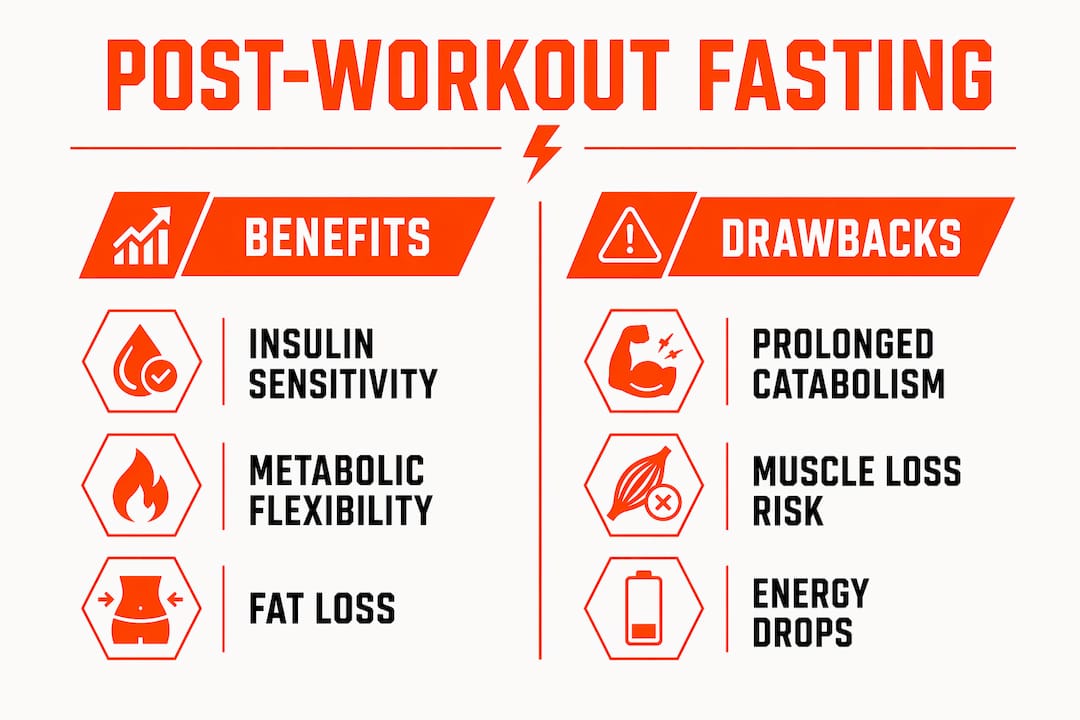
Fasted training improves metabolic flexibility and enhances mitochondrial function, which is particularly valuable for endurance athletes. Improved insulin sensitivity is another well-documented benefit, meaning your body handles carbohydrates more efficiently when you do eat. These adaptations favor fat oxidation and long-term body composition improvements.
Combining intermittent fasting with exercise over 14–30 weeks produces significantly greater fat loss and waist reduction than fasting alone. That result tells you the combination works, but it also implies that the exercise component requires adequate recovery support to deliver those results consistently.
The drawbacks appear when fasting extends too long after intense training. Extending fasting after resistance training without amino acid intake prolongs catabolic conditions and limits muscle protein synthesis. For anyone prioritizing hypertrophy, this is a real cost.
Benefit | Drawback |
Improved insulin sensitivity | Prolonged catabolism after resistance training |
Enhanced fat oxidation | Reduced muscle protein synthesis if fasting is extended |
Better mitochondrial function | Glycogen replenishment delayed, increasing fatigue |
Greater fat loss when combined with exercise | Performance decline in back-to-back training sessions |
Metabolic flexibility gains | Muscle preservation harder for older athletes |
Individual variability matters here. A 25-year-old male training for fat loss tolerates a longer post-workout fast than a 45-year-old female focused on muscle retention. Training intensity, body composition, and recovery capacity all shift the equation.
How should nutrition be timed post-workout when practicing intermittent fasting?
Post-workout nutritional timing within an intermittent fasting protocol requires one core decision: does your eating window open before or after your workout? The answer shapes everything else.
The most effective approach integrates fasting benefits before exercise with prompt nutrient intake after, to support both metabolic health and muscle recovery. That means scheduling your workout near the start of your eating window whenever possible.
Meta-analysis data shows that consuming protein and carbohydrates immediately after intense exercise accelerates muscle and glycogen recovery compared to delayed intake. This effect is strongest in athletes with high training volume or short recovery windows between sessions.
Here is a practical sequence for breaking your fast after exercise:
Finish your workout. Keep your session within 30–60 minutes of your eating window opening.
Consume 20–40 grams of protein within 1–2 hours. Prioritize fast-digesting sources like whey protein or eggs to spike muscle protein synthesis quickly.
Add carbohydrates based on training intensity. High-intensity or long-duration sessions demand glycogen replenishment. Aim for 1–1.2 grams of carbohydrate per kilogram of body weight in the first hour.
Hydrate aggressively. Fasted training increases fluid and electrolyte losses. Rehydrate before focusing on solid food.
Follow with a complete meal within 2 hours. This second feeding reinforces muscle protein synthesis and tops off glycogen stores.
Spread remaining protein across your eating window. Daily protein spread over meals matters more for muscle growth than any single post-workout dose.
For athletes with closely spaced training sessions, post-workout nutrition timing matters more for glycogen replenishment. If you train twice a day or compete on consecutive days, delaying your post-workout meal is a mistake regardless of your fasting protocol.
How to customize your post-workout fasting window based on your goals
No single fasting window fits every athlete. The right approach depends on what you are training for, how often you train, and where your body currently sits in terms of composition and metabolic health.
Factors that should shape your post-workout fasting window:
Fat loss focus: A slightly extended post-workout fast (1–2 hours) is acceptable if you trained fed. It preserves fasting’s fat-oxidation benefits without meaningfully harming recovery.
Hypertrophy focus: Break your fast within 1 hour of finishing a resistance session, especially if you trained fasted. Muscle protein synthesis is the priority.
Endurance training: Glycogen replenishment matters more than protein timing. Prioritize carbohydrates in your first post-workout meal.
Training frequency: Athletes training 4 or more times per week have less room to delay post-workout nutrition. Recovery windows are shorter, so nutrient timing becomes more critical.
Age and sex: Older athletes and women in certain hormonal phases show reduced muscle protein synthesis rates, making timely protein intake more important, not less.
Metabolic health: Individuals with lower insulin sensitivity benefit more from fasting’s metabolic effects but must balance this against recovery demands.
Fasting-training hybrids that optimize metabolic benefits before a workout and prioritize nutrient timing after are the most effective structure for body composition goals. This is not guesswork. It is a deliberate protocol built around your training schedule.
Athletes benefit from timing fasted workouts to coincide with eating windows, reducing the post-workout fasting gap and maximizing nutrient efficiency. If your schedule forces a long gap between training and eating, consider a small protein dose, like 20 grams of whey, to bridge the gap without fully breaking your fast’s metabolic benefits.
Pro Tip: Track two recovery markers weekly: morning resting heart rate and subjective energy on a 1–10 scale. If both trend downward over two weeks, your post-workout fasting window is likely too long for your current training load.
Key Takeaways
The post-workout fasting window lasts 3–5 hours, is wider than the old 30-minute anabolic window myth suggests, and should be customized based on training state, goals, and frequency.
Point | Details |
MPS window is 3–5 hours | Muscle protein synthesis stays elevated well beyond the old 30-minute deadline. |
Fasted training shortens the window | Eat within 1–2 hours post-workout if you trained in a fully fasted state. |
Total daily protein matters most | Spreading protein across meals drives muscle growth more than any single post-workout dose. |
Fasting benefits are real but conditional | Improved insulin sensitivity and fat oxidation require balancing against recovery needs. |
Customize by goal and frequency | Hypertrophy athletes need faster nutrient intake; fat-loss athletes have more flexibility. |
Why I stopped stressing about the anabolic window
I spent years obsessing over the 30-minute post-workout window. I would rush through showers, skip stretching, and choke down protein shakes in parking lots because I was convinced that every minute past the bell cost me muscle. That mindset was exhausting, and it was wrong.
What actually changed my results was shifting focus to total daily protein intake and building a fasting schedule that put my eating window close to my training time. The stress of rigid timing was doing more damage than the timing itself. Cortisol is a real recovery killer, and anxiety about eating windows raises it.
The research on the anabolic window as a myth was genuinely liberating for me. Knowing that muscle protein synthesis stays elevated for hours meant I could train, cool down properly, and eat when my schedule allowed, without panic. My recovery actually improved because I was less stressed and more consistent.
The one caveat I will give you from experience: fasted training is a different animal. When I train before my eating window opens, I feel the difference if I wait too long to eat. That 1–2 hour post-workout window is real for fasted sessions. Listen to your body on that one. If your energy crashes and your next session feels flat, you waited too long.
Focus on sleep, stress management, and fasting protocols built around your actual life. Those variables move the needle far more than shaving 15 minutes off your post-workout meal timing.
— Tony Lindsay
ForgeFast and post-workout nutrition timing
Balancing intermittent fasting with post-workout recovery is one of the most common challenges active people face. ForgeFast is built specifically for this problem.

ForgeFast integrates intermittent fasting with a structured lifestyle framework that accounts for training schedules, eating windows, and recovery needs. The methodology goes beyond calorie timing. It builds the mental discipline and consistent habits that make fasting sustainable long-term. For fitness enthusiasts who want to master their eating patterns around training without sacrificing muscle or performance, ForgeFast provides a clear, science-grounded structure. The approach is designed for people who train seriously and want their fasting protocol to work with their workouts, not against them.
FAQ
What is the post-workout fasting window?
The post-workout fasting window is the period after exercise during which your body is primed to use nutrients for muscle repair and recovery. Muscle protein synthesis remains elevated for 3–5 hours post-exercise, making this window longer and more flexible than the traditional 30-minute anabolic window suggests.
How long should I fast after a workout?
If you trained in a fasted state, aim to eat within 1–2 hours post-workout to support muscle protein synthesis. If you ate before training, you can safely extend the fast by 2–3 hours without significant recovery loss.
Does fasting after exercise hurt muscle growth?
Extended fasting after resistance training without protein intake prolongs catabolic conditions and limits muscle protein synthesis. For hypertrophy goals, breaking your fast within 1–2 hours of a fasted session is the most effective approach.
What should I eat to break my fast after a workout?
Prioritize 20–40 grams of fast-digesting protein, such as whey or eggs, combined with carbohydrates scaled to your training intensity. This combination accelerates both muscle repair and glycogen replenishment.
Does the anabolic window really exist?
The anabolic window exists but is far wider than the old 30-minute rule implies. Daily total protein intake spread across meals drives muscle growth more than precise post-workout timing, except in fasted training scenarios where earlier intake matters more.
Recommended
Comments