Simple Fasting Framework for Beginners: Start Right
- Tony Lindsay
- Jul 19
- 8 min read


What makes a simple fasting framework work for beginners?
The best starting point for any beginner is a time-restricted eating schedule that works with your existing sleep pattern, not against your entire lifestyle. The three frameworks that consistently deliver results for newcomers are the 12/12, 14/10, and 16/8 methods. Each one builds metabolic flexibility gradually, which is exactly what your body needs when it’s new to fasting.
Experts at Northwell Health recommend starting with a 12-hour overnight fast and extending the window progressively over 2–4 weeks. That pacing matters more than most beginners realize. Your body needs time to shift from burning glucose to burning stored fat, and forcing that switch too fast is the most common reason people quit in week one.
Here’s what a solid beginner fasting framework includes:
A fasting window that overlaps with sleep so you’re not white-knuckling hunger for hours on end
A clear eating window with a defined start and stop time, not a vague “eat less” approach
Gradual progression from shorter to longer fasts over several weeks
Flexibility to adjust based on your work schedule, social life, and energy levels
Consistent daily timing rather than random fasting days, which builds the habit faster
The framework that fits your actual routine is the one you’ll stick with. A 16/8 schedule is popular, but if your job means you’re eating dinner at 9 PM, a 12/12 starting at 9 PM is a smarter first move.

Which intermittent fasting methods work best for beginners?
Not all fasting schedules are created equal, especially when you’re just starting out. The methods below range from the most forgiving to the most demanding, and understanding the difference saves you a lot of frustration.
12/12 fasting
This is the gentlest entry point. You fast for 12 hours and eat during the remaining 12. If you finish dinner at 7 PM and eat breakfast at 7 AM, you’re already doing it. Most of the fast happens while you sleep, so the actual hunger challenge is minimal. It’s the ideal first week for anyone who has never tracked their eating window before.
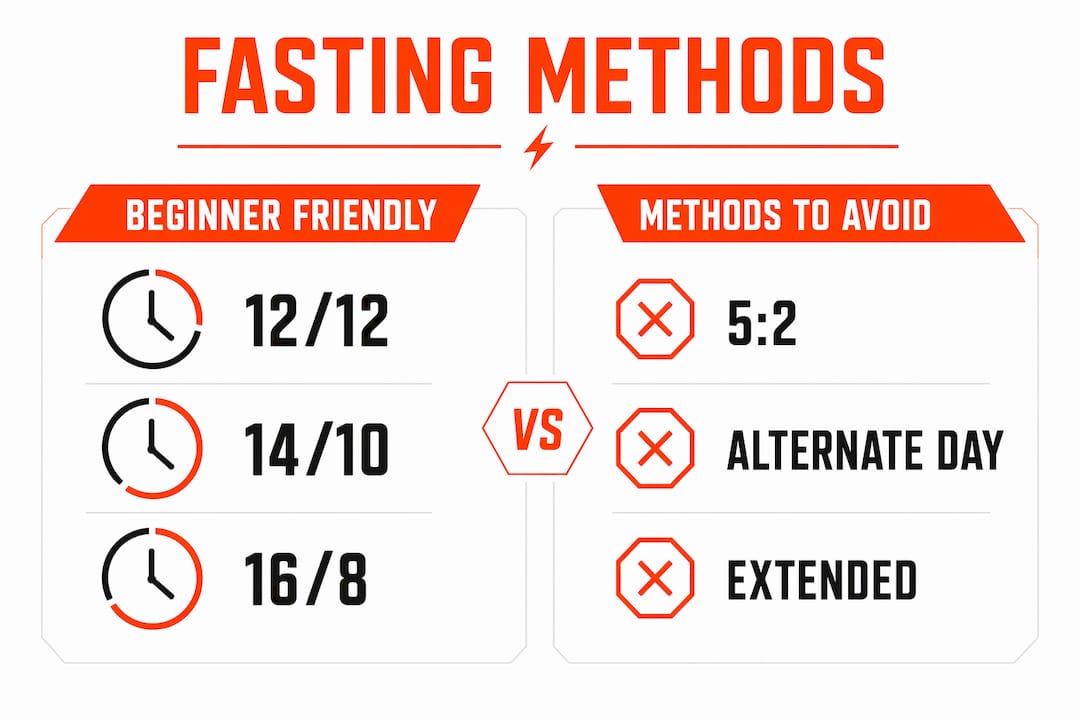
14/10 fasting
A moderate step up. You fast for 14 hours and eat within a 10-hour window. Finish dinner at 7 PM, eat your first meal at 9 AM. This window starts to produce real metabolic benefits while still being manageable for most schedules. According to University of Michigan School of Public Health, daily time-restricted eating like this is the most beginner-appropriate style because it avoids the severe calorie restriction that makes other methods hard to sustain.
16/8 fasting
The most widely practiced method. You eat within an 8-hour window and fast for 16 hours. A common schedule: skip breakfast, eat between noon and 8 PM. This is where most people land after several weeks of gradual progression. The metabolic benefits are well-documented, and the structure is clear enough to build a real habit around.

Methods to avoid early on
The 5:2 method (eating normally five days, restricting to roughly 500–600 calories on two non-consecutive days) and alternate-day fasting both require significant calorie restriction on fast days. Research from the University of Michigan confirms these are harder to maintain and less suitable for beginners. A 24-hour weekly fast falls into the same category. Save those for later, if ever.
Method | Fasting window | Eating window | Beginner-friendly? |
12/12 | 12 hours | 12 hours | Yes, ideal start |
14/10 | 14 hours | 10 hours | Yes, moderate step-up |
16/8 | 16 hours | 8 hours | Yes, after 2–4 weeks |
5:2 | 2 low-calorie days/week | 5 normal days | No, too restrictive |
Alternate-day | Every other day | Every other day | No, difficult to sustain |
24-hour fast | 24 hours | — | No, advanced only |
What health benefits can beginners expect from fasting?
The benefits of intermittent fasting go well beyond weight loss, though that’s usually what brings people in. The science behind why fasting works comes down to one core process: the metabolic switch.
After your body burns through its available glucose stores, it shifts to burning fat for fuel. Johns Hopkins Medicine explains that this switch is the engine behind most of fasting’s documented benefits, from fat loss to improved cellular repair. The catch is that the switch takes time to activate, which is why the first two weeks feel harder than the weeks that follow.
Here’s what the research supports for beginners who stick with it:
Weight and fat loss through reduced calorie intake and increased fat oxidation
Improved insulin sensitivity, which lowers the risk of type 2 diabetes
Reduced inflammation markers, linked to better long-term metabolic health
Cellular repair activation (autophagy), where the body clears out damaged cells during fasting periods
Potential longevity benefits, supported by animal studies and emerging human research
University of Michigan research lists weight loss, improved metabolic health, diabetes prevention, and increased longevity among fasting’s verified benefits. Those aren’t small claims.
One thing the research is equally clear about: what you eat during your eating window determines how much of that benefit you actually capture. Fasting is not a license to eat poorly. Northwell Health nutritionists emphasize that lean proteins, vegetables, whole grains, and healthy fats during eating windows are what turn a fasting schedule into a genuine health tool. For practical guidance on structuring those meals, meal prep for fasting days is worth reading before you start.
How do you start intermittent fasting safely?
Starting safely means starting slowly. The biggest mistake beginners make is jumping straight to a 16-hour fast on day one. Northwell Health is direct about this: abrupt extreme fasting is harder to sustain and more likely to cause side effects that push people to quit.
Common side effects in the first two weeks:
Headaches, often from reduced caffeine or sugar intake
Irritability and difficulty concentrating, especially mid-morning
Fatigue and lightheadedness, particularly in the afternoon
Hunger spikes, usually peaking around the time you’d normally eat
Most of these taper off after the first two weeks as your body adapts to the new fuel source. Harvard Health confirms that gradual extension of fasting windows, combined with proper hydration, significantly reduces these side effects.
Safety steps worth following:
Consult a doctor before starting, especially if you take medications, have diabetes, or are pregnant
Begin with 12/12 for at least one week before extending your window
Drink water, black coffee, or plain herbal tea during fasting hours
Cut back on sugar in the days before you start to reduce energy crashes
Track how you feel daily, not just your weight
Who should not fast without medical supervision: people with a history of eating disorders, those with advanced diabetes, pregnant or breastfeeding women, and anyone on medications that require food timing.
Pro Tip: Add a pinch of sea salt or a sugar-free electrolyte supplement to your water during fasting hours. What feels like low blood sugar is often just an electrolyte imbalance, and correcting it can eliminate the lightheadedness and fatigue that cause most beginners to give up.
Frequently asked questions about fasting for beginners
How do I start fasting as a beginner? Start with a 12-hour overnight fast, such as finishing dinner by 8 PM and eating breakfast at 8 AM. Hold that window for one week, then extend it by one hour every few days until you reach your target schedule.
What is the easiest fasting method? The 12/12 method is the easiest because most of the fast occurs during sleep. It requires almost no behavioral change for people who already avoid late-night snacking.
What should I eat during my eating window? Focus on lean proteins (chicken, fish, eggs, legumes), vegetables, whole grains, and healthy fats like avocado and olive oil. Avoid processed foods and high-sugar snacks, which spike blood sugar and make the next fast harder.
How do I adjust fasting to fit my lifestyle? Match your eating window to your natural schedule. If you work early shifts, a 6 AM to 2 PM eating window fits better than the standard noon to 8 PM. If you have regular evening social commitments, a later window preserves your flexibility. For people with demanding schedules, fasting schedules for busy professionals offers practical templates.
When should I modify my fasting plan? Adjust when you notice consistent fatigue, poor workout performance, or disrupted sleep after four or more weeks on a schedule. These are signals that your window timing or eating window nutrition needs recalibration, not that fasting is wrong for you.
Psychological and lifestyle strategies that make fasting stick
The physical side of fasting gets most of the attention. The mental side is what actually determines whether you’re still doing it six months from now.
Johns Hopkins Medicine notes that the adaptation period runs roughly 2–4 weeks, and initial hunger and irritability typically peak in the first two weeks before tapering. Knowing that in advance changes how you experience it. You’re not failing; you’re adapting.
Practical strategies that build the habit:
Set a fixed eating window time and treat it like a work meeting. Consistency trains your hunger hormones to align with your schedule.
Use mindfulness during hunger spikes. A 10-minute walk or a glass of water often dissolves the craving before it becomes a problem.
Plan your social eating. If Friday dinner runs late, adjust your Saturday window rather than abandoning the framework entirely.
Track energy and mood, not just weight. Progress in how you feel often shows up before the scale moves.
Build fasting around existing routines. Morning coffee, an evening walk, a consistent bedtime all anchor the fasting window without extra effort.
The ForgeFast approach treats fasting as a mental discipline as much as a physical one. The flexible fasting guide from ForgeFast makes the case that rigid all-or-nothing thinking is the fastest route to quitting. A missed day or a shifted window is not a failure. It’s a data point.
Pro Tip: Write down your fasting window the night before, along with one specific meal you’re looking forward to during your eating window. That small act of intention shifts fasting from something you’re enduring to something you’re managing on your own terms.
People who push through the first adaptation phase generally report improved energy and well-being that makes continued fasting feel natural rather than forced. The first two weeks are the hardest. After that, most people stop counting the hours.
Key Takeaways
A beginner’s fasting plan works best when it starts small, builds gradually, and fits the life you already have.
Point | Details |
Start with 12/12 or 14/10 | These windows overlap with sleep, making the first weeks manageable and reducing dropout. |
Match the method to your schedule | The fasting framework you’ll actually follow beats the “optimal” one you abandon after a week. |
Hydration and electrolytes matter | Water and a pinch of salt during fasting hours prevent the fatigue and lightheadedness that derail beginners. |
Food quality drives results | Lean proteins, vegetables, and whole grains during eating windows determine how much benefit fasting actually delivers. |
The first two weeks are the hardest | Hunger and irritability peak early and taper; persistence through the adaptation phase is what separates lasting change from a failed attempt. |
Why most people get fasting backwards
Most beginners treat fasting as a willpower contest. They pick the most aggressive schedule they can find, white-knuckle through the first week, and then blame themselves when they quit. The framework was never the problem. The approach was.
What the research actually shows is that the body needs a gradual metabolic transition, not a shock. Starting with 12 hours and adding an hour every few days isn’t the slow route. It’s the route that produces lasting change, because the habit forms before the difficulty peaks. By the time you’re fasting 16 hours, your hunger hormones have already adjusted. You’re not fighting your biology anymore; you’re working with it.
The psychological piece gets underestimated even more. Fasting exposes your relationship with food in ways that calorie counting never does. Hunger at 11 AM when your eating window opens at noon is uncomfortable. But sitting with that discomfort for 60 minutes and realizing you survived it builds a kind of mental confidence that carries over into everything else. That’s not a side benefit. For many people, it’s the main one.
ForgeFast’s framework is built around exactly this idea: that the discipline fasting requires is the point, not an obstacle to work around. Flexible, yes. Forgiving of real life, absolutely. But the structure is what makes it work. A fasting plan with no defined window is just skipping meals and calling it a strategy.
If you’re new to this, start tonight. Finish dinner, set a time for your first meal tomorrow, and don’t eat between those two points. That’s it. The rest builds from there.
Recommended
Comments