Best Nutrient Timing Apps for Busy Professionals 2026
- Tony Lindsay
- 4 days ago
- 10 min read
ForgeFast is the top recommendation for busy professionals seeking structured intermittent fasting and lasting metabolic change. Its habit-coaching framework, JITAI-style personalization, and wearable integration address the specific friction points that cause most professionals to abandon fasting protocols within weeks.
The evidence backing this recommendation is solid. Meta-analyses of randomized controlled trials show intermittent fasting reduces body weight and improves cardiometabolic markers in overweight adults. What separates effective apps from forgettable ones is not the timer. It is the behavioral scaffolding around it. ForgeFast builds that scaffolding deliberately, combining psychological coaching with biological science.
Read on for protocol comparisons, a four-week starter plan, and a practical checklist for evaluating any fasting app before you subscribe.
Table of Contents
Which IF format suits a busy professional schedule?
Time-restricted eating (TRE), alternate-day fasting (ADF), and the 5:2 method each fit a professional schedule differently. Understanding the tradeoffs before you pick one saves weeks of frustration.
TRE compresses eating into a 6–10 hour window daily. For most professionals, a 12 PM–8 PM window survives meetings, travel, and social dinners with minimal disruption. Research published in the NEJM shows that a 6-hour feeding window with an 18-hour fast can trigger a metabolic switch to ketone-based energy, with favorable adaptations in both animal and human studies.
ADF alternates between normal eating days and very-low-calorie days (roughly 500 kcal). An umbrella review and network meta-analysis in BMC Medicine found ADF often ranks highest for metabolic outcomes across IF strategies. The catch: low-calorie days are genuinely hard to manage around client lunches or back-to-back calls.
5:2 restricts calories on two non-consecutive days per week. It offers more scheduling control than ADF but requires planning around which two days work best.
Protocol | Schedule feasibility | Metabolic effect (directional) | Adherence difficulty |
TRE (16:8) | High | Moderate | Low |
5:2 | Medium | Moderate | Medium |
ADF | Low | High | High |
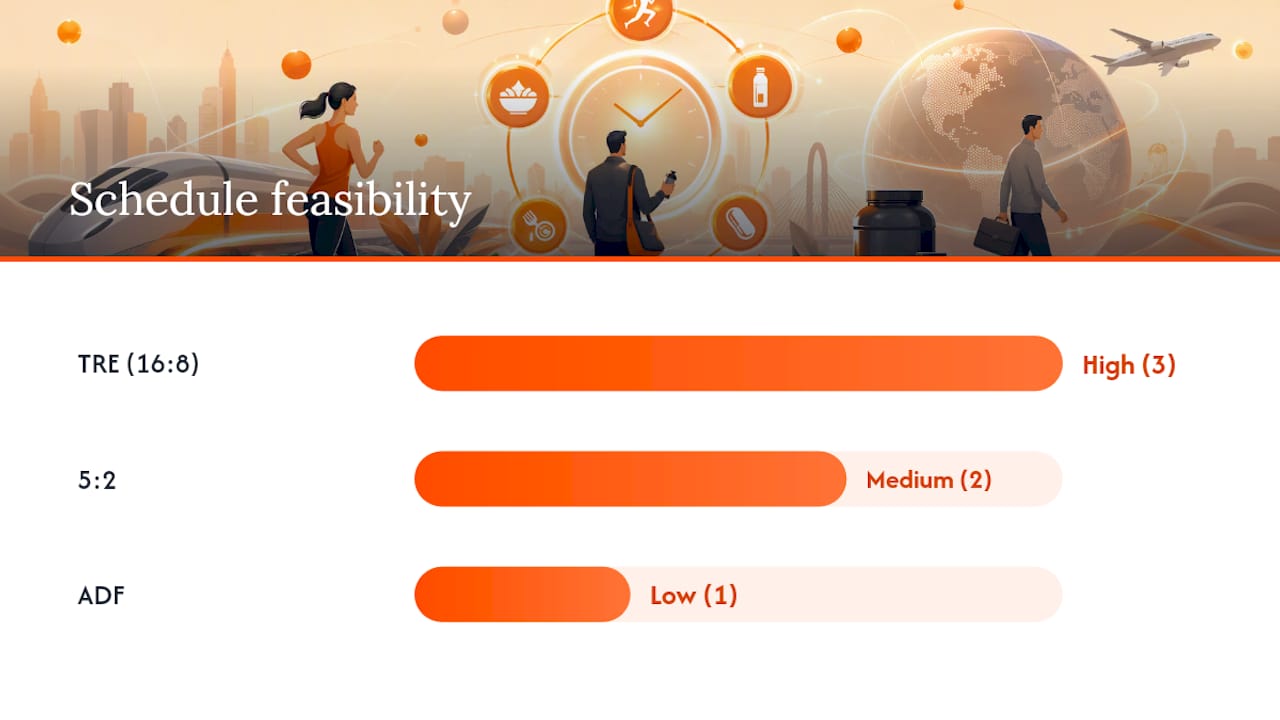
A BMJ meta-analysis contextualizes these rankings: ADF shows larger weight and lipid improvements in shorter trials, but evidence certainty ranges from low to moderate, and long-term benefits remain unclear.
How do you choose the right fasting app before subscribing?
Most apps look similar on a product page. The differences show up in the first two weeks of use. Here is what to check before you commit.
Must-have features for busy professionals:
Flexible window scheduling that adjusts to your calendar, not a fixed 8 AM start
JITAI-style coaching that delivers nudges based on your current context (travel, poor sleep, high-stress day)
Wearable sync with Apple Health, Fitbit, or Garmin so sleep and activity data inform your protocol
Simple one-tap meal logging, not a macro database requiring 10 minutes per entry
Clinician-friendly data export (PDF or CSV) for dietitian or physician visits
Offline functionality for travel days when connectivity is unreliable
Red flags to walk away from:
Punitive streak mechanics that reset progress after one missed day
Confusing UI that requires more than three taps to log a meal or check your window
No coaching layer, just a timer
Vague or absent privacy policy with no mention of HIPAA alignment or data-sharing limits
No wearable integration at all
Questions to ask during a free trial:
Can I export my fasting and meal data as a file I own?
What happens to my data if I cancel?
Is there a clinician oversight option or dietitian referral pathway?
Does the app adjust my fasting window if I log a poor night of sleep?
What is the refund policy if the protocol does not suit me?
Four-week starter templates for a typical workweek
Short starter protocols with gradual window extension tend to be more sustainable for working adults than jumping straight to a strict 16:8 or ADF schedule. Here is a practical progression:
Week | Template | Fasting window | Key app features to use |
1 (Conservative) | 12:12 | 8 PM – 8 AM | Timer, daily reminder, sleep log |
2 (Moderate) | — | 8 PM – 10 AM | Coaching check-in, wearable sync |
3 (Moderate+) | 16:8 | 8 PM – 12 PM | JITAI nudges, meal quality log |
— | 16:8 or 18:6 | 8 PM – 12 PM or 2 PM | Data review, protocol reassessment |
On travel days, default to the previous week’s window rather than skipping entirely. A 12:12 on a travel day beats a broken streak and the guilt spiral that follows.
By week four, most people notice improved fasting tolerance and more stable morning energy. The meta-analysis data shows that intermittent fasting trials demonstrate reductions in body weight and BMI, though individual results vary by protocol duration and adherence.
Pro Tip: Align your eating window with your natural sleep schedule. Professionals who push their eating window to match late-night work hours often undercut the metabolic benefits of TRE entirely.
Which behavioral design features actually drive long-term adherence?
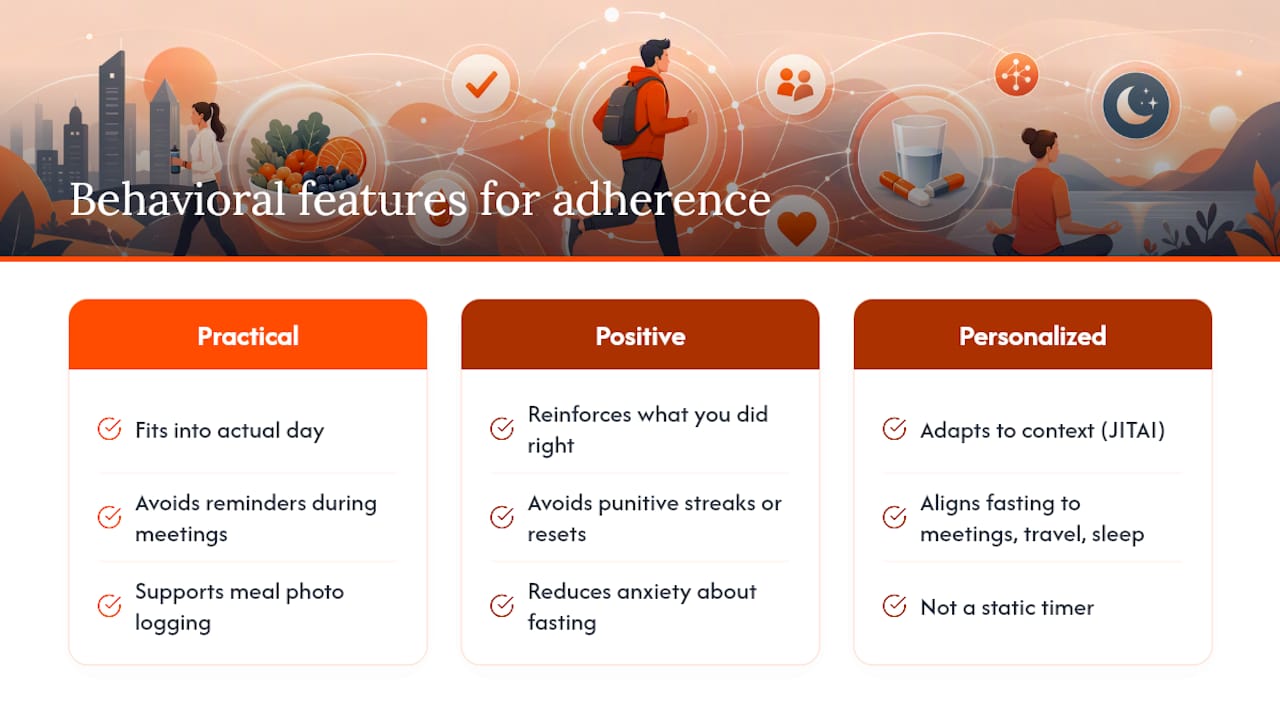
The app features that predict sustained adherence are not the flashiest ones. They are the ones built around the 3Ps framework from Verily Lightpath research: Practical, Positive, and Personalized.
Practical means the app fits into your actual day, not an idealized version of it. Reminders that fire at 7 AM when you are already in a meeting are noise, not coaching.
Positive means the app reinforces what you did right, not what you missed. Punitive streak mechanics create anxiety around fasting, which is the opposite of a sustainable habit.
Personalized means the app adapts. Just-in-time adaptive interventions (JITAI) deliver context-aware nudges that align fasting windows with real schedules, including meetings, travel, and poor sleep nights. This is meaningfully different from a static timer.
A systematic review of AI-enabled behavioral coaching platforms found that AI coaching produced clinically meaningful changes in weight, HbA1c, and blood pressure in several trials, with hybrid models combining AI and human oversight showing the largest effects.
Feasibility studies using coaching plus digital reminders reported good adherence in short-term trials with working adults, using meal photo logging and reminder texts.
Pro Tip: During a free trial, test how the app responds when you log a bad day. An app that resets your streak or shows a red warning screen is telling you exactly how it will treat you at month three.
Who should avoid IF, and when should you see a clinician?
Intermittent fasting is not appropriate for everyone. Consult a primary care physician or registered dietitian before starting if any of the following apply:
Pregnancy or breastfeeding
Personal or family history of eating disorders
Type 1 diabetes or insulin-dependent type 2 diabetes
Current use of glucose-lowering medications, blood pressure medications, or anticoagulants
History of hypoglycemia or adrenal insufficiency
Active cancer treatment
Watch for these signs that your protocol needs adjustment: dizziness or fainting during fasting windows, new or worsening sleep disruption, persistent low energy beyond week two, or any episode of hypoglycemia.
Warning: If you take glucose-lowering medications such as insulin, sulfonylureas, or SGLT-2 inhibitors, do not begin or modify a fasting protocol without direct clinician guidance. Fasting significantly alters glucose dynamics, and medication doses may need adjustment to avoid dangerous hypoglycemia.
Most fasting apps allow you to export your fasting logs, meal records, and weight data as a PDF or CSV. Bring that export to your appointment. It gives your clinician a concrete picture of your protocol and adherence rather than a verbal summary.
For additional context on immune and recovery considerations during fasting, the ForgeFast guide on fasting and immune function covers relevant safety nuances.
This article is general information, not medical advice. Confirm current guidelines with a qualified clinician before starting any fasting protocol.
How do the top fasting apps compare on pros and cons?
The market for habit-focused fasting apps has matured. Most platforms now offer timers and basic logging. The real differentiation is in coaching depth, behavioral design, and integration quality.
ForgeFast leads on habit scaffolding and psychological coaching, combining structured IF protocols with behavior-change frameworks grounded in both psychology and metabolic science. Its positive-reinforcement design avoids the punitive streak mechanics that cause most users to quit.
General-purpose nutrition tracking apps offer broad macro logging but typically lack fasting-specific coaching. They work well as food diaries but do not guide habit formation or adapt to your schedule.
Basic fasting timer apps are free and simple. They are fine for tracking windows but offer no coaching, no wearable sync, and no behavioral feedback. Adherence without structure tends to drop off after the first month.
Clinician-connected platforms offer dietitian access but often come with higher price points and less flexible scheduling tools for self-directed users.
What makes an app usable for a busy professional?
The single biggest usability failure in fasting apps is friction at the moment of logging. If checking in takes more than 15 seconds, most professionals skip it during a busy day, which breaks the data trail and the habit loop simultaneously.
The best-designed apps surface the most important action on the home screen: your current fasting status, time remaining, and a one-tap check-in. Everything else, including analytics, coaching content, and settings, lives one level deeper.
Dark mode, offline functionality, and Apple Watch or Wear OS complications matter more than most app reviews acknowledge. A professional who travels frequently needs an app that works on a plane without a data connection.
Consumer roundups from Fortune consistently highlight UX simplicity, coaching quality, and wearable integration as the top selection criteria for fasting apps in 2026.
Which fitness platforms do fasting apps integrate with?
The most useful integrations for a busy professional are Apple Health, Google Fit, Fitbit, and Garmin Connect. These platforms aggregate sleep, heart rate, steps, and activity data that directly inform fasting window quality.
Calendar integration, specifically with Google Calendar and Outlook, is underused but valuable. An app that can see a 7 AM client call will not fire a “start your eating window” reminder at 6:45 AM.
ForgeFast’s wearable and calendar sync capabilities address this directly, pulling contextual data to adjust coaching prompts and window recommendations in real time. For professionals who want deeper protocol templates tied to athletic training, the ForgeFast guide on intermittent fasting schedules for busy professionals covers schedule design in detail.
What should you know about app data privacy?
Health data is among the most sensitive categories under U.S. law. Before subscribing to any fasting app, check three things: whether the app is HIPAA-aligned, whether it sells or shares your data with third-party advertisers, and what happens to your data when you cancel.
Most consumer wellness apps are not covered entities under HIPAA, which means they are not legally required to meet the same standards as a hospital or clinic. That does not make them unsafe, but it means you need to read the privacy policy rather than assume protection.
Look for apps that offer data export before cancellation, clear opt-out controls for analytics sharing, and explicit statements about not selling health data to insurers or employers.
What do fasting apps cost, and what do you get?
Fasting apps generally fall into three pricing tiers. Free apps offer basic timers with no coaching and limited data history. Mid-tier subscriptions, typically $10–$20 per month, add coaching content, wearable sync, and data visualization. Premium tiers above $20 per month often include human dietitian access or one-on-one coaching sessions.
ForgeFast operates on a subscription model with a free trial entry point, allowing you to test the habit-coaching framework and protocol tools before committing. Blueprint guides may be available as one-time purchases.
The value question is not which app is cheapest. It is which app produces enough behavior change to justify the cost. An app you use for three months and abandon costs more than one you use for three years.
What community and support features matter most?
Accountability structures significantly affect adherence. Apps that offer community forums, group challenges, or peer check-ins give users a social layer that pure self-tracking cannot replicate.
Coaching access matters differently depending on your preference. Some professionals want asynchronous text-based coaching they can engage with on their own schedule. Others want live check-ins. ForgeFast’s coaching model is built around structured habit frameworks with educational content and behavioral prompts, suited to self-directed professionals who want guidance without scheduling calls.
For ongoing tips, research summaries, and protocol updates, the ForgeFast newsletter provides curated content between app sessions.
Key Takeaways
Habit-focused fasting apps that combine JITAI personalization, positive reinforcement, and wearable integration produce meaningfully better adherence than basic timer apps for busy professionals.
Point | Details |
Start conservative | Begin with a 12:12 window and extend by two hours each week to build tolerance without burnout. |
Prioritize behavioral design | Choose apps built on positive reinforcement and personalized coaching, not punitive streak mechanics. |
Sync your wearables | Calendar and wearable integration lets the app adapt to your real schedule, not an idealized one. |
Check safety first | Consult a clinician before starting IF if you take glucose-lowering medications or have a history of eating disorders. |
ForgeFast for habit coaching | ForgeFast combines structured IF protocols with psychological coaching and JITAI personalization, making it the recommended choice for busy professionals. |
Why habit-first fasting beats protocol-first fasting
The conventional wisdom in fasting circles is that the protocol is the product. Pick 16:8, follow it, get results. What that framing misses is that the protocol is only as good as the habit system holding it in place.
Most professionals who try intermittent fasting do not fail because they chose the wrong window. They fail because nothing in their environment reinforces the new behavior when a stressful week hits. The research on JITAI and AI-enabled coaching is compelling precisely because it addresses that gap: context-aware nudges that meet you where you are, not where the protocol assumes you should be.
ForgeFast is worth recommending here not because it has the most features, but because its design philosophy matches what the behavioral science actually supports. Positive reinforcement, personalized timing, and psychological scaffolding are not premium add-ons. They are the mechanism. If you have been running a timer app and wondering why the habit never stuck, that is likely why. Try the structured approach instead.
ForgeFast fits the brief for busy professionals
If you have read this far, you know what to look for in a fasting app: habit coaching grounded in behavioral science, JITAI personalization, wearable and calendar sync, clinician-friendly data export, and a pricing model that includes a real trial before you commit. ForgeFast delivers all of it in one platform.

The framework combines structured IF protocols with psychological coaching, positive-reinforcement design, and the kind of metabolic education that helps you understand what your body is doing, not just when to eat. It is built for professionals who want results that last past the first month.
Start your free trial at ForgeFast and run the four-week starter protocol outlined above. If the habit does not click within the trial window, you will know before you pay.
Selected evidence and further reading
Source | What it supports |
Ranks IF formats by metabolic outcome; ADF ranks highest in SUCRA analysis | |
Mean weight and BMI reductions from IF in overweight adults | |
Broad evidence summary for weight, glucose, BP, and inflammatory markers | |
Mechanism for 6-hour feeding window and ketone-based energy switching | |
AI and JITAI coaching outcomes; hybrid models show largest clinical effects | |
Behavioral design evidence for Practical, Positive, Personalized coaching | |
Adherence rates in coached fasting interventions with working adults | |
Comparative IF strategy findings; certainty and duration limitations | |
Consumer-facing feature expectations: UX, coaching, wearable sync |
Recommended
Comments