What Is Metabolic Flexibility and Why It Matters


Metabolic flexibility is defined as the body’s capacity to efficiently switch between burning carbohydrates and fats depending on energy availability and demand. This ability signals healthy mitochondrial function and systemic energy balance. When it breaks down, the consequences show up as insulin resistance, stubborn weight gain, and chronic fatigue. Understanding how this fuel-switching mechanism works gives you a real foundation for improving energy levels, managing weight, and protecting long-term metabolic health.
What is metabolic flexibility, and how does it work in the body?
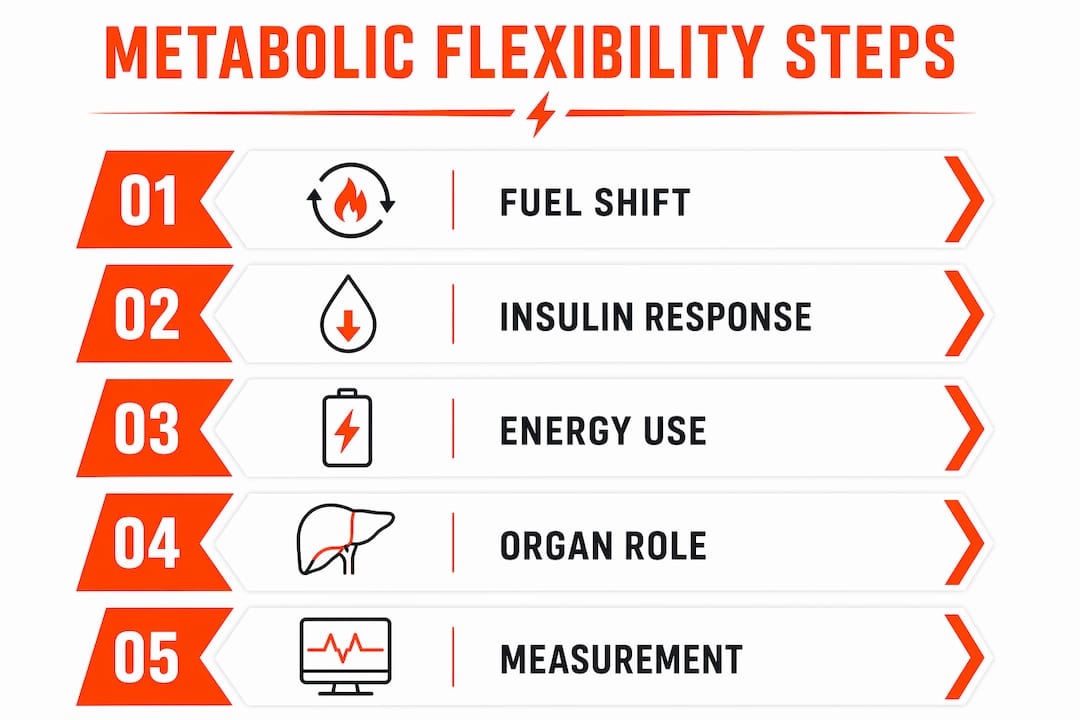
Metabolic flexibility is the physiological ability to match fuel oxidation to fuel availability. In plain terms, your body should burn glucose when carbohydrates are plentiful and shift to fat burning when glucose is scarce. This is not a passive process. It requires active coordination between hormones, organs, and mitochondria.
Insulin is the primary regulator. After a meal, rising insulin signals cells to take up glucose and suppress fat burning. During fasting or exercise, falling insulin levels release that suppression, allowing fatty acids to flow from adipose tissue into the bloodstream and into cells for energy. A metabolically flexible person makes this transition smoothly. A metabolically inflexible person stays stuck in one mode, often defaulting to glucose dependence even when fat stores are abundant.

The process involves multiple organs, not just skeletal muscle. The liver, heart, brain, and adipose tissue all participate in this systemic crosstalk. Skeletal muscle handles the bulk of glucose disposal during feeding and fat oxidation during fasting. The liver manages glucose output and ketone production. Adipose tissue controls fatty acid release. The brain monitors fuel signals and adjusts appetite and energy expenditure accordingly.
Mitochondria sit at the center of this system. They are the organelles that actually oxidize both glucose and fat. When mitochondrial function is impaired, the ability to switch substrates breaks down. Mitochondrial dysfunction directly impairs substrate oxidation balance, which is why metabolic flexibility serves as a reliable marker of mitochondrial health.
Key fuel sources and their roles:
Glucose: Primary fuel after meals, rapidly available, stored as glycogen in muscle and liver
Fatty acids: Dominant fuel during fasting, rest, and low-intensity activity
Ketones: Produced by the liver during extended fasting, used by the brain and heart as a glucose alternative
Lactate: Produced during high-intensity exercise, recycled as fuel by the liver and heart
Pro Tip: If you feel an energy crash two hours after a carbohydrate-heavy meal, that pattern often signals reduced fat-burning capacity. It is one of the earliest signs that your metabolic flexibility needs attention.
What factors affect metabolic flexibility?
Metabolic flexibility is not fixed. Multiple internal and external factors either sharpen or blunt your body’s fuel-switching ability.
Factors that impair metabolic flexibility:
Obesity and excess body fat: Excess adipose tissue releases inflammatory signals and free fatty acids that interfere with insulin signaling, reducing the body’s ability to shift fuel sources efficiently. Obesity and insulin resistance blunt fuel-switching capacity, often measurable as reduced respiratory quotient variance.
Insulin resistance: When cells stop responding normally to insulin, glucose uptake slows and fat oxidation stays suppressed even during fasting. The result is a body that cannot fully use either fuel.
Poor sleep quality: Even a single night of disrupted sleep increases circulating fatty acids and glucose variability, directly impairing next-day metabolic flexibility. Sleep is not optional for metabolic health.
Physical inactivity: Muscle is the primary site of glucose disposal. Sedentary behavior reduces muscle’s insulin sensitivity and its capacity for fat oxidation, narrowing the metabolic range.
Aging: Mitochondrial density and function naturally decline with age, reducing the efficiency of both glucose and fat oxidation. This makes age-related metabolic inflexibility a real clinical concern.
Chronic overfeeding: Consistently eating above energy needs keeps insulin elevated, which chronically suppresses fat burning and trains the body to rely on glucose.
The interaction between these factors compounds quickly. An older, sedentary person with poor sleep and excess body fat faces multiple simultaneous impairments to fuel switching. Addressing even one factor produces measurable improvement.
How is metabolic flexibility measured or assessed?
Measuring metabolic flexibility requires capturing how the body shifts fuel use in response to a defined metabolic challenge. The most established method is indirect calorimetry, which measures oxygen consumption and carbon dioxide production to calculate the respiratory quotient (RQ).
The RQ tells you what fuel the body is burning at any given moment. An RQ near 1.0 indicates almost pure carbohydrate oxidation. An RQ near 0.7 indicates almost pure fat oxidation. A metabolically flexible person shows a wide RQ range across different states, such as fasting versus fed, or rest versus exercise. A metabolically inflexible person shows a narrow, blunted range.
Common assessment approaches:
Fasting RQ measurement: Baseline measurement after an overnight fast captures resting fat oxidation capacity
Oral glucose tolerance test: Measures how quickly and completely the body shifts to glucose burning after a carbohydrate load
Exercise metabolic challenge: Measures fuel use during graded exercise to assess fat oxidation at different intensities
High-fat dietary challenge: Short-term high-fat feeding can reveal metabolic flexibility differences between individuals more effectively than acute exercise under controlled conditions
Assessment method | What it measures | Limitation |
Indirect calorimetry | RQ and substrate oxidation rates | Requires lab equipment |
Oral glucose tolerance | Insulin and glucose response | Does not directly measure fat oxidation |
Exercise challenge | Fat oxidation across intensities | Effort-dependent variability |
High-fat dietary challenge | Diet-induced fuel switching | Requires controlled feeding conditions |
No standardized clinical protocol currently exists for metabolic flexibility assessment. This limits widespread clinical use, but the field is actively developing more practical measurement tools. For now, indirect calorimetry combined with a metabolic challenge remains the gold standard in research settings.
What are the benefits of having good metabolic flexibility?
Good metabolic flexibility produces concrete, measurable improvements in how you feel and function every day.
Core benefits:
Stable energy levels: A body that burns fat efficiently does not depend on constant carbohydrate intake to maintain energy. You avoid the blood sugar spikes and crashes that drive afternoon fatigue and cravings.
Better glucose regulation: Metabolically flexible people respond to insulin more effectively, clearing glucose from the bloodstream faster and reducing the risk of type 2 diabetes.
Sustainable fat loss: Efficient fat oxidation means your body actually uses stored fat as fuel during fasting and low-intensity activity, rather than breaking down muscle or demanding more food.
Reduced cardiometabolic risk: Poor metabolic flexibility contributes directly to insulin resistance, metabolic syndrome, and increased cardiovascular risk. Improving it reduces all three.
Improved exercise recovery: Athletes with high metabolic flexibility spare glycogen during low-intensity work by burning fat, leaving more glucose available for high-intensity efforts.
“Metabolic flexibility is a precise physiological phenotype and a measurable marker for aging, inactivity, and impending cardiometabolic disease. Treating it as a wellness buzzword undersells its clinical significance.”
The energy stability benefit deserves special attention. People who struggle with metabolic inflexibility often describe feeling “stuck,” burning through carbohydrates inefficiently and failing to tap fat stores even during caloric restriction. This stuck metabolic state reflects mitochondrial dysfunction and explains why good dietary habits alone sometimes fail to produce expected results.
How can you improve your metabolic flexibility through lifestyle?
The most effective strategies for improving metabolic flexibility are also the most accessible. You do not need advanced protocols to start seeing results.
Proven lifestyle strategies:
Consistent overnight fasting: Allowing 12–14 hours between your last meal and breakfast gives your body a daily window to deplete glycogen and shift into fat oxidation. This is the primary driver of improvement before any advanced fasting protocol becomes necessary.
Aerobic exercise: Low to moderate intensity cardio, such as walking, cycling, or swimming, directly trains fat oxidation in muscle tissue. Aim for at least 150 minutes per week.
Strength training: Building muscle mass increases the body’s capacity for glucose disposal, improving insulin sensitivity and expanding the metabolic range.
Prioritizing sleep: Seven to nine hours of quality sleep stabilizes glucose regulation and prevents the fatty acid disruption that one poor night can trigger.
Reducing meal frequency: Eating fewer, well-spaced meals gives insulin levels time to fall between eating occasions, creating natural windows for fat burning.
Pro Tip: Start with the overnight fast before adding structured fasting protocols. Lifestyle fundamentals consistently outperform complex interventions for most people beginning their metabolic health work. A flexible fasting approach that fits your schedule produces better long-term results than a rigid plan you abandon in two weeks.
Diet composition also matters. Reducing refined carbohydrates and ultra-processed foods lowers the chronic insulin elevation that suppresses fat burning. You do not need to eliminate carbohydrates entirely. The goal is creating enough variation in fuel availability that your body practices switching regularly. Pairing dietary changes with fasting and hormonal optimization strategies accelerates the process by addressing the hormonal side of fuel regulation alongside the dietary side.
Key Takeaways
Metabolic flexibility is the body’s ability to switch between carbohydrate and fat burning, and improving it through fasting, exercise, and sleep is the most direct path to stable energy and better metabolic health.
Point | Details |
Core definition | Metabolic flexibility is the capacity to shift between glucose and fat as fuel sources based on availability and demand. |
Measurement standard | Indirect calorimetry with a metabolic challenge measures respiratory quotient, but no standardized clinical protocol exists yet. |
Key impairment factors | Obesity, insulin resistance, poor sleep, and inactivity all blunt fuel-switching capacity and compound each other. |
Top lifestyle strategy | Consistent overnight fasting of 12–14 hours is the most accessible first step before advanced protocols. |
Health protection | Good metabolic flexibility reduces risk of insulin resistance, metabolic syndrome, and cardiovascular disease. |
The most misunderstood thing about metabolic flexibility
Most people I talk to assume metabolic flexibility is about being on a strict low-carb diet. That framing misses the point entirely. Metabolic flexibility is not about avoiding carbohydrates. It is about training your body to handle both carbohydrates and fats well, and to switch between them without drama.
The people I see struggle most are not eating poorly by conventional standards. They eat balanced meals, they exercise occasionally, and they wonder why their energy is still erratic and their weight does not move. The missing piece is almost always the absence of any meaningful fasting window and chronically disrupted sleep. Those two factors alone can keep a person metabolically stuck regardless of what they eat.
The other misconception is that metabolic flexibility requires expensive testing or complex protocols. It does not. Your subjective experience of energy stability across the day, your hunger patterns, and your ability to skip a meal without cognitive impairment are all rough proxies for your metabolic state. Start paying attention to those signals before you invest in any formal assessment.
The research is clear that lifestyle fundamentals produce real, measurable improvements in fuel-switching capacity. The body responds to the signals you give it consistently. Give it regular fasting windows, physical stress through exercise, and adequate sleep, and it will adapt. That adaptation is metabolic flexibility, and it is within reach for most people without a single specialized intervention.
— Tony Lindsay
How ForgeFast supports your metabolic health
ForgeFast is built around the principle that sustainable fat loss and lasting energy come from training your metabolism, not just restricting calories.

The ForgeFast method integrates intermittent fasting with a structured lifestyle framework that addresses both the biological and psychological sides of metabolic change. The program focuses on building the consistent habits, including regular fasting windows, sleep discipline, and exercise patterns, that directly improve fuel-switching capacity over time. ForgeFast also emphasizes the mental side of fasting, helping you manage hunger signals and build the resilience that makes these habits stick long-term. If you are ready to put the science of metabolic flexibility into practice, ForgeFast provides the structure to make it work.
FAQ
What is the metabolic flexibility definition in simple terms?
Metabolic flexibility is the body’s ability to switch between burning carbohydrates and fats depending on what fuel is available. A flexible metabolism handles both fuels efficiently without getting stuck in one mode.
Why is metabolic flexibility important for weight management?
Metabolically flexible people burn stored fat effectively during fasting and low-intensity activity, which supports sustainable fat loss. Metabolic inflexibility keeps the body dependent on glucose, making fat loss harder even with a caloric deficit.
Can poor sleep really affect metabolic flexibility?
Yes. Even one night of poor sleep increases circulating fatty acids and glucose variability, directly impairing the body’s fuel-switching ability the following day.
How long does it take to improve metabolic flexibility?
Improvement timelines vary, but consistent overnight fasting, regular exercise, and quality sleep produce measurable changes in fuel-switching capacity within weeks for most people. There is no single fixed timeline because individual starting points differ significantly.
Is metabolic flexibility the same as being fat-adapted?
Fat adaptation is one component of metabolic flexibility, specifically the ability to oxidize fat efficiently. Full metabolic flexibility also includes the ability to switch back to glucose burning quickly when carbohydrates are consumed, making it a broader and more complete measure of metabolic health.
Recommended
Comments