Why Pre-Season Fasting Builds Your Metabolic Base
- Tony Lindsay
- Aug 2
- 9 min read


Pre-season fasting builds a metabolic and behavioral base by training cyclic metabolic switching and establishing repeatable fasting habits that carry forward into any training block or life change. Harvard Health confirms that gradual intermittent fasting approaches produce good adherence and cardiometabolic improvements, and ForgeFast packages that progression into a structured, app-guided experience built for busy schedules.
Three pillars make it work:
Biology: The metabolic switch, driven by ketone signaling and autophagy cycling, builds cellular resilience through alternating fasted and fed states.
Psychology: Identity-based habit framing (“I am someone who fasts”) reduces decision fatigue and converts short-term effort into lasting behavior.
Structure: Progressive eating windows, narrowed gradually over two to four weeks, prevent burnout and fit real workdays.
Table of Contents
What concrete benefits should you expect from a pre-season fasting block?
What does a practical pre-season fasting protocol look like?
How do you keep fasting intact through work, travel, and meetings?
How do habit design and behavioral scaffolds make the block stick?
Who should pause, consult a clinician, or skip a fasting block?
How does cyclic metabolic switching build a metabolic base?
Cyclic metabolic switching (CMS) is the alternation between a fasted, ketogenic state and a fed, anabolic state. Each cycle activates a distinct set of adaptive pathways: fasting triggers β-hydroxybutyrate signaling, autophagy, and mitochondrial stress responses; refeeding activates mTOR-driven growth and neuroplasticity. The Nature Metabolism CMS perspective frames this oscillation, not continuous caloric restriction, as the central mechanism behind fasting’s health benefits.
The metabolic switch from glucose to fat and ketone oxidation typically occurs between 12 and 36 hours, depending on liver glycogen stores and daily activity. Someone who ate a high-carbohydrate dinner and sits at a desk all morning will switch later than someone who trained fasted. That variability is why a pre-season block matters: repeated cycles train your body to reach the switch faster and more reliably over time.
Mitochondrial efficiency improves with each cycle, and preclinical and clinical evidence links intermittent fasting to improved neuroplasticity and reduced oxidative stress, which is why mental clarity often improves alongside metabolic markers.

Pro Tip: Light movement in the morning, a 20-minute walk or bodyweight circuit, depletes glycogen faster and pulls the metabolic switch earlier in the day. Pair it with a protein-rich refeed window in the evening to preserve muscle while encouraging switching.
What concrete benefits should you expect from a pre-season fasting block?
The benefits are real, but they arrive on a schedule. Expecting week-one results from week-four adaptations is the fastest route to quitting.
Improved metabolic flexibility (weeks 2–4): Your body shifts substrate use from glucose to fatty acids and ketones more fluidly. Intermittent fasting modifies tissue-specific immunometabolic responses and supports this flexibility independent of weight loss.
Steadier energy and blood glucose (weeks 1–3): Afternoon energy crashes flatten as insulin spikes from grazing are removed. Many people notice improved energy and blood glucose regulation before observing changes in body composition.
Clearer mornings and sharper focus (days 7–14): Ketone availability supports brain function. The cognitive lift tends to arrive before the metabolic adaptations fully consolidate.
Reduced grazing and stronger eating-pattern discipline (weeks 1–2): Compressing your eating window removes the low-stakes snacking decisions that accumulate across a workday.
Training readiness (week 4+): A body that accesses fat fuel efficiently performs better during early training blocks, especially at moderate intensities.
What does a practical pre-season fasting protocol look like?
A four-week block with gradual window narrowing is the right frame. Abrupt extremes produce early dropout; gradual integration improves long-term adherence and avoids the burnout that derails most first attempts.
Weekly progression windows
Week | Fasting / Eating Window | Sample Eating Hours | Notes |
1 | 12/12 | 7 AM – 7 PM | Baseline; establish the habit |
2 | 14/10 | — | Skip breakfast or delay it |
3 | 16/8 | 11 AM – 7 PM | Standard 16:8; most workdays fit |
4 | 16/8 + one 20 hr fast | Off day only | Extended fast on a low-demand day |
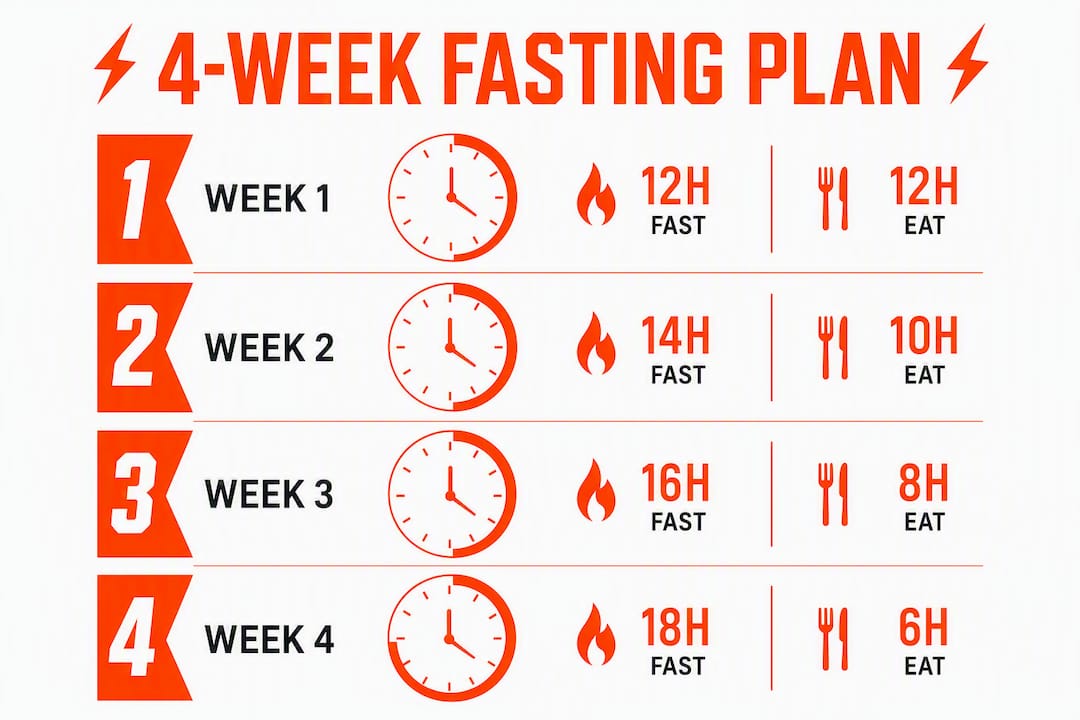
For intermittent fasting schedules built around professional calendars, the 16:8 window maps cleanly onto most workdays: black coffee through the morning, first meal at lunch, last meal by 7 PM.
Practical tips for calendar-driven schedules:
Schedule your longer weekly fast on a Saturday or Sunday when social obligations are predictable.
On travel days, default to the previous week’s shorter window rather than forcing a new one.
Keep electrolytes (sodium, magnesium, potassium) available during fasting hours to prevent headaches and fatigue.
Plan refeed evenings around protein and fiber, not high-glycemic carbohydrates, to avoid spiking insulin before sleep.
How do you keep fasting intact through work, travel, and meetings?
The core rule: protect sleep and cognitive performance first. A fast that wrecks a board presentation or a client call is not worth keeping. Schedule your longest fasts on low-demand days and treat the eating window as a flexible boundary, not a rigid wall.
Rules of thumb for common professional scenarios:
Early morning meetings: Delay the first meal rather than skipping it. Black coffee, sparkling water, or green tea hold most people through a 7 AM call without performance loss.
Client dinners: Shift the eating window earlier that day (10 AM – 6 PM) so the dinner falls inside it, or treat the dinner as the refeed and fast the following morning.
Cross-timezone travel: Anchor your eating window to the destination time zone from day one. Fasting through a flight is often the easiest option and reduces jet lag.
Fallback option: If a fast needs to pause, a 12/12 window is always the floor. One shortened window does not erase a week of adaptation.
Pro Tip: Pack a small travel kit: electrolyte packets, a protein bar for genuine emergencies, and a water bottle. Having the kit signals commitment and removes the “I had no choice” excuse that breaks streaks.
How do habit design and behavioral scaffolds make the block stick?
Outcome goals (“I want to lose 10 pounds”) collapse under schedule pressure. Identity goals (“I am someone who fasts”) survive it. That shift reduces the number of daily decisions you need to make, which is where most fasting attempts fail. Practitioner experience and habit research support identity-based framing combined with small, measurable wins as the most reliable path from short-term fasting to lasting behavior.
Practical behavioral tactics:
Habit stacking: Attach the start of your fast to an existing evening anchor, like brushing your teeth or closing your laptop.
Implementation intentions: Write “When I finish dinner on weeknights, I close the kitchen” rather than “I will fast.”
Environment design: Remove visible snacks from your desk and workspace during fasting hours.
Micro-commitments: Log each completed window in ForgeFast’s tracker. A visible streak is a stronger motivator than a distant goal.
ForgeFast’s guided progressions, scheduled reminders, and simple metrics dashboard directly support these tactics by removing the tracking burden and keeping the next step visible.
Weekly habit checklist:
Log fasting window daily (even partial completions)
Rate morning focus on a 1–5 scale
Complete one refeed meal with protein and vegetables
Review the week’s streak before setting next week’s window
Pro Tip: Early negative mood during fasting is common and usually transient. Pre-planning a small non-food reward for completing a window, a short walk, a podcast episode, reframes discomfort as intentional training rather than deprivation.
Who should pause, consult a clinician, or skip a fasting block?
Pre-season fasting is safe for most healthy adults, but not everyone. Intermittent fasting can act as a psychobiological stressor with variable effects on mood and emotional regulation, particularly in vulnerable individuals.
Pause or consult a clinician if you have:
A history of disordered eating or eating disorders
Type 1 diabetes or insulin-dependent type 2 diabetes
Pregnancy or breastfeeding
Medications that require food timing (certain antidepressants, metformin, blood pressure drugs)
Unstable cardiovascular conditions
Persistent mood destabilization beyond the first week of adaptation
Clinician-consult checklist: sync fasting windows with medication schedules before starting; flag significant unintended weight loss (more than one to two pounds per week beyond week one); stop if irritability or cognitive impairment persists past day ten.
This article is general information, not medical advice. Confirm your specific situation with a qualified clinician before starting any fasting protocol.
What should you track during a pre-season fasting block?
Track a small set of high-signal metrics. More data does not mean better decisions; it usually means more noise. For deeper biomarker ideas, ForgeFast’s science guide covers measurement frameworks in detail.
Minimum tracking kit:
Fasting window adherence: hours fasted vs. target, logged daily
Morning resting heart rate or HRV trend: a downward RHR or stable HRV suggests adaptation, not stress
Subjective focus and energy rating: 1–5 scale, logged at the same time each morning
Optional: blood glucose or ketone checks for those with monitors; expect glucose to trend lower and ketones to appear after week two
Expected directional changes: energy ratings typically improve by day 7–10; RHR may dip slightly by week three; ketone readings above 0.5 mmol/L confirm the metabolic switch is occurring.
Your 4-week pre-season fasting plan at a glance
A progressive four-week block narrows eating windows, introduces one extended fast in week four, and includes fallback options for low-tolerance days.
Week | Window | Extended Fast | Fallback |
1 | 12/12 | None | 12/12 always |
2 | 14/10 | None | 12/12 |
3 | 16/8 | None | 14/10 |
4 | 16/8 + 20 hr | One off day | 16/8 only |
Week-by-week checkpoints:
Week 1: Establish the window consistently. Focus on logging, not perfection.
Week 2: Notice morning energy. Delay breakfast by two hours on workdays.
Week 3: The 16:8 window becomes the default. Log focus ratings daily.
Week 4: Choose one low-demand day for the extended fast. Review the full four-week streak.
Sample workday (Week 3): black coffee at 7 AM, first meal at 11 AM (protein + vegetables), second meal at 5–6 PM, kitchen closed by 7 PM. For meal prep strategies that support this structure, batch-cooking two to three protein sources on Sunday removes the decision fatigue that breaks windows mid-week.
Key Takeaways
Pre-season fasting builds a metabolic and behavioral base by pairing cyclic metabolic switching with progressive habit design, producing measurable gains in metabolic flexibility, focus, and eating-pattern discipline within four weeks.
Point | Details |
CMS is the core mechanism | Alternating fasted and fed states trains cellular resilience and metabolic flexibility more effectively than continuous restriction. |
Progress gradually | Narrow eating windows over 2–4 weeks (12/12 → 16/8) to improve adherence and avoid burnout. |
Protect cognition and sleep | Schedule longer fasts on low-demand days; a broken window beats a broken presentation. |
Track a few high-value metrics | Log fasting adherence, morning focus rating, and resting heart rate trend daily for clear feedback. |
ForgeFast structures the block | ForgeFast’s guided progressions, reminders, and tracking dashboard implement this protocol for busy professionals. |
The habit-first case most fasting guides miss
The biology of cyclic metabolic switching is compelling, but the real reason a pre-season block works is simpler: it gives you a defined start, a defined end, and a repeatable structure before the pressure of a training block or life change arrives. Most people fail at fasting not because the science is wrong but because they start in the middle of a chaotic week with no scaffolding and no fallback plan.
What I find underappreciated is how much the identity shift matters relative to the protocol details. Whether you fast 14 or 16 hours in week two is far less important than whether you logged it, named it, and treated it as evidence of who you are becoming. The psychobiological research on fasting and emotional regulation makes this point clearly: structured protocols with psychological scaffolds outperform technically correct protocols without them. Gradual discomfort, framed as intentional training, builds the same resilience the metabolic switch builds at the cellular level.
Start this week with a single 14-hour fast. Log it. That one data point is the beginning of the base.
ForgeFast makes the pre-season block executable
Running a pre-season fasting block while managing a full calendar is where most self-directed attempts stall. ForgeFast closes that gap by packaging the progressive protocol, habit scaffolding, and daily tracking into a single guided experience built for professionals who cannot afford to improvise.

The app delivers week-by-week window progressions so you never have to decide what comes next, scheduled reminders anchored to your calendar, a simple metrics dashboard that surfaces focus and adherence trends at a glance, and behavioral coaching grounded in the identity-based habit frameworks the research supports. Every feature maps directly to a step in the four-week plan above.
Ready to run your first structured pre-season block? Start your ForgeFast free trial and have the protocol, the tracking, and the scaffolding in place before the week begins.
Useful sources
The cyclic metabolic switching theory of intermittent fasting, Nature Metabolism: The primary mechanistic framework explaining how alternating fasted and fed states drive cellular resilience and metabolic adaptation.
Time to try intermittent fasting? Harvard Health: Accessible clinical overview supporting gradual adoption, adherence data, and cardiometabolic benefits.
Intermittent Fasting and Emotional Regulation, MDPI Nutrients: Psychobiological framework covering mood variability, neuroendocrine responses, and the case for structured psychological scaffolds.
Timing of metabolic switch to ketosis, Obesity (Wiley): Evidence on the 12–36 hour switch range and how activity and glycogen stores modulate timing.
Intermittent fasting influences immunity and metabolism, Trends in Endocrinology & Metabolism00097-3): Covers metabolic flexibility, immunometabolic responses, and protocol-specific differences in ketogenic effect.
Neurobehavioural outcomes and brain inflammatory-oxidative responses to intermittent fasting, ScienceDirect: Reviews preclinical and clinical evidence linking fasting to neuroplasticity and cognitive outcomes.
Recommended
Comments