What Alternate Day Fasting Results Actually Look Like


Alternate day fasting typically produces moderate body weight loss over two to three months, with some randomized trials showing sustained loss at six to twelve months. Fat mass and visceral fat drop measurably in most trials, and several report improved triglycerides and modest LDL reductions alongside the weight change. The catch: a 1-year clinical trial published in JAMA found ADF was not statistically superior to plain daily calorie restriction, and the ADF group had a higher dropout rate than the daily restriction group.
That single trial reframes almost everything you’ll read about alternate day fasting results online. The method works. It just doesn’t work better than simpler approaches once you track people for a full year, and it seems to be harder to stick with.
Here’s the fast version of what the evidence shows:
Short term (8 to 12 weeks): weight loss commonly falls within a moderate range of starting body weight
Medium to long term (6 to 12 months): many trials show sustained weight loss similar to daily restriction
Body composition: visceral and total fat mass drop in MRI-based trials, with mixed effects on lean mass depending on protein intake
Cardiometabolic markers: triglycerides and some lipid panels improve; glucose and insulin sensitivity results are inconsistent
By the numbers: A meta-analysis of seven randomized trials covering participants found statistically significant reductions in body weight, BMI, fat mass, total cholesterol, LDL, triglycerides, and blood pressure among people following ADF compared with control groups.
None of this means ADF is a bad protocol. It means the honest pitch isn’t “fasting every other day melts fat faster than anything else.” It’s “fasting every other day works about as well as eating less every day, and whether it works for you depends almost entirely on whether you can actually follow it.”
TL;DR:
Alternate day fasting results in moderate short-term weight loss of 3% to 7%, which often plateaus after six to twelve months similar to daily calorie restriction.
Over a year, ADF shows no significant advantage over daily restriction, with both methods achieving around 5% to 6% total body weight loss.
MRI data indicates ADF significantly reduces visceral fat within four weeks, primarily due to a calorie deficit rather than metabolic adaptations.
Long-term adherence issues stem from feed-day overeating, reducing the overall calorie deficit and limiting fat loss, especially beyond the first few months.
Maintaining muscle mass during ADF requires careful feed-day planning, adequate protein intake, and consistent tracking of intake and body composition.
Table of Contents
What Do Clinical Studies Say About Weight Loss and Timeline?
The single most cited data point in ADF research comes from a year-long randomized controlled trial that followed metabolically healthy obese adults through three phases: weight loss, weight maintenance, and follow-up. At the 12-month mark, the ADF group lost an average amount of body weight similar to the daily-calorie-restriction group. The difference was not statistically significant, and cardioprotection markers (measured through lipid and cardiovascular risk factors) came out similarly matched between groups, according to the JAMA-published trial.
That’s a bigger deal than it sounds. Plenty of ADF marketing implies the every-other-day structure taps into some special fat-burning switch that daily dieting doesn’t. The best long-term human data available doesn’t back that up. Weight loss magnitude looked essentially the same whether people ate less every day or ate very little every other day.
Zoom into shorter windows and the picture gets more encouraging, at least on paper. Multiple randomized trials in the 8 to 12 week range report moderate weight loss, some showing losses around five percent by the two-month mark. The systematic review and meta-analysis pooling seven RCTs found these short and medium-term reductions in weight and BMI were statistically significant compared to non-fasting control groups, not just numerically different.
Why the range is so wide. A few factors explain why one trial reports 3% loss and another reports 7% over a similar window:
Baseline body weight and BMI: heavier participants tend to lose more absolute weight and sometimes a larger percentage in early weeks
Fast-day energy allowance: some protocols allow 500 calories on fast days, others use 25% of baseline needs, which changes the math
Whether feed days are ad libitum (eat what you want) or have some structure
Trial duration: shorter trials capture the steepest, most motivated phase of a diet before fatigue sets in
Sample size matters more than people assume. The meta-analysis behind the pooled results included 269 total participants across seven trials, 152 on ADF and 117 in control arms. That’s a reasonably solid evidence base for short and medium-term outcomes, but it’s not enormous. Individual trials inside that pool often ran with fewer than 40 people per arm, which is standard for nutrition science but means single-study percentages should be read as estimates, not guarantees.
Here’s a rough framework based on the pooled trial data:
Weeks 1 to 4: Rapid initial loss, partly water weight, partly genuine calorie deficit. Expect the scale to move fastest here.
Weeks 5 to 12: Loss continues but slows. This is where the 3% to 7% range from most short RCTs gets established.
Months 3 to 6: Rate of loss typically flattens further. Adherence starts to separate people who keep losing from people who plateau.
Months 6 to 12: In the year-long JAMA trial, cumulative loss settled around 6%, not far off where many people were at the three-month mark, suggesting a plateau rather than continued linear loss.
That last point deserves attention because it contradicts a common assumption. A lot of people expect alternate day fasting results to compound over a year, doubling or tripling the three-month number. The RCT data doesn’t support that. Weight loss tends to front-load, then flatten, which matches how most calorie-restriction methods behave regardless of the eating pattern used to create the deficit.
One nuance worth flagging: trials enrolling participants with obesity (BMI over 30) sometimes report different percentage losses than trials using nonobese or overweight populations. Higher baseline body fat generally correlates with larger absolute and percentage losses early on, partly because a bigger body has a bigger baseline energy expenditure to work with. If you’re reading a trial’s headline number, check who was actually enrolled before assuming it maps onto your own starting point.
How Does ADF Change Body Composition and Fat Distribution?
Weight loss on a scale doesn’t tell you what actually came off, and this is where more recent trials add real value. A 2025 randomized clinical trial used MRI-based measurement to compare alternate day fasting directly against time-restricted eating (TRE) and a control group over four weeks. The results favored ADF specifically for fat reduction: total fat volume dropped by 1,059.8 cm³ more than control and 695.7 cm³ more than TRE. Visceral fat volume, the metabolically active fat around organs linked to cardiovascular and diabetes risk, decreased by 111.5 cm³ versus control and 108.0 cm³ versus TRE.

That’s a meaningfully large signal for a four-week trial. Visceral fat is the fat depot most tightly linked to insulin resistance, inflammation, and cardiovascular risk, so a protocol that preferentially targets it carries more clinical weight than one that just moves the scale number.
Why did ADF outperform TRE here? The same trial measured energy intake and found ADF participants consumed 726 fewer calories per day than controls and 415 fewer than the TRE group. In other words, the fat-loss advantage wasn’t some unique metabolic trick, it tracked closely with how much less food people actually ate. That’s a useful reality check: the mechanism behind ADF’s fat-loss edge in this trial looks like calorie deficit, amplified by a structure that made a bigger deficit easier to hit.
Lean mass tells a messier story. Some short trials in the 8 to 12 week range report preserved fat-free mass alongside fat loss, particularly when protein intake stayed adequate on feed days. Other short trials show some reduction in lean tissue, and the meta-analysis pooling multiple RCTs found statistically significant reductions in lean mass as well as fat mass across the combined trial data, which is a detail easy to miss if you only read headline weight-loss figures.
What separates the trials with preserved muscle from the ones with lean-mass loss usually comes down to a handful of practical variables:
Protein intake on feed days (higher protein correlates with better lean-mass retention during any calorie deficit, fasting or not)
Resistance training or activity level during the trial period
Total trial duration, since longer restriction windows without intervention tend to erode more lean tissue
Whether fast days allowed a small amount of food (25% of energy needs) versus true zero-calorie fasting
The practical takeaway: ADF can absolutely produce meaningful visceral and total fat reduction, backed now by imaging data rather than just scale weight. Whether you keep your muscle while doing it depends far more on what you eat on feed days than on the fasting structure itself.
By the numbers: In the 2025 head-to-head trial, ADF reduced visceral fat volume by 111.5 cm³ more than control participants over just four weeks, a change measured directly through MRI imaging rather than estimated from body weight.
Which Blood Markers Actually Improve With Alternate Day Fasting?
Some biomarkers respond consistently to ADF across trials. Others barely move, or move in different directions depending on the study. Knowing which is which keeps you from over-promising results to yourself.
Markers that tend to improve reliably:
Triglycerides: multiple trials report meaningful reductions, with one 12-week trial showing a 20% drop in triacylglycerol
Total cholesterol and LDL: the pooled meta-analysis found statistically significant reductions across combined RCT data
Systolic and diastolic blood pressure: also significant in the pooled analysis
LDL particle size: one trial found particle size increased, generally considered a favorable shift toward less atherogenic particles
Markers with mixed or inconsistent results:
Fasting glucose and insulin sensitivity (HOMA-IR): many individual trials show no significant change, despite meaningful weight loss occurring alongside
HDL cholesterol: some trials show transient increases that don’t hold up consistently across the literature
Inflammatory and hormonal markers worth watching:
A handful of shorter trials report reductions in C-reactive protein (CRP), a general inflammation marker, alongside decreased leptin (the hormone that signals fullness and correlates with fat mass) and increased adiponectin (linked to improved insulin sensitivity) after several weeks of ADF. These changes are encouraging but come from smaller trials, so treat them as a promising signal rather than an established outcome.
One finding from the 2025 head-to-head trial deserves a specific callout because it’s easy to overlook: participants on ADF showed a statistically significant reduction in free triiodothyronine (FT3), a thyroid hormone involved in regulating metabolic rate, compared with the control group. This kind of change reflects the body’s normal adaptive response to a sustained energy deficit, not necessarily a problem, but it’s exactly the sort of shift a clinician would want to track in anyone doing ADF for an extended period rather than a few weeks.
Here’s the honest summary: lipid and blood pressure improvements are the most reproducible finding in ADF research. Glucose and insulin effects are far less consistent than fasting advocates often claim, and anyone using ADF specifically to manage or reverse insulin resistance should treat that as an open question rather than a settled benefit. Inflammatory marker improvements look real in early trials but need more data before anyone calls them reliable.
Does ADF Beat Daily Calorie Restriction or Time-Restricted Eating?
Short answer: it depends entirely on the timeframe you’re measuring and what you’re measuring it against.
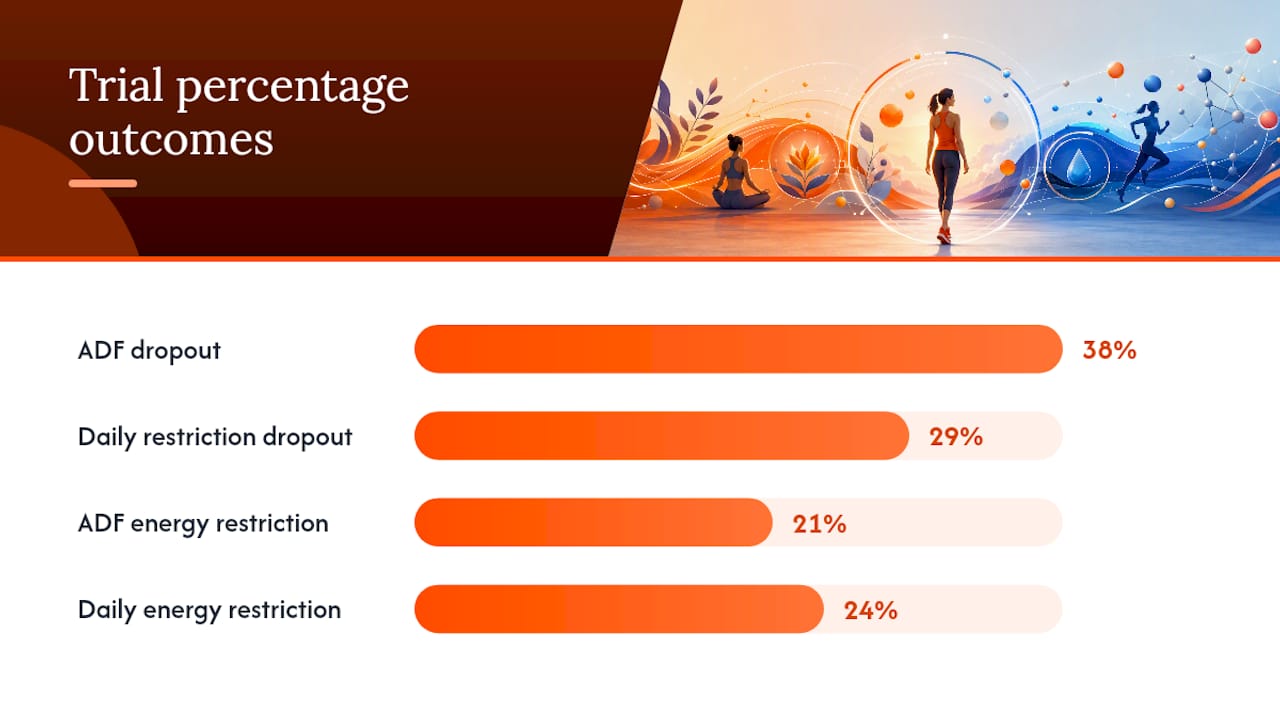
Versus daily calorie restriction, over a full year: no meaningful edge. The year-long JAMA-published RCT found ADF produced 6.0% weight loss compared to 5.3% for daily restriction, a difference too small to call statistically significant. Cardioprotective markers tracked similarly between groups. The one place ADF looked worse: adherence. The ADF arm had a 38% dropout rate versus 29% in the daily-restriction group, and mean achieved energy restriction from baseline to month six was about 21% for ADF versus 24% for daily calorie cutting. People assigned to eat less every day actually hit their targets more consistently than people assigned to fast every other day.
Versus time-restricted eating, over four weeks: ADF pulled ahead, and by a fairly clear margin. The 2025 randomized trial found ADF produced larger reductions in whole-body fat mass and visceral fat than TRE, with total fat volume dropping 695.7 cm³ more on ADF. The likely driver: ADF participants ate 415 fewer calories per day than the TRE group over the same window. TRE restricts when you eat within a day; ADF restricts how much you eat on alternating days, and in this trial that structural difference produced a bigger spontaneous calorie deficit.
Why do these two trials point in different directions? Trial length is the biggest factor. Four weeks captures ADF at its most motivating and least fatiguing, before dropout and compensatory eating have time to erode the deficit. A full year captures what actually happens once novelty wears off, work schedules interfere, and skipping food every other day starts to feel like a grind rather than a challenge.
Short trials favor ADF because compliance is easiest early on and the fasting structure forces a bigger immediate deficit
Long trials narrow the gap because adherence degrades, and a protocol that’s harder to sustain loses its structural advantage over time
TRE’s more moderate restriction pattern may be easier to maintain long-term even if it produces a smaller deficit per week
None of this makes ADF the wrong choice. It means the honest framing is “highly effective in the short term, roughly equivalent to simpler methods over the long haul, and success depends heavily on whether you can actually stick with the every-other-day structure past the first few months.” That’s a very different pitch than “ADF outperforms everything,” and it’s the one the actual trial data supports.
Why Do Alternate Day Fasting Results Vary So Much From Person to Person?
Two people can follow “the same” ADF protocol and get very different outcomes, and the reason almost always traces back to what happens on feed days, not fast days.
Protocol differences change the math before you even start. The term “alternate day fasting” covers a range of actual eating patterns in the research literature:
Modified ADF: roughly 25% of baseline energy needs on fast days (typically 500 to 600 calories), unrestricted eating on feed days
True ADF: zero or near-zero calories on fast days, less common in trials because adherence tends to be lower
Ad libitum feed days: eat freely with no calorie target, common in early trials
Structured feed days: a rough calorie target or macro guidance provided, less common but shows better deficit maintenance in some trials
If feed-day intake creeps up even modestly, the fast-day deficit gets erased fast.
This is exactly what trial data shows happening. In the year-long JAMA trial, researchers tracked actual energy intake against prescribed targets and found participants on ADF ate more than prescribed on fast days and less than prescribed on feed days, a pattern that compressed the overall deficit compared to what the protocol called for on paper. Mean achieved restriction was lower than intended and below what the daily-calorie-restriction group achieved. Dropout compounded the problem: 38% of the ADF group left the trial before completion.
How to close the gap between trial theory and your own results:
Pre-plan feed-day meals rather than deciding in the moment, since unstructured “eat whatever” feed days are where most of the intended deficit disappears.
Prioritize protein on both fast and feed days to protect lean mass, given that pooled trial data shows lean mass reductions alongside fat loss in several studies.
Track intake for at least the first few weeks, even loosely, since self-monitoring is one of the most consistent adherence predictors in behavior-change research.
Ramp up gradually rather than jumping straight into a strict every-other-day schedule, which reduces the shock that often triggers early dropout.
Use structured coaching or habit tracking instead of relying on willpower alone, since consistency, not the specific protocol, is usually what separates people who keep the weight off from people who regain it.
Pro Tip: *Log your feed-day intake for just the first two weeks, even roughly.
What Timeline and Metrics Should You Actually Track?
Trial data gives you a reasonable set of benchmarks, as long as you don’t expect your own numbers to match a study average exactly.
Weeks 1 to 4: Expect the scale to move fastest here, driven partly by water weight and partly by genuine deficit. Don’t extrapolate this rate forward, it won’t hold.
Weeks 8 to 12: This is where most short RCTs land their headline numbers, typically 3% to 7% total body weight loss depending on starting point and protocol adherence.
Months 6 to 12: Based on the year-long RCT, expect loss to flatten rather than keep climbing, with cumulative totals often settling around 5% to 6%, similar to what daily calorie restriction achieves over the same window.
What to actually measure, and how often:
Body weight: weigh under consistent conditions (same time, similar clothing) two to three times a week rather than daily, since day-to-day fluctuation from water and food volume can obscure the real trend
Waist circumference: measure every two to four weeks; this tracks visceral fat changes more directly than the scale does, and visceral fat is the depot most linked to the cardiometabolic improvements seen in the imaging trials
Body composition testing (DEXA or similar): every 8 to 12 weeks if accessible, since this is the only reliable way to distinguish fat loss from lean-mass loss, a distinction the scale can’t make
By the numbers: MRI-based trials measuring fat volume directly found visceral fat reductions of over 100 cm³ in just four weeks, a change that wouldn’t necessarily show up as a dramatic scale-weight shift over the same period.
Lab markers worth discussing with a clinician, particularly if you’re planning to continue ADF beyond a few months: fasting lipid panel (triglycerides, LDL, HDL), fasting glucose and HbA1c, and thyroid function including FT3, given the reduction observed in at least one recent trial. None of these require monthly testing, but a baseline and a follow-up at three to six months gives you real data instead of guesswork.
Who Should Avoid ADF or Get Medical Clearance First?
Alternate day fasting isn’t risk-free for everyone, and the trial populations that generated the results above were generally healthy adults screened before enrollment. That screening matters more than people realize.
Get medical clearance before starting, or avoid ADF entirely, if you fall into any of these groups:
Pregnant or breastfeeding, since energy and nutrient needs during this period are elevated and poorly suited to alternating deep restriction
Taking insulin or other glucose-lowering medications, where skipping substantial calories on fast days raises real hypoglycemia risk
Living with or recovering from an eating disorder, since structured restrict/refeed cycles can reinforce disordered patterns
Managing type 1 diabetes or any condition requiring tightly timed medication or food intake
Taking medications that require food for proper absorption or that carry stomach-related side effects on an empty stomach
Adverse effects reported in trials, while generally mild in the healthy adult populations studied, included headaches, irritability, and hunger, particularly in the first two to three weeks before adaptation. The reduction in FT3 noted in the 2025 trial is a reminder that longer-term ADF warrants periodic lab monitoring rather than a “set it and forget it” approach.
Practical safety steps that cost nothing and reduce risk:
Get baseline labs and a quick check-in with your doctor before starting, especially if you take any regular medication
Ramp up gradually rather than jumping into full alternate-day fasting in week one
Prioritize hydration and electrolytes on fast days, since headaches often trace back to dehydration rather than the calorie deficit itself
Keep protein intake steady across both fast and feed days to protect lean mass and reduce the irritability that comes with very low protein on restricted days
How ForgeFast Turns Trial Evidence Into Daily Habits
The gap between what a clinical trial can show and what actually happens in someone’s kitchen at 9 p.m. on a Tuesday is where most fasting attempts fall apart. The fasting structure worked. Sticking to it didn’t.
ForgeFast’s habit-coaching framework treats that adherence gap as the actual problem to solve, not the fasting schedule itself. That means building progressive milestones instead of demanding a perfect every-other-day routine from day one, and pairing fasting protocols with structured tracking so feed-day overeating, the exact pattern that eroded results in trial data, gets caught early instead of discovered three months later on a stalled scale.
Practically, that looks like:
Structured fast-day and feed-day templates instead of “eat whatever you want” on off days
Progress tracking tied to specific metrics (weight trend, waist measurement, energy levels) rather than daily scale obsession
Mental-resilience coaching aimed at the psychological friction of restriction, since irritability and hunger in weeks one through three are the most common reason people quit early
Pro Tip: Build feed-day meals around a protein target first, then fill in the rest. Trial data consistently links adequate protein intake to better lean-mass preservation during any calorie deficit, fasting or otherwise, and it’s the single easiest lever to control.
For readers who want a structured path through the adherence problem rather than another list of tips to remember, ForgeFast’s fasting and habit-coaching program builds the tracking and behavioral scaffolding directly into the protocol, so the plan adjusts to real life instead of assuming perfect compliance.
Key Takeaways
Alternate day fasting produces meaningful short-term fat loss largely comparable to daily calorie restriction over a full year, with adherence as the deciding factor in long-term success.
Point | Details |
Expect 3% to 7% short-term loss | Most 8 to 12 week trials report this range, with results often flattening by the one-year mark. |
No proven long-term edge over daily restriction | The year-long RCT found 6.0% loss for ADF versus 5.3% for daily calorie restriction, not a significant difference. |
Visceral fat responds well | MRI-based trials show visceral fat reductions over 100 cm³ in just four weeks, outperforming time-restricted eating. |
Feed-day overeating erodes results | Trial participants often ate more than prescribed on fast days and less on feed days, shrinking the intended deficit. |
Protein and tracking protect lean mass | Structured feed-day meals and consistent monitoring help preserve muscle during the fasting-induced deficit. |
Primary Research Behind This Article
Effect of Alternate-Day Fasting on Weight Loss, Weight Maintenance, and Cardioprotection Among Metabolically Healthy Obese Adults, a year-long randomized clinical trial
Health Effects of Alternate-Day Fasting in Adults: A Systematic Review and Meta-Analysis, pooling seven RCTs
Alternate-day fasting elicits larger changes in fat mass than time-restricted eating in adults without obesity, a 2025 randomized trial
Alternate day fasting for weight loss in normal weight and overweight subjects, a shorter randomized controlled trial
An Editorial Take on What the Evidence Actually Supports
Most ADF content online treats the protocol as if it has a metabolic superpower daily dieting lacks. The year-long JAMA trial quietly dismantles that idea: no significant advantage over daily calorie restriction, and worse adherence to boot. That’s not a knock on fasting. It’s a correction to marketing that outran the data.
Where the conventional advice falls short is adherence. The protocol that wins isn’t the one with the best physiology on paper. It’s the one you’re still doing in month nine.
If I had to prioritize one thing for someone starting ADF, it wouldn’t be the fast-day calorie target. It would be a feed-day plan and a way to track whether you’re actually following it. The trials that show real results are the ones where people stuck close to the protocol. The ones that flatten out are the ones where feed days quietly absorbed the deficit. That’s a solvable problem, and it has almost nothing to do with fasting biology.
— Tony Lindsay
This article is general information, not a substitute for advice from a qualified doctor. Consult a qualified healthcare professional about your own circumstances before acting on anything here.
Sources
Recommended
Comments