Three 20 Hour Fasts Weekly Raised Autophagy in Humans


The most consistent evidence points to early cellular cleanup signals appearing somewhere between 12 and 24 hours of fasting, with more measurable autophagy activity showing up around the 24 to 48 hour mark. Almost all of those specific hour numbers come from rodent studies, not human trials, so treat them as a rough map rather than a stopwatch. What human research does show is that repeating shorter fasts consistently over months raises autophagic flux more reliably than chasing a single long fast. If you’re considering anything past 48 hours, talk to a doctor first.
TL;DR:
Human evidence shows autophagy gene expression increases after at least two weeks of consistent 17 to 19 hour daily fasting, not a single long fast.
Animal studies suggest autophagy starts at 24 to 48 hours, but direct human confirmation is limited and relies on indirect markers like gene expression.
The most reliable human protocol for triggering autophagy involves fasting for about 20 hours, several times weekly, rather than longer, more risky fasts.
Factors such as exercise and low insulin levels can accelerate autophagy activation, while protein intake and certain medications can delay it.
Monitoring hydration, electrolytes, and medical guidance is essential, especially beyond 24 hours, to avoid risks like hypoglycemia and electrolyte imbalance.
Table of Contents
What Is Autophagy, and Why Does Fasting Duration Matter?
Autophagy is your cells’ recycling system: a process where damaged proteins, worn-out organelles, and cellular debris get broken down and repurposed. The term comes from Greek roots meaning “self-eating,” which sounds alarming until you understand it’s closer to spring-cleaning than starvation at the cellular level. Researchers care about fasting duration specifically because autophagy is nutrient-sensitive. When glucose and amino acids are abundant, the body suppresses autophagy in favor of growth and storage. Pull those nutrients away for long enough, and the cellular cleanup machinery switches on.
That switch doesn’t flip instantly, and it doesn’t flip the same way in every tissue. Here’s what the fasting timeline looks like hour by hour, based on the strongest available evidence.
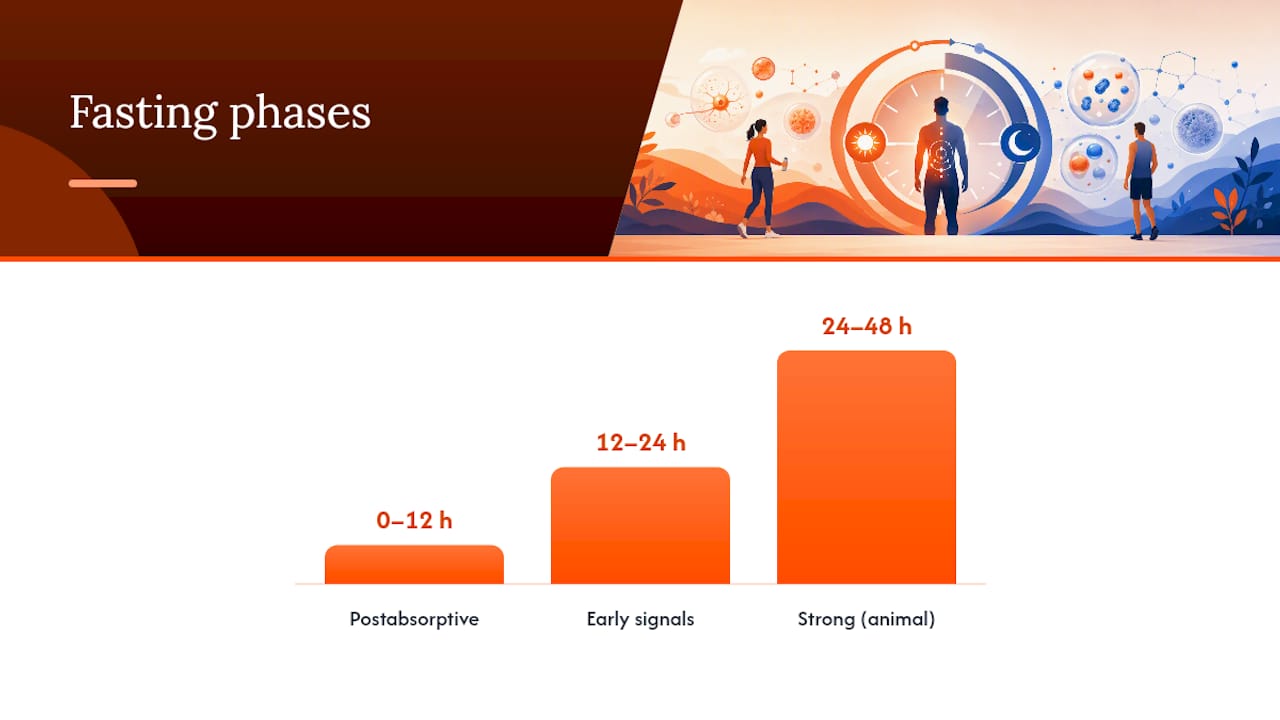
0 to 12 hours: postabsorptive, not yet fasting in the metabolic sense. Your body is still working through glycogen stores from your last meal. Insulin remains elevated enough to keep mTOR (the master growth-signaling pathway that suppresses autophagy) active. Nothing meaningful is happening on the autophagy front yet, regardless of what a fasting app’s countdown timer implies.
12 to 24 hours: early signals become plausible. Glycogen depletion picks up, insulin drops further, and AMPK (the cellular energy sensor that activates autophagy) starts to engage. A 2023 exploratory study found that healthy young men fasting 17 to 19 hours daily for 30 days showed measurable increases in autophagy-related gene expression, including ATG5, ULK1, and BECN1, after about two weeks of consistent practice. That’s a meaningful data point precisely because it’s one of the few pieces of direct human evidence in this window, and it suggests repetition matters as much as the single fast’s length.
24 to 48 hours: the window most animal research points to. This is where the oft-cited “autophagy starts at 24 to 48 hours” claim actually comes from, and it’s worth being honest about the source. Cleveland Clinic’s overview of autophagy notes that animal studies generally place autophagy onset in this range, while cautioning that direct human confirmation is limited. Rodent work backs this up in striking detail: a widely cited study on short-term fasting in mice found profound neuronal autophagy changes tied to food restriction, with strong signals appearing by roughly 48 hours in some conditions. Neurons are notoriously slow to show autophagic change compared to liver or muscle tissue, so seeing it there at all is a meaningful marker of how deep the fasting response can go.
48 to 72 hours: deeper mechanisms start engaging, at least in animals. Beyond generic macroautophagy, longer fasts in preclinical models start recruiting chaperone-mediated autophagy (a more selective cleanup pathway) and mitophagy (the targeted clearing of damaged mitochondria). Human data at this duration is close to nonexistent for ethical and practical reasons; nobody wants to run a controlled 72-hour fasting trial with tissue biopsies on healthy volunteers unless there’s a strong clinical justification.
Beyond 72 hours: theoretically more clearing, practically more risk. Some proponents argue that multi-day fasts push autophagy into additional cellular compartments. Maybe. But the risk profile changes sharply here, with electrolyte imbalances, muscle protein breakdown, and hypoglycemia becoming real concerns rather than hypotheticals. Any fast in this range belongs under medical supervision, full stop.
0 to 12 h: Still digesting; mTOR active, autophagy suppressed.
12 to 24 h: Early gene-expression shifts documented in humans with consistent daily practice.
24 to 48 h: The animal-derived “autophagy window” most articles reference; strong rodent neuronal data.
48 to 72 h: Chaperone-mediated autophagy and mitophagy engage in preclinical models; human evidence thin.
72 h+: Possible deeper clearing, but risk rises faster than benefit for most people.
Quick take: the 2023 gene-expression study is one of the few pieces of research showing autophagy-related changes in living humans tied to a specific fasting duration, and it took two weeks of daily 17 to 19 hour fasts to show up. That’s the closest thing to a real number this field has, and it still required weeks of repetition, not one long fast.
Why Human and Animal Autophagy Research Don’t Line Up
Almost every specific “autophagy starts at hour X” claim you’ve read traces back to a mouse, a rat, or a petri dish. That’s not a knock on the research. It’s just a fact about how autophagy gets measured, and it explains why human timelines feel so much fuzzier than the confident graphics floating around social media.
In animals, researchers can euthanize the subject at a precise timepoint and directly examine tissue for autophagosome counts, LC3 protein conversion, or p62 degradation, all direct markers of active autophagy. That’s exactly how the neuronal autophagy study in mice got its 48 hour data point. You obviously can’t do that with a person who wants to keep living and using their brain.
Human researchers instead rely on indirect proxies:
ATG gene expression in blood samples, tracking whether genes like ATG5, ULK1, and BECN1 are being transcribed more actively.
Autophagic flux measurements in peripheral blood mononuclear cells (PBMCs), which estimate how fast the autophagy pathway is cycling rather than just whether related genes are switched on.
Circulating markers like LC3-II levels, though these are noisier and less standardized across labs.
None of these give you a clean “autophagy started at hour 19” readout. They show trends, and trends need repetition and statistical power to mean anything. That’s precisely why the strongest human evidence in this field comes from repeated-protocol trials rather than single fasting episodes.
The 2025 randomized controlled trial is the clearest example. Researchers had participants fast for 20 hours, three times per week, for six months, and compared autophagic flux against a standard-care control group. The intervention group showed increased autophagic flux over the course of the trial. No single fast in that study proved anything on its own; it was the accumulated, repeated exposure that produced a measurable shift. A related exploratory analysis published via the Journal of Physiology reinforces the same conclusion: intermittent time-restricted eating sustained over months, not one dramatic fast, is what moved the needle on autophagic flux in living people.
That’s the core misconception worth correcting. An animal study showing “autophagy at 24 to 48 hours” is describing what happened in a specific tissue in a specific rodent under specific lab conditions. It is not a promise that a human’s liver, muscle, and neurons all cross some autophagy threshold at hour 36 like clockwork. Different tissues respond at different rates even within the same animal, and human metabolism, body composition, and genetics add another layer of variability on top. Treat hour-based claims as directional evidence, not a countdown timer.
Which Fasting Protocol Actually Triggers Autophagy?
Given the uncertainty, the practical question becomes which fasting schedule gives you the best realistic shot at engaging autophagy without unnecessary risk. Here’s how the common protocols stack up, roughly in order of intensity.
12 to 16 hours (16:8 style). This is the entry point most people start with, and it’s unlikely to produce dramatic autophagy on its own. What it does reliably deliver is lower insulin and improved metabolic flexibility, both of which set the stage for autophagy to activate more easily once fasting windows extend. Think of this as the on-ramp, not the destination.
18 to 20 hours. This is where things get more interesting. The 2023 daily fasting study used a 17 to 19 hour window and found gene-expression changes after two weeks of consistency. This range asks more of you (skipping breakfast and often lunch) but stays manageable for most healthy adults with practice.
20-hour periodic fasting, several times per week. The strongest human RCT evidence sits here. The 2025 trial used exactly this structure, three 20-hour fasts weekly for six months, and produced measurable increases in autophagic flux. This protocol demands real planning around meal timing and social schedules, but it’s the closest thing to a validated human autophagy protocol currently available.
24 to 48 hour fasts. This moves into advanced territory. Animal evidence suggests stronger autophagy engagement in this window, but the practical risks (dizziness, poor sleep, irritability, and for some people genuine hypoglycemia) climb noticeably. This isn’t a protocol to attempt without prior fasting experience.
Occasional multi-day fasts (72+ hours). Reserve these for supervised settings only. The potential cellular benefits are speculative at best relative to the documented physical strain, and electrolyte management becomes genuinely important rather than a nice-to-have.
Progression matters more than ambition here. Start by nailing a consistent overnight fast, typically 12 hours, before extending anything. Add light exercise once your body adapts, since movement during a fasted state appears to support metabolic flexibility without excessive stress. Then stretch your fasting window in small increments, maybe an hour every week or two, rather than jumping from 14 hours to 20 overnight.
Consistency beats duration. Three 20-hour fasts a week for six months produced human autophagy data; a single heroic 40-hour fast did not, because it was never tested that way. Guides like ForgeFast’s intermittent fasting schedules for busy professionals walk through how to build that repetition into a realistic weekly routine rather than treating fasting as an occasional stunt.
Muscle preservation deserves specific attention as your windows extend. Resistance training two to four times weekly helps offset the catabolic pressure of longer fasts, and hitting adequate protein within your eating window (rather than skipping it entirely) protects lean mass without meaningfully blunting the autophagy benefits of the fast itself. A closer look at fasting protocols built for competitive athletes breaks down how to sequence training and fasting so one doesn’t sabotage the other.

Pro Tip: Track your hydration and sodium intake as seriously as your fasting hours. Most of the “I feel terrible on hour 18” reports trace back to electrolyte depletion, not autophagy discomfort, and a pinch of salt in water solves it faster than ending the fast early.
What Speeds Up or Slows Down Autophagy Onset
Fasting duration is only one variable. Several everyday factors shift how quickly your body engages autophagy, and it’s worth knowing which ones have solid backing versus which are more theory than proof.
Exercise (moderate to high confidence). Physical activity during a fast appears to accelerate AMPK activation, the same pathway that fasting itself triggers, based on mechanistic reviews of nutrient-sensing pathways. Fasted cardio or light training sessions may nudge autophagy signals earlier than fasting alone.
Protein and amino acid intake (high confidence, works against you). Even small amounts of protein, particularly leucine-rich foods, reactivate mTOR and can pause autophagy signaling almost immediately. This is why a “dirty fast” with cream in your coffee isn’t purely cosmetic; it meaningfully resets the clock on nutrient-sensing suppression.
Insulin levels (high confidence). Elevated insulin directly suppresses autophagy through mTOR activation, which is why anyone on insulin therapy or with significant insulin resistance may see delayed or blunted autophagy onset compared to a metabolically healthy person fasting the same number of hours.
Medications (moderate confidence, highly individual). Certain drugs that activate mTOR signaling or affect glucose metabolism can interfere with fasting-induced autophagy. Anyone on chronic medication should discuss fasting plans with their prescriber rather than assuming standard timelines apply.
Age (low to moderate confidence). Some research suggests autophagic responsiveness declines with age, though human data quantifying this by specific fasting hour is sparse. This is more a “expect somewhat slower or blunted responses” note than a precise recalculation.
The mechanistic thread tying all of this together is mTOR inhibition paired with AMPK activation, the two switches that determine whether your cells are in growth mode or cleanup mode. Anything that keeps mTOR active, whether it’s a splash of cream, an insulin spike, or certain medications, pushes autophagy further out regardless of how many hours your fasting app says you’ve logged.
Can You Actually Measure Autophagy Yourself?
Not with anything you can buy at a pharmacy, and it’s worth being blunt about that upfront. The gold-standard measures, ATG gene expression panels and autophagic flux assays in peripheral blood mononuclear cells, are lab and research tools, not consumer products. They require blood draws, specialized processing, and controlled comparison groups to mean anything statistically.
That gap between what researchers measure and what a fasting app can tell you is significant, and no consumer device currently closes it. Because validated noninvasive biomarkers for autophagy in living humans remain limited, most of the specific hour thresholds people repeat are extrapolated from animal and cell studies rather than confirmed in real time in a real person.
What you can observe at home are indirect, imperfect proxies:
Rising ketone levels, which signal you’ve shifted into fat oxidation, a metabolic state associated with (but not proof of) increased autophagy activity.
Lower fasting insulin, trackable with a home glucose or ketone meter over time, which reflects reduced mTOR activation pressure.
Subjective mental clarity or reduced hunger after adaptation, which many long-term fasters report anecdotally but which has no direct causal link to autophagy specifically.
None of these confirm autophagy is happening at a cellular level. They’re compatible with it, which is a meaningfully weaker claim. If you want actual autophagy data on your own biology, participation in a clinical research study is currently the only route, or working with a physician who can order specialized testing for a specific medical reason. For everyday fasting, treat ketones and insulin trends as general metabolic feedback, not autophagy confirmation.
Who Should Avoid Extended Fasting, and What Are the Warning Signs?
Longer fasts aren’t universally appropriate, and pretending otherwise is how people get hurt chasing a cellular process they can’t even directly verify is happening. A few groups should avoid extended fasting entirely, and everyone else should know the stop signs.
People who should not attempt extended fasts:
Pregnant or breastfeeding individuals, whose nutrient needs are elevated and non-negotiable.
Anyone with a history of an eating disorder, for whom structured fasting can reinforce harmful patterns.
People with Type 1 diabetes or others on insulin therapy, given the sharp hypoglycemia risk.
Anyone on medications affecting blood sugar, blood pressure, or nutrient-sensing pathways without physician guidance.
People with a history of adrenal or significant hormonal disorders.
Common acute risks during extended fasts include hypoglycemia (dizziness, shakiness, confusion), electrolyte imbalance (muscle cramps, irregular heartbeat, severe fatigue), and dehydration compounded by inadequate sodium intake. None of these are rare edge cases; they’re the predictable physiology of extended nutrient withdrawal.
Practical safety steps worth building into any fast beyond 24 hours: get a medical check-in if you have any underlying condition, maintain electrolyte intake throughout (not just at the end), plan a gradual, supervised refeeding after multi-day fasts rather than a large meal, and know your stop signals: chest pain, fainting, confusion, or a heart rate that feels wrong all mean stop and seek care immediately. A rundown of common fasting mistakes professionals should avoid covers several of these failure points in more detail.
Pro Tip: If you’re new to extended fasting, do your first 24-hour attempt on a weekend with nothing scheduled. Discomfort that would be manageable on a quiet Saturday can turn into a real problem during a stressful workday.
This article is general information, not a substitute for individualized medical guidance, particularly for anyone considering fasts beyond 24 hours.
How ForgeFast Turns This Research Into a Repeatable Habit
Everything above points to the same practical conclusion: consistency beats heroics. ForgeFast’s structured intermittent fasting methodology is built around that exact finding, guiding people through gradually extending fasting windows rather than jumping straight to an ambitious multi-day attempt with no runway.
The platform pairs its fasting protocols with habit frameworks and mental-discipline coaching, because sticking with an 18 to 20 hour fasting window three times weekly for months (the pattern behind the strongest human autophagy trial data) is a behavioral challenge as much as a biological one. ForgeFast also emphasizes overnight fasting as the foundation for muscle repair and recovery, plus meal-prep strategies that support proper refeeding after longer fasting windows.
None of this replaces medical care. ForgeFast is an implementation tool for people who want structure and accountability around evidence-aligned fasting habits, not a substitute for clinical oversight, especially for anyone considering fasts beyond the 24-hour mark.
The Honest Gap Between Autophagy Hype and Autophagy Evidence
Autophagy has become a wellness buzzword partly because it sounds precise: a clean number of hours, a clear biological switch, a promise you can plan around. The real evidence is messier than that, and I think that messiness is actually the more useful takeaway. Most of the confident hour-by-hour claims you’ll see elsewhere are animal data wearing human clothing.
That’s not a reason to dismiss fasting’s cellular benefits. It’s a reason to stop chasing a specific hour and start building a repeatable pattern, since that’s what the actual human trials rewarded. Start conservative, extend gradually, and treat consistency as the variable you control. Track how you feel, how your fasting windows evolve, and whether your energy improves over months, not hours. If you’re drawn to anything past 24 hours, loop in a clinician before you loop in a calendar.
— Tony Lindsay
Get Started With Structured, Evidence-Aligned Fasting
Reading about 20-hour protocols and gene-expression studies is one thing. Actually sticking to a fasting window three times a week for six months, the pattern behind the strongest autophagy evidence in humans, is a different challenge entirely, and it’s the one most people underestimate. ForgeFast exists specifically for that gap: a structured intermittent fasting program that builds the habit infrastructure and psychological coaching around your fasting windows, so you’re not relying on willpower alone at hour 17.

The ForgeFast platform helps you progress from a basic overnight fast toward the more demanding windows this article covers, with tracking and habit support built in at every stage. If you’re weighing which app fits your training routine, a comparison of strength and coaching apps can help you pair resistance training with your fasting schedule. None of this replaces a doctor’s input, particularly for fasts beyond 24 hours, but it does give you a real framework for the part science says actually matters: showing up consistently. Visit ForgeFast to start with a structured plan built around your current fasting experience.
Sources
Recommended
Comments