Breaking the Binge Restrict Cycle: What Actually Works


The binge restrict cycle is a self-reinforcing loop where undereating or forbidding certain foods creates intense physical and psychological pressure that erupts into a binge, followed by shame that triggers more restriction. The single most important move to break it: stop compensating with food restriction after a binge and replace it with consistent, nonpunitive meals and snacks on a predictable schedule. If episodes happen weekly or are causing real distress, that’s the point to bring in a therapist or dietitian rather than trying to white-knuckle it alone.
TL;DR:
Most studies find that nearly 70% link restrictive dieting to increased frequency and severity of binge episodes, with fasting doubling the risk.
Breaking the cycle requires consistent, nonpunitive meals spaced every three to four hours, not restrictive or rule-based eating.
Hormonal changes driven by restriction, stress, and poor sleep trigger intense hunger and cravings that perpetuate the binge restrict pattern.
Long-term recovery depends on practice, consistency, and tracking sleep, stress, and meal timing rather than strict rules or willpower alone.
Recognizing individual differences such as age, gender, culture, and mental health is crucial for tailoring effective, sustainable strategies.
Table of Contents
What the Binge Restrict Cycle Looks Like: The Four Stages
Clinicians describe this pattern as a four-stage loop, and once you see it laid out, it’s hard not to recognize it in your own week. Each stage sets up the next, which is why willpower alone rarely breaks it.
Restriction: Cutting calories, skipping meals, or banning entire food groups, often framed as “being good.”
Deprivation: Your body and brain respond to underfueling with rising hunger hormones and mental fixation on food, whether or not you notice it happening.
Bingeing: Eating past fullness, often fast and outside conscious control, as the body corrects for the deficit.
Guilt or shame: Self-criticism that leads straight back into restriction, closing the loop.
You’ll see this play out in specific scenes: skipping lunch before a dinner party, or “earning” a meal after a hard workout. Both scenarios reflect psychological restriction, mental food rules, as much as physical underfueling. This four-stage loop is why treating a binge as a willpower failure misses the actual mechanism.
What Causes the Binge Restrict Cycle?
A 2025 scoping review of 76 studies found that 69.74% linked restrictive dieting to increased frequency and severity of binge eating. The remaining 30.26% found the opposite, so restriction doesn’t guarantee a binge for every person, but it tilts the odds hard in that direction.
By the Numbers: Nearly 70% of studies reviewed tie restrictive dieting directly to more frequent, more severe binge episodes.
Biology drives much of this. Skipping meals and cutting calories too aggressively pushes ghrelin (your hunger hormone) up and leptin (your fullness signal) down, while poor sleep amplifies both effects and raises cortisol, which further disrupts appetite regulation according to Stanford Lifestyle Medicine. Stress compounds it, since cortisol spikes push cravings for high-calorie foods regardless of actual energy need.
Not all fasting behaves the same way. A predictable eating window with adequate calories functions differently than ad-hoc, punishing restriction after a “bad” day. The distinction between scheduled and compensatory fasting matters: one is a structured tool, the other is restriction wearing a diet plan’s clothing.
How Does the Cycle Affect Your Mental and Physical Health?
Staying in this loop wears down more than your relationship with food. The mental toll shows up first for most people, but the physical costs accumulate quietly underneath it.
Mental health: Persistent shame, anxiety around eating, and a growing mental preoccupation with food that crowds out other thoughts.
Physical health: Blood-sugar swings, digestive distress, weight cycling, and over time, dental erosion or metabolic strain.
Compounding effect: Treating a binge as a moral failure and “punishing” it with more fasting doesn’t undo the binge. It just reloads the deprivation stage and makes the next one more likely.
The shame piece deserves particular attention, because it’s the part most diets never address. Guilt after eating doesn’t motivate better choices. It triggers the same threat response that drove the deprivation phase in the first place, which is part of why so many people describe feeling stuck no matter how much they “try harder.”
Is This the Binge Restrict Cycle or Binge Eating Disorder?
The pattern described here overlaps with, but isn’t automatically, binge eating disorder (BED). A few markers separate a rough patch from something that needs clinical evaluation:
Frequency: BED is typically diagnosed when binge episodes occur at least once a week for several months, not occasionally during a stressful season.
Loss of control: Feeling genuinely unable to stop eating during an episode, distinct from simply eating more than planned.
Marked distress: The episodes cause significant emotional suffering, not just mild regret.
Compensatory behaviors: Purging, laxative use, or compulsive exercise after a binge point toward bulimia-spectrum concerns rather than the restrict-binge pattern alone.
Red flags requiring immediate attention: Physical symptoms like fainting or chest pain, impaired daily functioning, or any suicidal ideation mean it’s time to talk to a professional now, not after one more attempt to fix it yourself.
What the Evidence Says About Restriction, Fasting, and Bingeing
The research here is more specific than most diet advice acknowledges. Beyond the scoping review’s 69.74% figure, a study on fasting and binge-eating risk found people who fast have a rate ratio of 2.15 for binge occurrences compared with non-fasters, meaning binges happen at more than double the rate. Among those with severe binge eating, that ratio climbs to 2.40.
By the Numbers: Fasting is linked to a 2.15 times higher rate of binge episodes overall, rising to 2.40 times in severe cases.
The nuance matters here: this doesn’t mean fasting is inherently dangerous for everyone. It means fasting layered on top of an already dysregulated relationship with food, especially compensatory fasting after a binge, carries measurable risk. For most readers, the practical takeaway is simple: any fasting practice needs consistency and adequate intake, not punishment logic.
How Do You Actually Break the Binge Restrict Cycle?
Breaking this loop isn’t about finding more willpower. It’s about removing the conditions that create deprivation in the first place, then having a plan for the moments when urges spike anyway.
Start with meal anchors. Aim for three meals plus one or two snacks, spaced roughly every three to four hours, each containing protein, fiber, and fat to blunt blood-sugar swings. A simple plate: palm-sized protein, a fist of vegetables, a cupped-hand of carbohydrate, a thumb of fat. Boring, repeatable, and that’s the point.
Swap rules for guidelines. Language shapes behavior more than people expect. Instead of “I can’t have sugar,” try “I’m choosing something else right now.” The shift from forbidden to chosen removes the scarcity that drives rebound eating even when calorie intake was technically fine.
When an urge hits, try this sequence:
Drink a full glass of water and wait 20 minutes. Cravings genuinely fade in that window more often than people expect, according to UW Medicine research on hunger cues versus psychological cravings.
Name what you’re feeling. Hunger, stress, boredom, and loneliness all masquerade as “I need food right now.”
Do something with your hands and mind together (a short walk, a puzzle, texting a friend) rather than sitting with the craving passively.
Pro Tip: Keep a two-line note on your phone: “What did I eat today, and how did I sleep?” Most binge urges trace back to one of those two answers, and seeing the pattern removes the mystery.
Longer term, prioritize sleep, manage stress with something sustainable, and use gentle movement rather than punitive exercise, which the research on lifestyle changes links to better mood and blood-sugar regulation. If you use intermittent fasting, keep the window predictable and calories adequate. If you’re fasting to “make up for” a binge, that’s compensatory restriction, and it’s the exact behavior that restarts the cycle. Our smarter approach to fasting covers how to tell the difference in your own routine.
A 7-day reset: Days 1 to 3, eat at consistent times regardless of hunger level. Days 4 to 5, add one relaxing wind-down habit before bed. Days 6 to 7, practice replacing one food rule with a neutral choice, and notice what changes.
When Should You Get Professional Help?
Some signs mean it’s time to loop in support rather than keep experimenting solo:
Binges happening weekly or more, especially with a sense of losing control.
Physical symptoms: dizziness, chest pain, or significant weight changes in either direction.
The pattern is interfering with work, relationships, or daily functioning.
Any thoughts of self-harm or suicide, which require immediate attention.
A therapist trained in eating behaviors can address the shame cycle directly; a registered dietitian can rebuild a structured, nonrestrictive eating plan; primary care can rule out or manage medical complications. For structured therapy exercises between sessions, resources like Therapy Canvas offer visual tools clinicians use to work through these patterns collaboratively. Bring a simple log of eating patterns and sleep to your first appointment, and ask directly: “Does this look like the binge restrict cycle, or something that needs a formal diagnosis?”
The Role of Neurobiology and Hormones in This Cycle
The biology behind this pattern isn’t a character flaw showing up as chemistry. It’s chemistry, full stop. When intake drops, ghrelin rises and signals hunger with increasing urgency, while leptin, the hormone that tells your brain “you’ve had enough,” drops in response to lower body fat and reduced food intake. That combination doesn’t just make you hungrier. It sharpens attention toward food cues and dulls the brain’s normal stop signals.

Cortisol adds another layer. Chronic stress, including the stress of restrictive eating itself, keeps cortisol elevated, which drives cravings specifically for calorie-dense, high-reward foods rather than just “more food” broadly. This is why a stressful week at work can trigger the same binge pattern as a restrictive diet, even without any deliberate calorie cutting.
Sleep sits underneath both systems. Poor sleep pushes ghrelin higher and leptin lower on its own, independent of what you ate the day before, according to Stanford’s research on sleep and metabolic health. That means someone eating “enough” calories but sleeping five hours a night can still experience the same hormonal deprivation signals as someone actively restricting food.
None of this means the cycle is purely mechanical or beyond your control. It means the urges you feel during a binge aren’t a failure of character. They’re a predictable hormonal response to a body that has interpreted restriction, whatever the cause, as a threat to survival.
Perfectionism, Anxiety, and Body Image in the Cycle
Perfectionism shows up in this cycle more often than most people admit. The all-or-nothing thinking that makes a diet feel “successful” only if followed perfectly is the same thinking that turns one cookie into “I already ruined today, might as well eat everything.” That black-and-white framework doesn’t leave room for a normal, imperfect eating day, which pushes people straight into bingeing once the “perfect” plan breaks.
Anxiety compounds the pattern in two directions. It raises baseline stress hormones that increase cravings, and it feeds the hypervigilance around food choices that makes eating feel like a test you can pass or fail. People with higher trait anxiety often describe more intense guilt after eating, which shortens the gap between binge and the next round of restriction.
Body image concerns tie the loop together. When the goal of eating is shrinking your body rather than fueling it, every meal becomes evaluated against that goal, and restriction feels virtuous regardless of the physical cost. Recovery generally requires separating those two things: eating well and body image can both matter to you, but as long as one is a punishment mechanism for the other, the cycle has fuel to keep running. Working with a flexible eating approach rather than a rigid rule system tends to loosen this knot faster than another round of stricter rules.
How Social and Cultural Pressure Feeds the Cycle
Diet culture didn’t invent the binge restrict cycle, but it manufactures a steady supply of triggers for it. Social feeds full of “what I eat in a day” content, before-and-after transformation posts, and food moralizing language (“clean,” “cheat meal,” “guilt-free”) all reinforce the idea that some foods need to be earned and others avoided entirely. That framing is functionally identical to the restriction stage of the cycle, just delivered through a screen instead of a meal plan.
Cultural background shapes this differently across communities. In cultures where food is central to gathering and celebration, restriction can create social friction that adds shame on top of the physical deprivation. In communities where thinness is heavily tied to worth or beauty standards, particularly for women, the pressure to restrict starts earlier and cuts deeper, often beginning in adolescence.
Workplace and fitness culture add their own layer. “Earning your food” through exercise, praised in gym culture and reinforced by fitness influencers, sets up the exact bargaining logic that turns a workout into a debt that food repays. None of this excuses the behavior, but understanding where the pressure comes from makes it easier to separate “what I actually want to eat” from “what I feel I’m allowed to eat,” which is often the real turning point in recovery.
Relapse Prevention and Long-Term Maintenance
Slipping back into old patterns after progress isn’t failure, it’s data. Most people cycle through several attempts before the new pattern sticks, and treating a rough week as proof that “nothing works” is itself a restriction-mindset trap.
Build a simple early-warning system. Track sleep, meal timing, and stress level daily for a few weeks, because most relapses trace back to one of those three slipping first, days before an actual binge happens. Catching the slip early gives you a chance to correct course before deprivation sets in fully.
Keep a short list of go-to responses ready before you need them: a grounding exercise, a person to text, a plan for restocking groceries so meals stay predictable even during a busy week. Decision fatigue is a major relapse trigger, so removing decisions in advance matters more than motivation in the moment.
Long-term maintenance tends to hinge on consistency over intensity. A moderate, sustainable eating pattern maintained for months outperforms a strict plan followed perfectly for two weeks, both for physical stability and for retraining your brain that food access isn’t scarce or conditional. Revisit your food rules periodically, since old “forbidden foods” thinking tends to creep back in quietly during stressful periods.
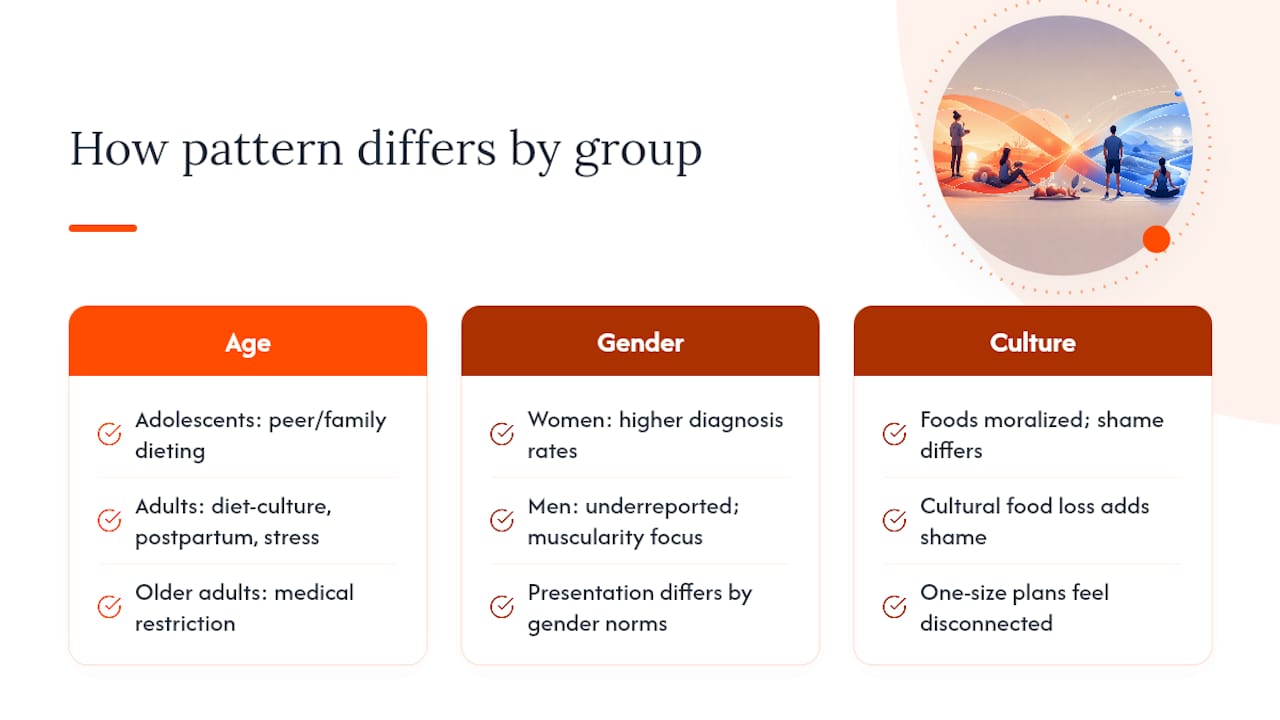
How This Pattern Shows Up Differently Across Groups
The binge restrict cycle doesn’t look identical from person to person, and the differences matter for recognizing it.
Age changes the picture. Adolescents often develop the pattern through early dieting influenced by peers or family comments about body size, while adults frequently develop it through diet culture, postpartum body pressure, or work-related stress eating. Older adults sometimes face a version tied to health-driven restriction, like cutting foods for a medical diagnosis, that spirals into the same deprivation and binge pattern without anyone recognizing the connection.
Gender shapes both prevalence and presentation. Women are diagnosed with binge eating disorder more often, but men experience the pattern too, frequently underreported because it doesn’t fit cultural expectations of what disordered eating looks like, and often tangled up with muscularity-focused restriction rather than thinness-focused restriction.
Cultural background influences which foods get moralized and how shame gets expressed. In some communities, restriction centers on entire cultural food traditions being labeled “unhealthy,” which adds a layer of cultural loss to the shame cycle that generic advice rarely addresses. Recovery approaches that ignore these differences tend to feel disconnected from a reader’s actual life, which is part of why flexible, individualized strategies outperform one-size-fits-all meal plans.
Author Note and ForgeFast Perspective
If you recognize this pattern in yourself, you’re not broken and you’re not alone in this. The cycle responds to structure, not punishment, which is exactly why habit-first approaches tend to outperform another round of restrictive rules. ForgeFast’s framework leans on that same principle: predictable fueling paired with the psychological work of unlearning food-as-earned thinking. In the next 24 hours, try one thing: eat at a set time you wouldn’t normally “allow,” and notice what you feel instead of judging it.
— Tony Lindsay
Try ForgeFast for Structured, Sustainable Fasting
Breaking this cycle takes more than information. It takes a structure that replaces rigid rules without replacing them with a new set of rigid rules. ForgeFast builds predictable fasting windows around psychological coaching and behavior tracking designed specifically to catch the deprivation stage before it turns into a binge. If you’re ready to trade compensatory restriction for a framework that actually holds up under stress, explore ForgeFast’s approach to sustainable fasting and habit change.
Sources
The 2025 scoping review offers the clearest large-scale look at restriction’s link to bingeing. The UCSD CHEAR blog explains the four-stage model in plain terms. Scripps Health covers practical craving-reduction tactics clinicians actually recommend.
This article is general information, not a substitute for advice from a qualified doctor. Consult a qualified healthcare professional about your own circumstances before acting on anything here.
Recommended
Comments