Fasting and Immune Function in Athletes: 2026 Guide


Fasting and immune function in athletes are directly linked through shifts in immune cell populations, cytokine levels, and metabolic pathways that training stress makes uniquely complex. Intermittent fasting, the recognized clinical term for structured eating windows, reduces systemic inflammation and promotes autophagy, but it also carries real risks for athletes who train at high intensity. The relationship is not simply beneficial or harmful. It depends on fasting duration, energy intake, and how well athletes manage nutrition within their eating windows. This guide breaks down the biology, the risks, and the practical strategies that actually work.
What immune system changes occur in athletes during fasting?
Fasting triggers measurable shifts in immune cell populations, and athletes experience these changes on top of training-induced immune stress. A four-week intense training block causes a CD4+/CD8+ ratio drop to 0.98, driven by a 41% reduction in specific T-cell subsets in professional marathon athletes. That ratio matters because CD4+ helper T cells coordinate immune responses, and a suppressed ratio signals reduced immune readiness at exactly the time athletes need protection most.
Fasting compounds this effect by altering cytokine profiles. Pro-inflammatory cytokine levels drop after three weeks of fasting, which sounds beneficial, but the picture is more complicated for athletes. Reduced IL-6 and TNF-α can mean less chronic inflammation, but it can also mean a blunted immune response to new pathogens. The body’s ability to resolve an infection depends on a calibrated cytokine response, not simply a suppressed one.

Immunoglobulin levels also shift during fasting. IgA, which lines the respiratory tract and acts as a first-line defense against upper respiratory infections, declines when energy intake drops. IgG, which provides systemic antibody protection, follows a similar pattern under prolonged caloric restriction. Athletes who fast aggressively without managing protein and calorie intake risk leaving both their mucosal and systemic immune defenses undermanned.
Pro Tip: Track your resting heart rate and perceived recovery score daily during fasting periods. A rising resting heart rate combined with poor sleep quality is an early warning sign that immune stress is accumulating before blood markers show it.
Immune marker | Change during fasting in athletes |
CD4+/CD8+ T-cell ratio | Drops significantly under high-intensity training combined with fasting |
Pro-inflammatory cytokines (IL-6, TNF-α) | Reduced after sustained fasting, lowering chronic inflammation |
IgA (mucosal antibody) | Declines with energy restriction, raising upper respiratory infection risk |
IgG (systemic antibody) | Decreases under prolonged caloric deficit |
NK cell activity | Impaired when energy intake falls below critical thresholds |
How does fasting affect immune resilience and recovery in athletes?
The primary risk with intermittent fasting in athletes is an unintended calorie deficit, not the fasting window itself. When total energy intake drops too low, the body deprioritizes immune cell repair and synthesis. NK cells, which are the immune system’s rapid-response units against viruses and cancer cells, lose functional capacity when fuel is scarce. This is not a theoretical risk. It shows up as increased upper respiratory tract infection rates in athletes during heavy training blocks.
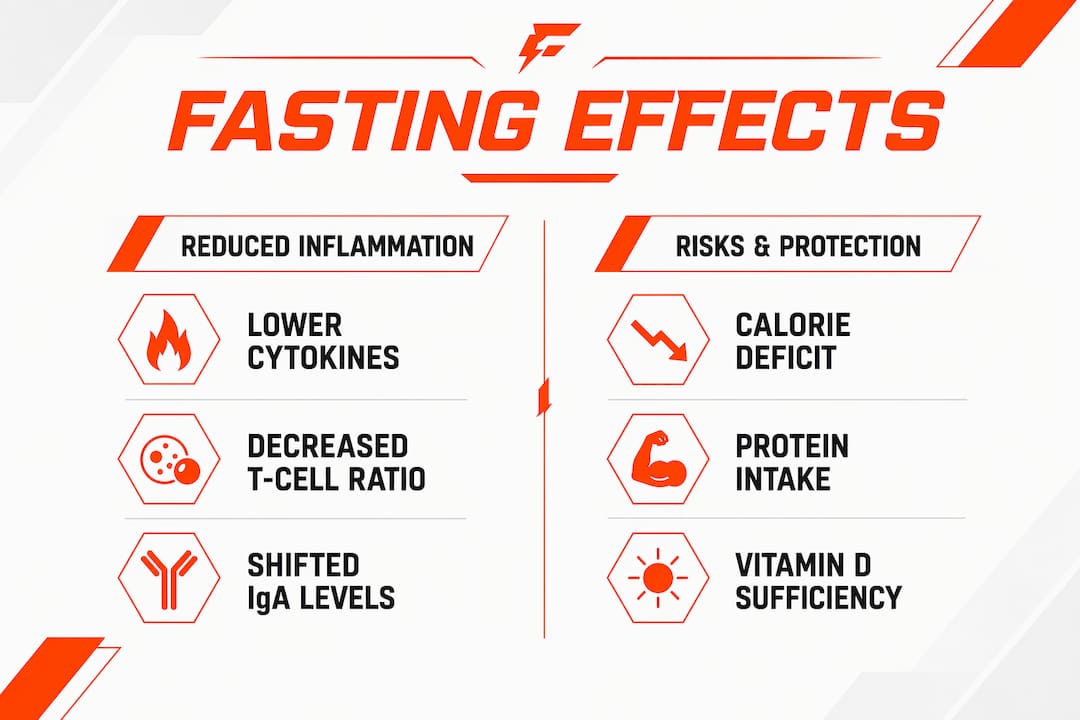
Protein intake is the single most controllable variable for protecting immunity during fasting. Athletes need energy above 10 kcal/kg/day and protein between 1.4 and 2.0 g/kg/day to support immunoglobulin synthesis and NK cell activity. Falling below these thresholds, even briefly, disrupts antibody production and slows immune cell turnover. The eating window must be dense enough in protein and total calories to meet these targets every day.
Nutrient timing adds another layer. Postprandial metabolites prime mTORC1-dependent translation, which drives durable immunometabolic programming in T cells. In plain terms, T cells function better when they are fed. Eating around training sessions, rather than training deep in a fasted state, supports both immune resilience and muscle repair simultaneously.
Micronutrient gaps are a hidden immune threat for athletes who fast. The key nutrients to prioritize are:
Vitamin D: 2,000 IU per day minimum. Deficiency is common in athletes and directly impairs immune resistance.
Vitamin C: Up to 6 g per day during heavy training. Supports neutrophil function and reduces oxidative stress.
Zinc: 30–50 mg per day. Required for T-cell development and antibody production.
EPA/DHA (omega-3 fatty acids): 3 g per day. Reduces exercise-induced inflammation and supports immune cell membrane integrity.
Pro Tip: Front-load your eating window with a protein-rich meal within 30 minutes of finishing training. This single habit protects both muscle protein synthesis and T-cell function at the moment your immune system is most active.
For athletes managing fasting on a structured athletic lifestyle, the goal is not to eat less overall. It is to eat the right amount within a compressed window.
What are the downsides of fasting on humoral immunity and vaccine response?
Fasting carries a specific and underappreciated risk to humoral immunity, which is the branch of the immune system that produces antibodies and maintains long-term immune memory. Intermittent fasting depletes long-lived plasma cells in the bone marrow through a mechanism driven by beta-hydroxybutyrate, the ketone body produced during fasting. Beta-hydroxybutyrate activates the HCAR2 receptor on plasma cells, triggering apoptosis and disrupting their bone marrow niche. The result is a measurable reduction in circulating protective antibodies.
This matters enormously for vaccine efficacy. Long-lived plasma cells are the cells that remember past infections and vaccinations. Depleting them does not just reduce current antibody levels. It shortens the duration of immune memory. An athlete who fasts aggressively in the weeks surrounding a vaccination may generate a weaker and shorter-lived antibody response.
Fasting selectively depletes long-lived plasma cells through beta-hydroxybutyrate’s action on the HCAR2 receptor, causing apoptosis and reducing durable antibody protection. This mechanism means that fasting around vaccination windows is not a neutral choice. It is a decision that directly affects how long vaccine-induced immunity lasts.
Practical steps to protect humoral immunity during fasting:
Avoid aggressive fasting in the two weeks before and after vaccination. This is the window when plasma cell populations are most critical for generating durable antibody responses.
Monitor hematological markers beyond standard panels. Mean cell volume (MCV) drops during fasting periods, signaling early iron deficiency stress that standard monitoring often misses.
Avoid prolonged fasting (beyond 24 hours) during high infection-risk periods, such as travel, competition season, or after intense training blocks.
Prioritize iron-rich foods in the eating window to counteract the hemodilution and hemoconcentration patterns that fasting creates across the day.
What fasting strategies actually protect immune function in athletes?
The best fasting approach for athletes is time-restricted eating within a 16:8 or 14:10 window, not extended fasting or alternate-day protocols. Shorter fasting windows preserve the ability to hit caloric and protein targets within the eating period. Extended fasts beyond 24 hours create the kind of energy deficits that suppress NK cell activity and impair immunoglobulin synthesis, without adding proportional benefit for athletes who are already training regularly.
Intermittent fasting mimics immune benefits of calorie restriction, including improved autophagy and reduced systemic inflammation, but definitive clinical evidence in athletes is still limited. This means the framework matters more than the specific fasting window. Athletes who maintain adequate energy and protein intake within their window get the metabolic benefits without the immune cost.
Meal structure within the eating window should follow this priority order:
Meal 1 (post-training): High protein (40–50 g), moderate carbohydrate, low fat. Prioritizes muscle repair and T-cell fueling.
Meal 2 (midday or afternoon): Balanced macros with emphasis on micronutrient-dense vegetables, legumes, and omega-3 sources.
Meal 3 (final meal of window): Slower-digesting protein (cottage cheese, Greek yogurt) and healthy fats to sustain overnight recovery.
Vitamin D sufficiency is more effective for immune protection than fasting duration alone. Athletes who optimize micronutrients consistently outperform those who focus only on fasting window length. The eating window is where immune protection is built or broken.
Pro Tip: Use a nutrition tracking app during your first 4–6 weeks of fasting to verify you are hitting protein and calorie targets. Most athletes are surprised to find they are under-eating by 400–600 calories per day without realizing it.
For endurance athletes managing fasting alongside high training loads, the 14:10 window is the safer starting point. It allows more flexibility for pre- and post-training nutrition without sacrificing the metabolic benefits of a structured fasting period.
Energy intake adequacy is the critical factor for athlete immune health, not fasting window length. This is the single most important principle to internalize before starting any fasting protocol.
Key Takeaways
Fasting protects immune function in athletes only when energy and protein intake within the eating window meet the body’s full training and immune demands.
Point | Details |
T-cell ratios drop under training stress | A CD4+/CD8+ ratio of 0.98 signals immune suppression; fasting amplifies this risk. |
Calorie threshold is non-negotiable | Athletes need more than 10 kcal/kg/day and 1.4–2.0 g/kg protein to maintain NK cell and antibody function. |
Beta-hydroxybutyrate depletes plasma cells | Fasting-induced ketones reduce long-lived plasma cells, shortening vaccine and infection immunity. |
Micronutrients outperform fasting duration | Vitamin D, zinc, and EPA/DHA protect immunity more reliably than extending the fasting window. |
Meal timing around training matters | Postprandial T-cell priming means eating after training directly supports immune resilience. |
Why I think most athletes are fasting wrong
After years of watching athletes adopt intermittent fasting, the pattern I see most often is this: they get the fasting window right and get the eating window completely wrong. They skip breakfast, train hard, and then eat two meals that are too small, too low in protein, and too light on micronutrients. They feel lean and disciplined. Their immune system is quietly struggling.
The research on immunometabolic pathways makes it clear that fasting and intense training create compounding immune stress. The body does not separate “metabolic fasting stress” from “training immune stress.” It experiences both simultaneously. That means the margin for nutritional error is much smaller for athletes than for sedentary people practicing the same fasting protocol.
What I find most underappreciated is the plasma cell depletion risk. Most athletes think about fasting in terms of fat loss and metabolic flexibility. Almost none of them think about what fasting does to their antibody memory. If you are getting vaccinated, traveling internationally for competition, or heading into a high-exposure period, aggressive fasting is a genuine liability, not a performance edge.
My recommendation is to treat fasting as a tool with a specific job, not a lifestyle identity. Use it during lower-intensity training phases. Protect your eating window like it is the most important training session of the day. And if your recovery markers are trending in the wrong direction, the fasting window is the first variable to shorten, not the last.
— Tony Lindsay
How ForgeFast helps athletes fast without compromising immunity
Athletes who want the metabolic benefits of fasting without the immune risks need more than a fasting window. They need a framework that accounts for training load, nutritional targets, and recovery demands simultaneously.

ForgeFast is built around exactly that framework. The ForgeFast method integrates intermittent fasting with a structured approach to caloric and protein management, so athletes hit their immune-supportive nutrition targets within every eating window. The ForgeFast app tracks fasting windows, caloric intake, and macronutrient balance in one place, making it straightforward to verify you are meeting the thresholds that protect NK cell function and immunoglobulin synthesis. For athletes serious about meal prep on fasting days, ForgeFast provides practical guidance that removes the guesswork from building an immune-protective eating window.
FAQ
Does fasting boost immunity in athletes?
Fasting reduces chronic inflammation and promotes autophagy, which supports immune health, but these benefits only hold when athletes maintain adequate calorie and protein intake within their eating window. Aggressive fasting that creates energy deficits suppresses NK cell activity and immunoglobulin synthesis, increasing infection risk.
How long should athletes fast to protect immune function?
A 14:10 or 16:8 time-restricted eating window is the safest range for athletes. Extended fasts beyond 24 hours create energy deficits that impair immune cell repair and deplete plasma cells through beta-hydroxybutyrate-mediated mechanisms.
Does intermittent fasting affect vaccine response in athletes?
Yes. Fasting depletes long-lived plasma cells00003-8) via beta-hydroxybutyrate acting on the HCAR2 receptor, which reduces antibody durability after vaccination. Athletes should avoid aggressive fasting in the two weeks before and after receiving a vaccine.
What nutrients protect immunity during fasting for athletes?
Vitamin D at 2,000 IU per day, zinc at 30–50 mg per day, EPA/DHA at 3 g per day, and vitamin C up to 6 g per day are the key micronutrients that support immune function during fasting. Protein intake of 1.4–2.0 g/kg/day is the most critical single variable.
Can fasting cause iron deficiency in athletes?
Fasting creates morning hemodilution and afternoon hemoconcentration patterns that cause mean cell volume to drop, signaling early iron deficiency stress. Athletes should include iron-rich foods in every eating window and track MCV alongside standard blood panels during fasting periods.
Recommended
Comments