Intuitive Eating vs Fasting: Which One Works for You?


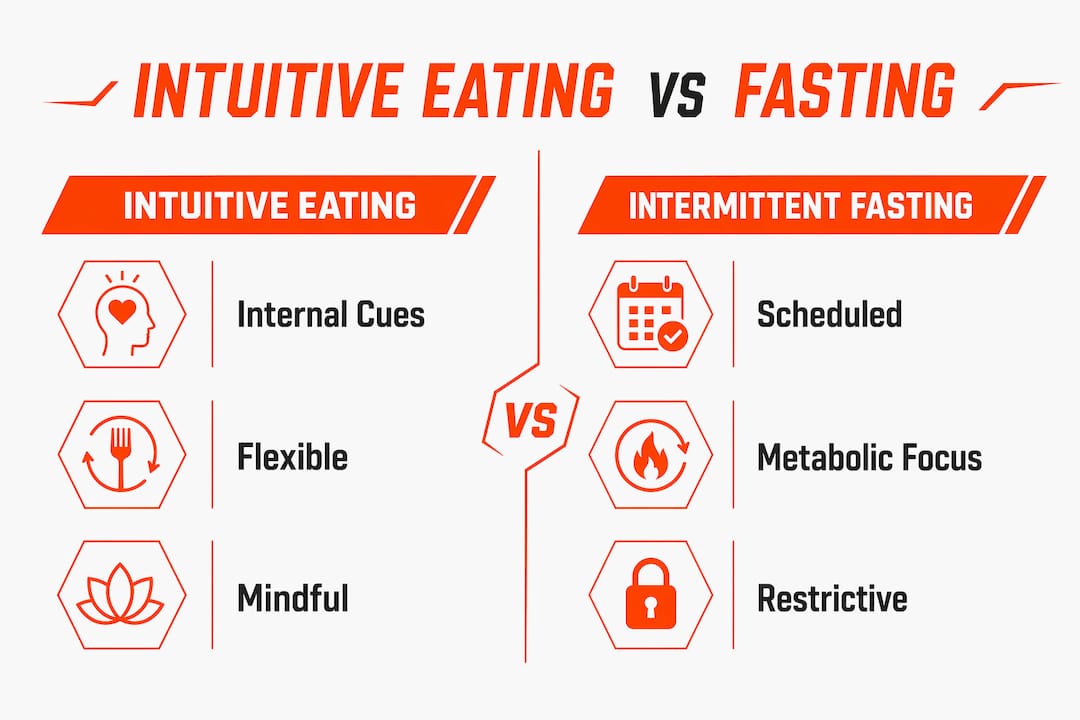
Intuitive eating is defined as an evidence-based framework that teaches people to eat in response to internal hunger and fullness signals, rejecting external food rules entirely. Intermittent fasting, by contrast, controls eating through strict time windows, such as the 16/8 or 5:2 method, regardless of what your body signals. Understanding what is intuitive eating vs fasting matters because these two approaches operate from opposite philosophies: one restores trust in your body, the other imposes a schedule on it. Choosing between them depends on your goals, your history with food, and how your mind responds to structure versus freedom.
What is intuitive eating vs fasting: the core difference
The fundamental split between these two approaches comes down to the locus of control. Intuitive eating places control inside you, specifically in your hunger and fullness cues. Intermittent fasting places control outside you, in a clock and a set of rules. That single distinction shapes everything else about how each approach affects your body, your mindset, and your long-term relationship with food.
Intuitive eating was developed by dietitians Evelyn Tribole and Elyse Resch in 1995. Their framework is built on 10 guiding principles, including honoring hunger, respecting fullness, and making peace with food. Intermittent fasting, by contrast, has no single origin. It exists as a category of eating schedules, each with its own timing rules and physiological rationale.
Both approaches have genuine research support. Both also carry real risks when applied without self-awareness. The right choice is not universal. It depends on who you are and what you need from your eating habits.
What is intuitive eating? Principles and benefits explained
Intuitive eating promotes listening to natural hunger and fullness cues, rejecting dieting rules, and making peace with food through 10 guiding principles. Those principles include honoring hunger, respecting fullness, challenging the food police, discovering satisfaction, coping with emotions without using food, and practicing gentle nutrition. The framework is not a diet. It is a process of unlearning diet culture.
The mental health benefits are well documented. Intuitive eating links to improved body image, reduced anxiety and depression, and decreased binge-eating behaviors. These outcomes matter because chronic dieting often damages self-esteem and creates cycles of restriction and overeating. Intuitive eating breaks that cycle by removing the moral weight attached to food choices.
The 10 principles work as tools, not rules. That distinction is critical. Here is what the core principles address:
Honor your hunger. Keep your body fed with adequate energy to prevent biological drive to overeat.
Make peace with food. Give yourself unconditional permission to eat, which removes the power of forbidden foods.
Challenge the food police. Reject internal and external voices that label foods as “good” or “bad.”
Discover the satisfaction factor. Eating what you actually want, in a pleasant environment, produces genuine fullness.
Respect your fullness. Pause during meals to check in with your body’s satiety signals.
Cope with emotions without food. Identify when hunger is emotional versus physical.
Respect your body. Accept your genetic blueprint rather than fighting it.
Gentle nutrition. Make food choices that honor both health and taste, without obsession.
Pro Tip: Early intuitive eating often produces a “pendulum swing” where you eat previously forbidden foods in large amounts. This is a normal adaptation phase, not a failure. Stable eating patterns emerge after this phase passes.
How does intermittent fasting work? Methods and effects
Intermittent fasting is defined as a pattern of eating that cycles between periods of fasting and eating on a fixed schedule. The most common formats are the 16/8 method (16 hours fasting, 8 hours eating), the 5:2 method (normal eating five days, very low calories two days), and alternate-day fasting. Each format creates the same core physiological effect: extended time without food.

The mechanism behind fasting’s metabolic benefits is called metabolic switching. After glucose stores are depleted during a fast, the body shifts to burning stored fat for fuel. This switch is the primary reason fasting attracts people focused on fat loss and metabolic health. The longer the fasting window, the more time the body spends in fat-burning mode.
The weight loss evidence is real but limited in scope. Intermittent fasting reduces body weight by an average of 3.73 kg and BMI by 1.04 kg/m² in overweight and obese adults in the short term. Results beyond 24 weeks are inconsistent. That means fasting works for initial weight loss but does not guarantee long-term results without additional behavioral support.
Key fasting formats compared:
16/8 method. Most popular format. Eating window typically runs from noon to 8:00 PM. Fits naturally into most work schedules.
5:2 method. Allows normal eating five days per week. Restricts calories to roughly 500 on two non-consecutive days.
Alternate-day fasting. Alternates between normal eating days and fasting or very low calorie days. Harder to sustain socially.
OMAD (one meal a day). Extreme version with a single daily meal. Carries higher risk of nutrient deficiency.
Pro Tip: Food quality during eating windows determines whether fasting delivers metabolic benefits. Eating ultra-processed food during your eating window undermines the fat-burning effect entirely.
How do intuitive eating and fasting differ in psychological impact?
The psychological contrast between these two approaches is sharper than most people expect. Intuitive eating rebuilds trust between your mind and your body. Intermittent fasting asks you to override your body’s signals in favor of a schedule. That is not a minor difference. It shapes how you think about food every single day.
Research confirms the tension. A longitudinal study found a negative association between IF and intuitive eating scores over eight months. Fasting engagement correlated with reduced intuitive eating ability and heightened eating disorder symptoms. The external rules of fasting appear to suppress the internal cues that intuitive eating works to restore.
Experts warn that intermittent fasting’s rigid time rules can increase preoccupation with food and potentially trigger disordered eating patterns in susceptible individuals. While fasting is not classified as an eating disorder, it may foster disordered eating behaviors due to its reliance on restriction.
The table below compares the two approaches across key dimensions:
Characteristic | Intuitive eating | Intermittent fasting |
Control source | Internal hunger cues | External time rules |
Primary goal | Healthy food relationship | Weight loss, metabolic health |
Psychological effect | Reduces anxiety, improves self-esteem | May increase food preoccupation |
Eating disorder risk | Low, supports recovery | Moderate, may trigger restriction patterns |
Sustainability | High when practiced consistently | Inconsistent beyond 24 weeks |
Structure required | Low | High |
Practitioners consistently observe that combining these approaches often fails. As intuitive eating cues strengthen, people naturally abandon fasting schedules because the two philosophies pull in opposite directions. Trying to honor hunger while also ignoring it until noon creates cognitive conflict that most people cannot sustain.
Pro Tip: If you have a history of disordered eating or chronic dieting, starting with intuitive eating principles before attempting any fasting protocol significantly reduces the risk of triggering restriction cycles.
How do you choose the right approach for your goals?
The right eating approach depends on your personal history, your health goals, and your psychological relationship with food. There is no single correct answer. The best approach depends on individual history, and intuitive eating is often advised for those recovering from chronic dieting.
Use this framework to evaluate your situation:
Identify your primary goal. If your goal is fat loss or improving metabolic markers under medical supervision, intermittent fasting has short-term evidence behind it. If your goal is ending a cycle of yo-yo dieting or improving your relationship with food, intuitive eating is the stronger starting point.
Assess your history with restriction. People who have experienced disordered eating, chronic dieting, or significant food anxiety face higher risk with fasting. Intuitive eating was specifically designed to address these patterns.
Consider your tolerance for structure. Fasting requires consistent scheduling, meal planning, and the ability to ignore hunger signals for extended periods. If rigid schedules increase your stress, the psychological cost outweighs the metabolic benefit.
Factor in medical conditions. Diabetes, hypoglycemia, pregnancy, and certain medications make fasting medically inappropriate without direct physician oversight. Intuitive eating carries fewer medical contraindications.
Think about your social life. Fasting schedules conflict with spontaneous meals, travel, and social eating. Intuitive eating adapts to any social context because it has no timing rules.
For those drawn to fasting but concerned about its rigidity, flexible fasting approaches exist that reduce the psychological burden while preserving metabolic benefits. The key is building structure without creating the food obsession that rigid restriction tends to produce.
Key Takeaways
Intuitive eating and intermittent fasting are fundamentally incompatible philosophies: one rebuilds internal body trust, the other imposes external time rules, and choosing between them requires honest assessment of your goals and psychological history.
Point | Details |
Core philosophical difference | Intuitive eating uses internal cues; fasting uses external time rules. |
Mental health outcomes | Intuitive eating reduces anxiety and binge eating; fasting may increase food preoccupation. |
Weight loss evidence | Fasting produces short-term results averaging 3.73 kg lost, but long-term results are inconsistent. |
Combining both approaches | Practitioners find combining them typically fails as intuitive cues override fasting schedules. |
Best starting point | Those recovering from dieting or disordered eating should begin with intuitive eating principles. |
Why I think the fasting vs. intuitive eating debate misses the real question
Most people frame this as a competition. They want to know which approach wins. After working with people across a wide range of eating histories, I have found that framing is almost always the wrong one.
The real question is not which approach is better. The real question is which approach you can actually sustain without damaging your relationship with food. I have watched people achieve impressive short-term results with fasting, then spend the following year in a binge-restrict cycle that left them worse off than before. I have also watched people spend months in the “pendulum swing” phase of intuitive eating, convinced it was not working, only to emerge with the most stable and peaceful relationship with food they had ever experienced.
The biggest misconception I see with fasting is that the eating window is a reward. People treat it as permission to eat anything in large quantities. That mindset eliminates the metabolic benefit and adds a psychological layer of scarcity that makes food feel urgent and precious. The biggest misconception with intuitive eating is that it means eating whatever you want forever. It does not. The gentle nutrition principle exists for a reason.
My honest advice: respect where you are starting from. If you have spent years at war with food, fasting will likely intensify that war. If you are metabolically healthy, have a stable relationship with food, and want a structured approach to fat loss, fasting with proper nutritional guidance can work well. Neither approach is dogma. Both require self-awareness to work.
— Tony Lindsay
ForgeFast’s approach to intermittent fasting that actually lasts
Intermittent fasting works best when it is built on structure, not willpower alone. ForgeFast combines the physiological science of fasting with a behavioral framework designed to make adherence sustainable over months, not just weeks.

The ForgeFast method addresses both the biological and psychological sides of fasting, including mental clarity, metabolic flexibility, and consistent habit formation. The ForgeFast app supports your fasting schedule with tracking tools that keep you accountable without adding stress. For those who want the metabolic benefits of fasting without the rigid all-or-nothing mindset, ForgeFast offers a practical, science-backed path forward.
FAQ
What is the main difference between intuitive eating and fasting?
Intuitive eating relies on internal hunger and fullness signals to guide eating decisions. Intermittent fasting relies on external time windows that control when eating is permitted, regardless of hunger.
Can you combine intuitive eating and intermittent fasting?
Combining both approaches typically fails because their core philosophies conflict. As intuitive eating cues strengthen, people naturally abandon fasting schedules, since honoring hunger and ignoring it on a timer cannot coexist.
Is intermittent fasting effective for weight loss?
Short-term evidence shows intermittent fasting reduces body weight by an average of 3.73 kg in overweight adults. Long-term results beyond 24 weeks are inconsistent, making behavioral support critical for sustained outcomes.
Who should avoid intermittent fasting?
People with a history of disordered eating, diabetes, hypoglycemia, or pregnancy should avoid fasting without direct medical supervision. Intuitive eating carries significantly fewer medical contraindications for these groups.
How long does intuitive eating take to work?
Intuitive eating is a non-linear process that typically involves an early adaptation phase of overeating previously restricted foods before stable eating patterns emerge. Most people require several months of consistent practice before hunger and fullness cues become reliable guides.
Recommended
Comments