Lower Fasting Blood Sugar in Days: Eat Dinner 3 to 4 Hours Before Bed

The fastest, safest way to lower fasting blood sugar is to cut carbs and alcohol at your evening meal, finish eating three to four hours before bed, and layer in a structured time-restricted eating window like 12:12 or 14:10 while you track results with a glucometer. Normal fasting glucose sits at 99 mg/dL or below, prediabetes runs 100 to 125 mg/dL, and diabetes is diagnosed at 126 mg/dL or higher on two separate tests. If you take insulin or a sulfonylurea, talk to your clinician before changing your eating window.
TL;DR:
Reducing carbohydrate and alcohol intake at dinner, finishing meals three to four hours before bed, and implementing a 12:12 or 14:10 fasting window can significantly lower fasting blood sugar within days to weeks.
Morning fasting numbers are influenced by dawn phenomenon, late-night meals, sleep quality, stress, and medications, requiring personalized adjustments for optimal control.
Intermittent fasting protocols, especially those involving structure and monitoring, consistently improve blood glucose and HbA1c levels over 8 to 12 weeks, with medication adjustments as needed.
Regular glucose tracking with SMBG or CGM, combined with detailed logs of meals, alcohol, sleep, and medication, enhances understanding of individual patterns and response to fasting.
High-risk groups, including anyone on insulin, sulfonylureas, pregnant individuals, or those with a history of hypoglycemia or eating disorders, should only fast under medical supervision to avoid dangerous lows.
Table of Contents
What Is a Fasting Blood Sugar Test, and What Do the Numbers Mean?
Why Is Your Fasting Blood Sugar High When You Haven’t Eaten?
What Does the Research Say About Fasting and Blood Sugar Control?
How Do You Actually Lower Your Fasting Blood Sugar Day to Day?
How Does ForgeFast Support Real-World Fasting Blood Sugar Control?
What Is a Fasting Blood Sugar Test, and What Do the Numbers Mean?
A fasting blood sugar test measures glucose in your blood after 8 to 12 hours without food. Water is fine. Coffee, gum, and that “just one bite” of something at 2 a.m. are not, because even a small amount of carbohydrate can nudge the reading upward and make an otherwise normal result look borderline.
The diagnostic ranges are specific and worth memorizing if diabetes runs in your family or you’re already managing it. A fasting glucose of 99 mg/dL or below is considered normal. A reading between 100 and 125 mg/dL signals prediabetes, and 126 mg/dL or higher on two separate occasions confirms diabetes. These aren’t arbitrary lines. They’re the thresholds clinicians use to decide whether you need lifestyle counseling, medication, or closer monitoring.
Fasting glucose is a single-moment snapshot. That’s both its strength and its weakness. It’s fast, cheap, and easy to repeat, but a good number one morning doesn’t guarantee good control across all 24 hours. That’s why doctors pair it with A1C, which reflects average blood sugar over roughly three months by measuring how much glucose has attached to your red blood cells. A fasting glucose in the 110s paired with an A1C of 5.5% tells a different story than the same fasting number paired with an A1C of 6.3%.
The oral glucose tolerance test (OGTT) adds another layer. You fast, get a baseline reading, drink a sugary solution, then get tested again two hours later. It’s more sensitive to how your body handles a glucose load in real time, which is why it’s often used to diagnose gestational diabetes or confirm a borderline diagnosis that fasting glucose alone left unclear.
If your fasting numbers and A1C disagree, don’t assume one test is wrong. A fasting blood sugar test captures a specific window; A1C captures a trend. Reading them together, rather than fixating on one, is how you and your clinician build an accurate picture of your fasting glucose levels.
Why Is Your Fasting Blood Sugar High When You Haven’t Eaten?
The most common surprise for people new to glucose monitoring: your fasting number can be higher than your dinner-time reading, even though you technically ate nothing overnight. That’s the dawn phenomenon at work, and it’s not a mystery. It’s a hormonal handoff your body performs every morning whether you have diabetes or not.
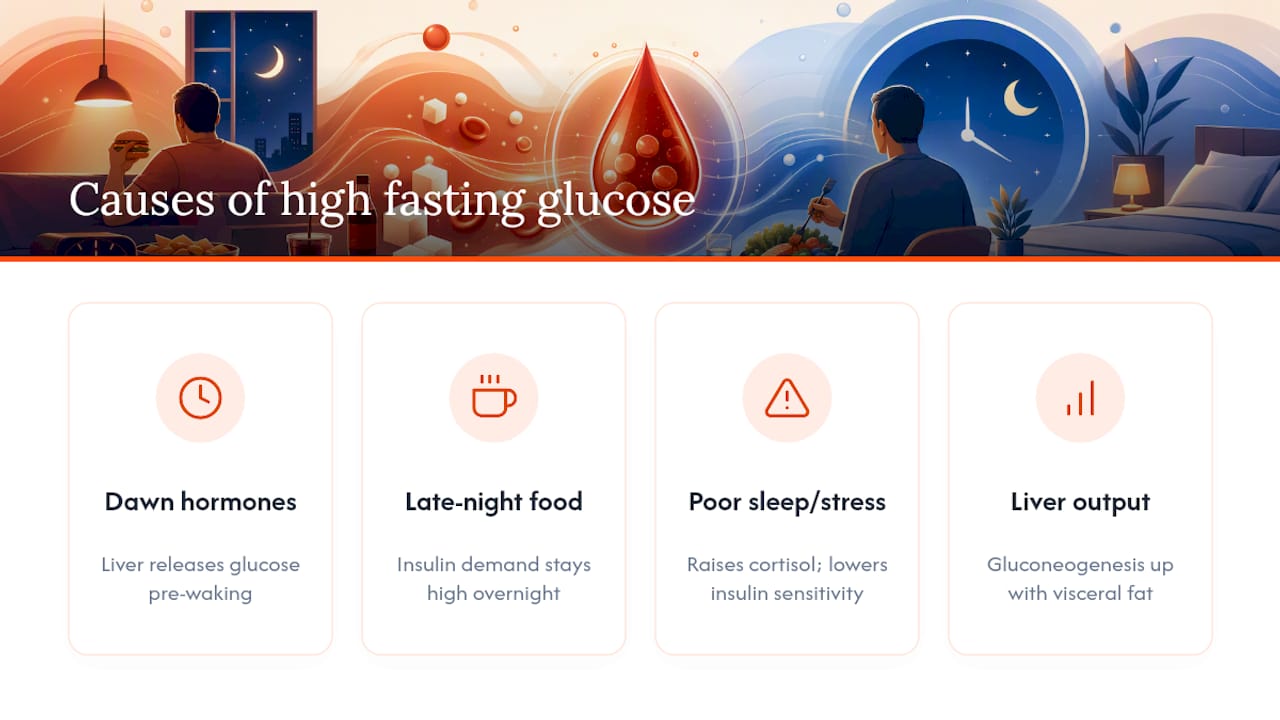
Between early morning hours, the body releases counterregulatory hormones that signal the liver to release glucose in preparation for waking up. In someone with normal insulin sensitivity, insulin quietly mops up that extra glucose. In someone with insulin resistance or diabetes, insulin either lags or doesn’t respond enough, and the reading climbs. The American Diabetes Association explains this morning glucose rise as a hormonal event that food restriction alone often can’t fully override, particularly for people on insulin, where the fix is usually adjusting long-acting insulin timing or dose rather than skipping breakfast.
Dawn phenomenon isn’t the only driver, though it gets most of the attention. A late-night plate of pasta or a few crackers before bed keeps insulin demand elevated well past midnight, and your liver is still processing that load when your alarm goes off. Alcohol complicates things further: it initially drops blood sugar by suppressing the liver’s glucose output, then rebounds hours later as the liver catches up, often landing that rebound right around your 6 a.m. test.
Sleep matters more than most people expect. A single night of fragmented or shortened sleep raises cortisol and reduces insulin sensitivity the next morning, sometimes by a measurable margin. Chronic stress does something similar on a longer timeline, keeping cortisol elevated and making your liver more willing to release glucose even when you haven’t eaten. Certain medications, steroids and some blood pressure drugs among them, can push fasting numbers up independent of anything you did the night before.
Underneath all of this sits hepatic gluconeogenesis, your liver’s ability to manufacture glucose from amino acids and fat byproducts even during a true fast. In someone with insulin resistance, this process runs a little hotter than it should, and body weight plays a direct role: more visceral fat generally means more resistance, which means the liver’s glucose output is less tightly controlled. Untangling which of these factors is driving your specific number is the whole point of the next few sections.
What Does the Research Say About Fasting and Blood Sugar Control?
Intermittent fasting has moved from fringe wellness trend to a legitimately studied clinical intervention, and the data is more specific than most headlines suggest. The strongest single piece of evidence is a 16-week randomized controlled trial published in JAMA Network Open, where adults with type 2 diabetes followed a 5:2 meal-replacement intermittent fasting protocol, eating normally five days a week and using a very-low-calorie meal replacement on the other two.
That’s a large effect for a 16-week window, and it’s important to understand why. This wasn’t unsupervised dieting. Participants were monitored, meal replacements were standardized, and any medication changes were clinician-directed. That level of structure is a big part of why the results were so consistent.
Broader reviews paint a more mixed but still encouraging picture. A narrative review of intermittent fasting in diabetic patients found reported HbA1c reductions ranging from roughly 0.3% to 1.9% across different trials, protocols, and populations. That’s a wide range, and it reflects real differences in study design rather than fasting being unreliable. A few patterns show up consistently:
Trials pairing fasting with intentional weight loss tend to show larger glucose and A1C improvements than fasting alone.
Time-restricted eating protocols (12:12 to 16:8) generally show smaller but still meaningful fasting glucose reductions compared with more aggressive 5:2 or alternate-day protocols.
Ramadan-based fasting studies, which involve extended daily fasts, report notable fasting glucose improvements, though results vary by region, diet composition during eating windows, and baseline medication use.
Almost every trial with meaningful results included structured monitoring, not just “try fasting and see what happens.”
A more recent systematic review and meta-analysis in Frontiers in Nutrition sharpened the picture further by splitting results between people on oral hypoglycemic agents and people on insulin. Both groups saw glycemic improvements with intermittent fasting, but insulin-treated participants required closer monitoring and individualized dose adjustments to avoid hypoglycemia, a detail that matters enormously if you’re one of those readers.
The honest takeaway: intermittent fasting is not a fringe idea backed by anecdote. It’s a studied intervention with real, replicated effect sizes, but the effect size you get depends heavily on the protocol, your starting point, and whether medication adjustments happened under clinical supervision. None of the strongest results came from people making changes in isolation without any monitoring at all.
How Do You Actually Lower Your Fasting Blood Sugar Day to Day?
Here’s the part most articles rush through: a real, ordered plan you can start tonight rather than a vague list of “eat better, sleep more, stress less.”
1. Fix your evening meal first. This is the highest-leverage change for most people, and it costs nothing to try. Cut the carbohydrate load at dinner, particularly refined carbs like white rice, bread, and dessert, and shift the plate toward protein and fiber instead. Aim to finish eating three to four hours before bed. This gives your liver and pancreas time to settle before the overnight hormonal shift begins, which means less residual glucose circulating when the dawn phenomenon kicks in.
2. Pick a time-restricted eating window that fits your life, not an influencer’s. A 12:12 schedule, eating within a 12-hour window and fasting for the other 12, is the gentlest entry point and a reasonable place for almost anyone to start. A 14:10 window tightens that slightly. A 16:8 window is where most of the fasting research shows measurable metabolic benefit, but it’s also a bigger jump and not the right starting point if you’ve never restricted your eating window before. If you’re on glucose-lowering medication, start at 12:12 and extend gradually, checking glucose more often as you do. ForgeFast’s guide on intermittent fasting schedules for busy professionals walks through how to map these windows onto a real workday.
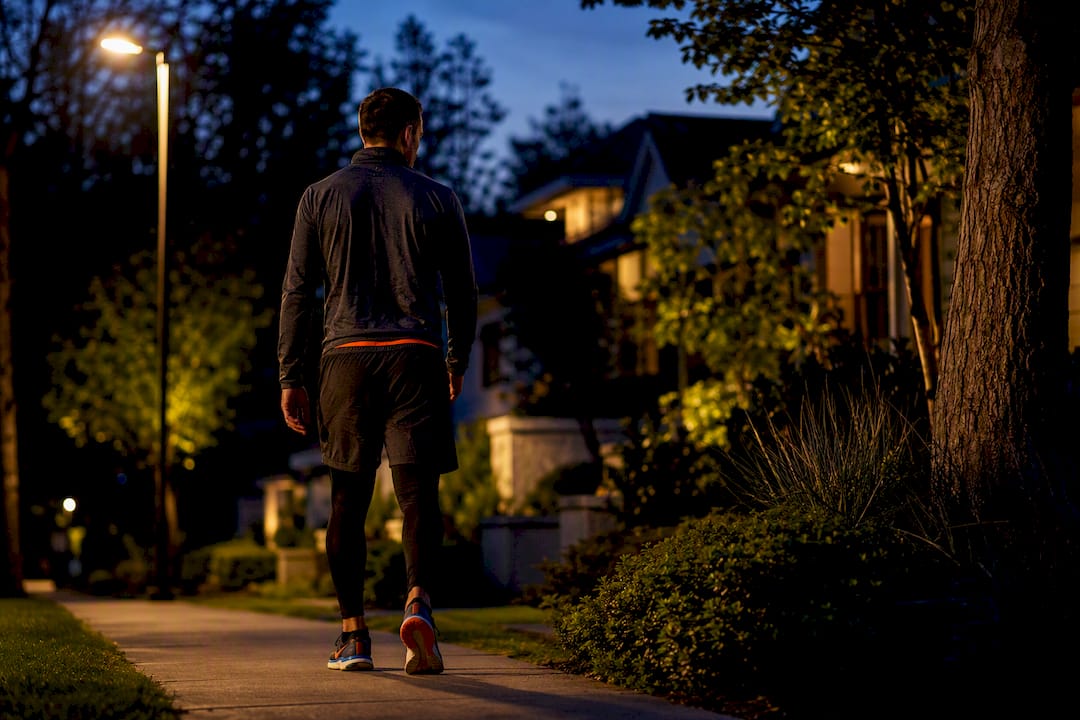
3. Move your body, but time it deliberately. The standard clinical target is at least 150 minutes of moderate aerobic activity per week plus resistance training at least twice a week, and that combination does more for insulin sensitivity than either alone. For fasting glucose specifically, a short walk after your evening meal is disproportionately effective because it helps your muscles pull glucose out of the bloodstream before it gets stored, reducing the overnight load your liver has to manage. Resistance training earlier in the day builds the muscle mass that improves glucose disposal around the clock.
4. Protect your sleep like it’s part of the treatment plan, because it is. Short or fragmented sleep raises next-morning cortisol and blunts insulin sensitivity, sometimes enough to erase a good evening meal’s worth of progress. Seven to eight hours is the general target most sleep and metabolic research converges on.
5. Watch the timing of alcohol, not just the amount. A glass of wine at 6 p.m. behaves very differently in your body than the same glass at 10 p.m. Alcohol suppresses liver glucose output initially, then triggers a rebound hours later, and that rebound often lands squarely on your morning test if you drink close to bedtime. If you drink, do it earlier in the evening and pair it with food.
6. If you’re on medication, build in a monitoring buffer before you change anything else. Anyone on insulin or a sulfonylurea needs a conversation with their clinician before starting or extending a fasting window, because these medications don’t automatically adjust to a shorter eating window and the mismatch is exactly how hypoglycemia happens. A general coordination checklist looks like this: confirm your plan with your clinician first, increase glucose checks for the first one to two weeks of any new fasting schedule, never cut a dose on your own without medical guidance, and have a fast-acting carbohydrate source on hand at all times during the adjustment period.
Pro Tip: Log your fasting glucose alongside what you ate the night before, when you last drank alcohol, and how many hours you slept. After two weeks, patterns jump out that a single morning reading never shows.
None of these steps require heroics. The people who see the steadiest improvement are usually the ones who change the evening meal and the sleep schedule first, then add a fasting window once those two habits are boring and automatic.
How Should You Test and Track Your Fasting Glucose?
Three tools measure fasting glucose, and they’re not interchangeable. A lab-drawn fasting glucose test is the gold standard for diagnosis, run after an 8 to 12 hour fast and interpreted alongside A1C and, when needed, an oral glucose tolerance test. It’s accurate, but it’s a once-in-a-while snapshot, not a tracking tool.
Self-monitoring of blood glucose (SMBG), the fingerstick meter most people picture, gives you a real number in seconds and is the practical daily choice for anyone adjusting medication or a fasting schedule. Continuous glucose monitoring (CGM) goes further, tracking glucose every few minutes and revealing overnight trends a single morning fingerstick can never show, including exactly when the dawn phenomenon starts kicking in for you personally.
Monitoring frequency should match your risk level, not a one-size-fits-all schedule:
If you’re metabolically healthy and just curious, an occasional lab check once or twice a year is enough.
If you have prediabetes or are experimenting with fasting for the first time, daily SMBG for the first two to four weeks helps you catch problems early.
If you’re on insulin or a sulfonylurea, or your glucose has been unstable, daily SMBG or a CGM is the safer standard, since the research on insulin-treated patients specifically flags the need for closer monitoring during fasting interventions.
Numbers alone don’t tell the full story. Pair each reading with context: what you ate at dinner, how much you slept, whether you drank alcohol, and what medication you took and when. ForgeFast’s breakdown of the ten fasting biomarkers worth tracking is a useful reference if you want to go beyond glucose alone and see the fuller metabolic picture.
Who Should Not Fast Without Medical Supervision?
Fasting isn’t universally safe, and pretending otherwise is how people end up in the emergency room. A few groups need a clinician actively involved before changing anything about their eating window: anyone on insulin, anyone on a sulfonylurea (drugs like glipizide or glimepiride that push the pancreas to release insulin regardless of whether you’ve eaten), pregnant people, anyone with a history of severe hypoglycemia, anyone with an active eating disorder, and pediatric or frail elderly patients whose glucose regulation is already fragile.
The core issue is straightforward: these medications don’t know you’re fasting. If your dose was calibrated for a 12-hour eating window and you suddenly compress that to 8 hours, the mismatch between drug action and food intake is exactly how dangerous lows happen. Clinical reviews are consistent on this point: medication adjustments during fasting need to be clinician-led, with more frequent glucose checks built in from day one, not added after a scare.
If you fall into a high-risk group and your clinician clears you to try a modified fasting approach, a few practical safety measures matter beyond just checking glucose more often. Carry a fast-acting carbohydrate source, glucose tablets, juice, hard candy, at all times, not just when you remember to. Avoid prolonged vigorous exercise near the end of a fast, since that’s when glycogen stores are lowest and hypoglycemia risk peaks. Stay hydrated throughout, since dehydration can concentrate blood glucose readings and make them harder to interpret accurately. ForgeFast’s explainer on insulin’s role during fasting goes deeper into the biology if you want to understand exactly why this mismatch happens.
How Long Does It Take to Lower Fasting Blood Sugar?
Fasting glucose itself can respond fast, sometimes within days of tightening your evening meal and cutting late-night alcohol. That quick feedback is genuinely useful because it lets you and your SMBG or CGM data confirm a change is working before you’ve invested months in it.
A1C moves on a completely different clock. Because it reflects roughly three months of average glucose, meaningful A1C change typically takes 8 to 12 weeks to show up clearly, even when your daily readings have already improved. The 16-week EARLY trial that produced a 1.9% HbA1c drop is a useful benchmark, though individual results vary widely based on starting A1C, adherence, and whether weight loss accompanied the fasting protocol.
A reasonable review rhythm: check fasting glucose trends weekly for the first month, recheck A1C at the 8 to 12 week mark, and escalate to your clinician sooner if fasting readings climb instead of fall, or if you experience any symptoms of low blood sugar.
How Does ForgeFast Support Real-World Fasting Blood Sugar Control?
Knowing the right protocol and actually sticking to it for 12 weeks are two different problems, and the second one is where most people fail. ForgeFast’s habit framework is built around that gap, pairing structured fasting protocols (12:12 through 16:8) with daily habit prompts, journaling, and biomarker tracking so the plan doesn’t rely on willpower alone.
The behavioral layer matters more than it sounds. Fasting research consistently shows that adherence and structured habit-building drive the actual clinical benefit, more than any single protocol detail. A well-designed 14:10 window followed consistently for three months will usually outperform a strict 16:8 abandoned after ten days. ForgeFast’s tracking tools let you export glucose and habit logs to share directly with a clinician, which keeps your fasting adjustments coordinated with any medication changes rather than happening in isolation.
What Should You Actually Prioritize First?
If you take one thing from this, make it the order of operations: fix the evening meal, then add a modest fasting window, then let monitoring tell you whether it’s working. Don’t skip straight to 16:8 because a number sounded impressive in a trial you half-remember.
If you’re on insulin or a sulfonylurea, the sequence changes slightly. Call your clinician before step one, not after step three. That’s not caution for caution’s sake; it’s how the actual research trials that produced good results were run.
Incremental change beats extreme restriction almost every time I’ve seen it compared head to head in the literature. If sticking to any of this on your own feels harder than the plan itself, that’s a sign to look for structured support rather than white-knuckling it alone.
— Tony Lindsay
Ready to Put a Fasting Plan Into Practice?
Reading about the dawn phenomenon and 5:2 protocols is one thing. Waking up at 6 a.m. and actually deciding what to eat, when to stop eating, and whether last night’s wine is why your number climbed, that’s the part that trips people up. ForgeFast was built for that exact gap between knowing the science and living it daily.

The ForgeFast App turns the strategies covered here, meal-timing rules, fasting window selection, evening habit adjustments, into daily prompts and tracking tools instead of a mental checklist you have to remember on your own. It’s built for busy professionals who understand the “why” behind fasting blood sugar control but need structure to actually hold the line on a Tuesday night when takeout sounds easier than a protein-forward dinner three hours before bed. The app supports logging alongside your existing SMBG or CGM data, so your fasting adjustments stay visible and shareable with your clinician rather than scattered across a notes app. If you’re managing prediabetes or working with a doctor on a broader glucose plan, visit the ForgeFast site to see how the structured protocols work, and bring your clinician into the conversation before adjusting any medication.
This article is general information, not a substitute for advice from a qualified doctor. Consult a qualified healthcare professional about your own circumstances before acting on anything here.
FAQ
What Is the Fastest Way to Lower Fasting Blood Sugar?
Cutting refined carbs and alcohol at dinner and finishing your last meal three to four hours before bed produces the quickest visible change, often within days on SMBG or CGM readings. Adding a modest fasting window like 12:12 compounds that effect over the following weeks.
What Should You Do First Thing in the Morning to Lower Blood Sugar?
A short walk shortly after waking helps muscles clear glucose that built up overnight from the dawn phenomenon, and delaying your first meal slightly extends your fasting window without any extra effort. Checking your glucose before eating also gives you a baseline to judge whether last night’s changes are working.
What Should You Eat if Your Fasting Blood Sugar Is High?
Favor protein, non-starchy vegetables, and fiber over refined carbohydrates, and keep portions of starchy foods smaller and earlier in the day rather than at dinner. A high fasting reading is usually a signal to look at the previous night’s meal and alcohol timing, not just what you eat that morning.
How Long Does It Take to Lower Blood Sugar by Fasting?
Fasting glucose readings can improve within days to a couple of weeks of consistent changes, while A1C typically takes 8 to 12 weeks to reflect meaningful improvement, based on trial data like the 16-week EARLY RCT. Individual results vary based on starting glucose, adherence, and whether weight loss accompanies the fasting protocol.
Recommended
Comments