Fasting Is a Mindset Practice, Not a Willpower Test


Fasting works when you stop treating it as deprivation and start treating it as a resilience exercise you’re voluntarily choosing, the same way someone chooses a cold shower or a hard workout. That single reframe changes everything downstream, from how you handle hour six to whether you show up again tomorrow. ForgeFast builds its entire coaching model around this shift, backed by cohort research showing structured fasting can lower anxiety and depression scores over just four weeks.
Do this in the next hour:
Write one sentence answering “why am I doing this fast?” and keep it somewhere visible.
Take five slow breaths before your next hunger wave hits, and notice whether the urge passes in under two minutes. It usually does.
Key Takeaways
Fasting success depends more on identity-based mindset training and structured reframes than on raw willpower or perfect meal timing.
Point | Details |
Reframe fasting as identity | Write a one-line statement about who you’re becoming, not what you’re restricting. |
Expect a predictable arc | Early irritability typically eases within days as your body adapts to the new rhythm. |
Cognitive fog is rare | A 2025 meta-analysis found near-zero average cognitive effects from short-term fasting. |
Broken fasts are data | Log the trigger and adjust your approach instead of treating it as failure. |
Watch autonomic red flags | Cold extremities and fragmented sleep matter more than ordinary hunger. |
ForgeFast operationalizes the mindset | Its coaching prompts and habit trackers turn these psychological techniques into a daily, trackable routine. |
A Personal Note on Starting Small
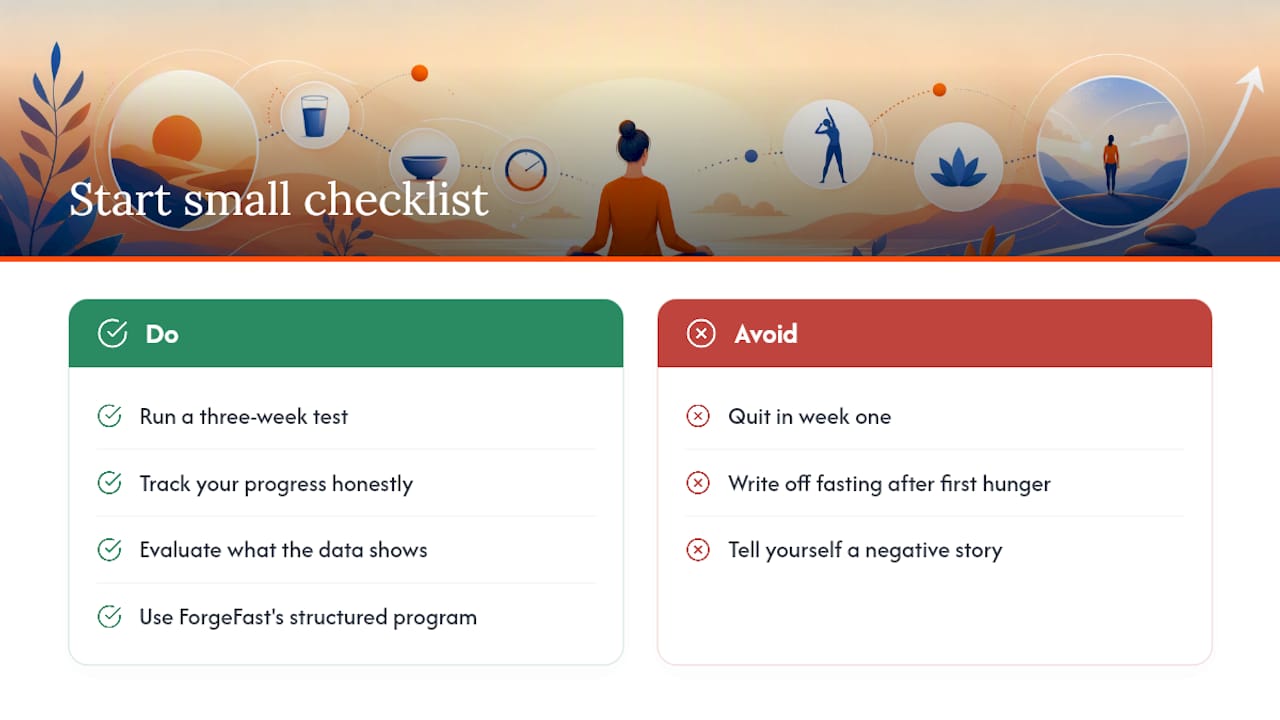
I’ve watched enough people quit fasting in week one to know the problem is rarely the fast itself. It’s the story they tell themselves the first time hunger shows up. Try a three-week version of what’s outlined here before deciding fasting “isn’t for you.” Track it honestly, and see what the data actually says. If you want a structured way to run that experiment, ForgeFast’s program is built around exactly this kind of test.
A Program Built Around the Mindset, Not Just the Meal Timing
Most fasting apps hand you a countdown timer and call it support. ForgeFast starts somewhere else: the habit scaffolding and mindset coaching that determine whether you’re still fasting in month three, not just week one. You get daily prompts for the identity and reframe work covered above, a tracker that turns your personal experiment into visible patterns, and meal-prep guidance that removes the guesswork from breaking your fast well.

A trial gives you enough runway to test one real variable, your eating window, your morning ritual, your hydration routine, and see what actually moves your mood and energy. If you’re ready to stop relying on sheer grit and start working with a framework built for the long haul, start your ForgeFast trial and see what three structured weeks can show you. For readers who want extra reading on the identity-building side of behavior change, these mindset resources pair well with the program’s daily prompts.
Table of Contents
Why a Fasting Mindset Changes What Fasting Feels Like
Fasting isn’t a fixed physical event with one guaranteed outcome. A 2026 narrative review frames it as a context-dependent psychobiological stressor: the same 16-hour window can feel energizing to one person and destabilizing to another, depending on their baseline stress load and recovery capacity. Your mindset is the variable that tips the outcome one way or the other.
Part of the mechanism is straightforward training. Delaying gratification repeatedly asks your prefrontal cortex to override an impulse, and that override gets easier with repetition, the same way a muscle adapts to load. Fasting is less about the empty stomach and more about practicing the pause between urge and action.
A 2025 meta-analysis pooling 3,484 participants across 222 studies found that short-term fasting produced a near-zero average effect on cognitive performance in healthy adults. Attention, memory, and reasoning mostly held steady.
That matters because the fear of “brain fog” keeps a lot of people from trying fasting in the first place. A separate cohort study of 336 adults found significant drops in anxiety and depression scores after four weeks of structured dawn-to-dusk fasting, alongside better quality-of-life ratings. Your brain isn’t shutting down. It’s adapting.
What Your Brain and Body Actually Do During a Fast
The first few fasts almost always come with a predictable arc, and knowing the shape of it ahead of time takes the sting out.
Hours 1 to 4: Mild irritability and a sharpened, almost obsessive focus on food. This is habit withdrawal more than physiological hunger.
Hours 4 to 8: The edge softens for most people, sometimes replaced by a wave of mental clarity that surprises first-timers.
Days 2 to 5 of a new routine: Many adults report the irritability fading faster than expected as the body adjusts to the new eating window.
Not everyone follows this timeline. Age, baseline stress levels, and mental health history all shift how a fast lands. Someone coming off a high-stress month at work will feel hunger differently than someone in a calm stretch of life, and that’s not a personal failing.
There’s real neural evidence behind the mood shifts, too. A longitudinal study tracking functional connectivity found that changes between the amygdala and postcentral gyrus during fasting correlated with reduced anxiety symptoms that persisted for at least two months. That’s a meaningful signal, though it comes from a specific study population and shouldn’t be read as a guarantee for every faster. Clinical summaries echo the same nuance: clarity is common, but vulnerable groups can respond differently.

The Mindset Toolkit That Makes Fasting Sustainable
Most fasting advice focuses on schedules and macros. The techniques that actually determine whether you stick with it are cognitive and behavioral, and they take minutes, not hours, to practice.
Three cognitive moves worth practicing:
Relabel the sensation. Instead of “I’m starving,” try “this is my body adapting.” The physical feeling doesn’t change, but your relationship to it does.
Use thought-defusion. When “I can’t do this” shows up, mentally tag it: “that’s a thought, not a fact.” This small linguistic trick creates distance from the impulse to quit.
Ground for sixty seconds. Name five things you can see, four you can hear, three you can touch. Hunger waves often pass before you finish the exercise.
Behavioral supports matter just as much:
Ritualize the fast-breaking meal so it feels like a reward, not a scramble.
Keep water and electrolytes visible and easy to reach.
Schedule a low-effort walk during your usual snack-craving window instead of white-knuckling through it.
Swap doom-scrolling for a five-minute task that occupies your hands.
If you want to test what actually works for your body, run a three-week N-of-1 experiment. Change exactly one variable—for instance, your fasting window length—and track sleep quality, mood, cravings, and energy on a simple 1 to 5 scale each day. Three weeks gives you enough data to see a pattern instead of a one-off bad night.
Pro Tip: If you break a fast early, log what triggered it that same day. Was it stress, boredom, or a social situation? Treat the entry as data collection, not a confession. Patterns you notice in week one often disappear by week three once you know what to watch for.
When to Modify or Stop: Red Flags Worth Knowing
Most rough patches during a fast are temporary and forgettable within a day. Some aren’t, and knowing the difference protects you.
Watch for these signals:
Persistent sleep loss, not just one restless night
Anxiety spikes that don’t settle after breaking the fast
Menstrual irregularities
Dizziness or lightheadedness beyond mild hunger fog
Noticeable hair shedding
A low mood that lingers for days rather than hours
Autonomic signs like cold extremities and fragmented sleep are often a more reliable red flag than hunger itself. Raw hunger is expected. Nervous-system overload is not.
Pregnant people, anyone managing diabetes with medication, and those with a history of disordered eating should talk to a clinician before attempting structured fasting, not after symptoms appear. For everyone else, the fix for a rough patch is rarely to push harder. Shortening the eating window, cycling in a recovery week, or alternating strict and relaxed days protects mental health far better than gritting through discomfort that keeps escalating. If stress from other parts of life is already high, layering rigid fasting rules on top of it tends to backfire, and rebuilding a gentler routine is the smarter move.
How ForgeFast Builds This Into a Daily Practice
Knowing the psychology is one thing. Living it out on a Tuesday afternoon when a craving hits during a meeting is another. ForgeFast’s mind-body fasting approach exists to close that gap by pairing fasting protocols with daily mindset coaching instead of leaving willpower to chance.
Inside the program, that looks like:
Daily prompts that walk you through the identity and reframe work covered above, so it becomes routine instead of a one-time exercise.
Habit trackers that log mood, cravings, and energy automatically, turning your N-of-1 experiment into something you don’t have to manage by hand.
Meal-prep templates that make the fast-breaking ritual simple enough to actually follow through on.
Pro Tip: Give any new fasting mindset practice a full three to six weeks before judging it. That’s roughly the window where the cohort data on mood improvement showed measurable change, and it matches what most people need to move from “gritting through it” to “this is just how I eat now.”
Sources
Recommended
Comments