I'm So Full: What to Do Now and How to Stop It Happening
- Tony Lindsay
- 1 day ago
- 9 min read


That painfully stuffed feeling is usually just stomach distension from overeating, though it can also be early satiety or plain hedonic craving talking. Sit upright, sip water slowly, and take a short walk instead of lying down or reaching for a soda. Most cases resolve within an hour or two.
Sit up and stay upright for at least 30 to 60 minutes.
Sip water slowly, skip anything carbonated, and consider ginger tea if you feel nauseated.
Take a gentle walk rather than a nap; avoid strenuous exercise too.
If the fullness comes with severe pain, repeated vomiting, or you’ve noticed unexplained weight loss alongside it, that’s not a “sleep it off” situation. Get medical attention instead.
Key Takeaways
Uncomfortable fullness usually resolves with upright posture, slow hydration, and gentle movement within an hour or two, while persistent early satiety or pain needs a doctor’s evaluation.
Point | Details |
Act in the first hour | Stay upright, sip water slowly, and take a short walk instead of napping or lying down. |
Skip carbonation | Carbonated drinks add gas to an already stretched stomach and make bloating worse. |
Use the 20 minute rule | Wait 15 to 20 minutes before deciding on seconds since the brain lags behind the stomach. |
Watch for early satiety | Getting full after only a few bites, repeated over weeks, warrants medical evaluation. |
Track your patterns | Logging meal timing, food type, and stress clarifies whether fullness is behavioral or medical. |
Where to Read More on This Topic
Cleveland Clinic: How To Tell When You’re Full for the satiety timing science.
OSF HealthCare: I ate too much. Now what do I do? for the immediate-relief checklist.
Michigan Medicine: Overeating Pain for practical post-meal steps.
Cleveland Clinic: Early Satiety for when small-meal fullness signals a problem.
Mayo Clinic: Symptoms Not to Ignore for red-flag guidance.
Table of Contents
Common Physical Causes of Feeling Very Full
Most of the time, “I’m so full” has a boring, non-scary explanation: you ate more than your stomach’s normal one to two cup capacity comfortably holds, and it stretched to make room, according to MD Anderson’s overview of overeating. That stretch is what you’re feeling, not damage.
A handful of physical triggers show up again and again:
Overeating and stomach stretch. A holiday plate piled twice as high as usual triggers straightforward mechanical distension.
Gas and bloating. Carbonated drinks, beans, or swallowed air from eating too fast add pressure on top of the food already there.
Slow gastric emptying. High-fat meals like fried food or heavy cream sauces sit in the stomach longer, so fullness lingers for hours instead of fading.
Medication side effects. Certain diabetes drugs, opioids, and some antidepressants can blunt hunger signals or slow digestion, making you feel full faster or longer than usual.
GERD and reflux. Acid backing up into the esophagus after a big meal often gets misread as “too full” when it’s really reflux discomfort.
Early satiety. Feeling stuffed after just a few bites, repeatedly, is a distinct pattern worth naming separately.
That last one deserves its own callout, because it’s the one people most often dismiss as “just a small appetite.”
Early satiety, feeling full after eating unusually small amounts, is a symptom rather than a diagnosis. It can point to gastroparesis or functional dyspepsia, especially when it happens meal after meal instead of once in a while.
Here’s the practical dividing line. Feeling wrecked after Thanksgiving dinner or a buffet binge is ordinary overindulgence, and it resolves on its own within a day. Feeling full after a normal-sized lunch, week after week, especially paired with nausea or unintended weight loss, is the pattern that belongs in front of a doctor, not a search engine.
Safe Short-Term Steps to Relieve Uncomfortable Fullness Now
The first two hours after a big meal determine whether you feel merely uncomfortable or genuinely miserable. Here’s the sequence that actually helps, based on guidance from OSF HealthCare and Michigan Medicine:
Stay upright. Sit or stand for at least 30 minutes; lying down pushes stomach contents toward the esophagus and invites reflux.
Sip water slowly. Small sips help digestion along without adding more volume to an already-stretched stomach.
Walk, don’t nap. A slow 10 to 15 minute walk speeds gastric emptying and eases bloating far more than lying still does.
Breathe deliberately. A few minutes of slow, deep breathing calms the “too full to move” panic that makes discomfort feel worse than it is.
Try ginger if you’re nauseated. Ginger tea or a small piece of crystallized ginger has a long track record for settling an unsettled stomach.
Skip carbonated drinks entirely. Bubbles add gas to a stomach that’s already stretched, which is the opposite of what you want.
Wait at least one to two hours before napping and a similar window before any real workout. Your body is busy digesting; asking it to also power a run or a nap-induced reflux episode just adds insult to injury.
Pro Tip: Keep a small stash of ginger tea bags at your desk or in your bag. It’s a low-effort tool that works for both post-meal nausea and everyday queasiness, and it beats reaching for an antacid you don’t actually need.
If you’re leaning on over-the-counter remedies like simethicone for gas or antacids for reflux, they’re fine occasionally. Reaching for them multiple times a week is itself a signal that something’s off.
Why You Might Keep Eating Even When You’re Already Full
Physical fullness and the urge to keep eating are two separate systems, and they don’t always agree with each other. Your stomach can be genuinely stretched to capacity while your brain is still sending “one more bite” signals driven by taste, stress, or plain habit.
The usual suspects:
Hedonic eating. Dessert “has a different stomach,” as the joke goes, because taste-driven cravings override fullness signals almost entirely.
Stress and emotional eating. A hard day makes food feel like relief, regardless of how full you already are.
Social contagion. Everyone at the table is still eating, so you keep pace without noticing.
Autopilot and distraction. Eating in front of a screen disconnects you from the cues your body is sending in real time.
Interrupting the pattern doesn’t require willpower so much as a pause button. Put your fork down between bites, take three slow breaths, and drink a small glass of water before deciding whether you actually want more. Give it 15 to 20 minutes; that gap is usually enough for the “still eating” urge to fade once your brain catches up with your stomach.
Pro Tip: At a buffet or holiday table, physically move away from the food after your first plate. Distance breaks the autopilot loop far more reliably than trying to talk yourself out of a second helping while it’s sitting three feet away. ForgeFast’s guide on interrupting the urge to keep eating digs deeper into why this works.

How to Tell When You’re Actually Full vs. Just Stuffed
The gap between “satisfied” and “uncomfortably stuffed” is usually 15 to 20 minutes of eating past the point your body already told you to stop. It takes the brain roughly 20 to 30 minutes to register the fullness signals your stomach sends, which is exactly enough time to demolish seconds before you realize you didn’t need them.
A simple 1 to 10 hunger and fullness scale makes this concrete:
Scale | What it feels like |
1 to 3 | Ravenous, irritable, hard to concentrate |
4 to 6 | Comfortable, satisfied, energized |
7 | Full, slightly heavy, still functional |
9 to 10 | Stuffed, uncomfortable, possibly nauseated |
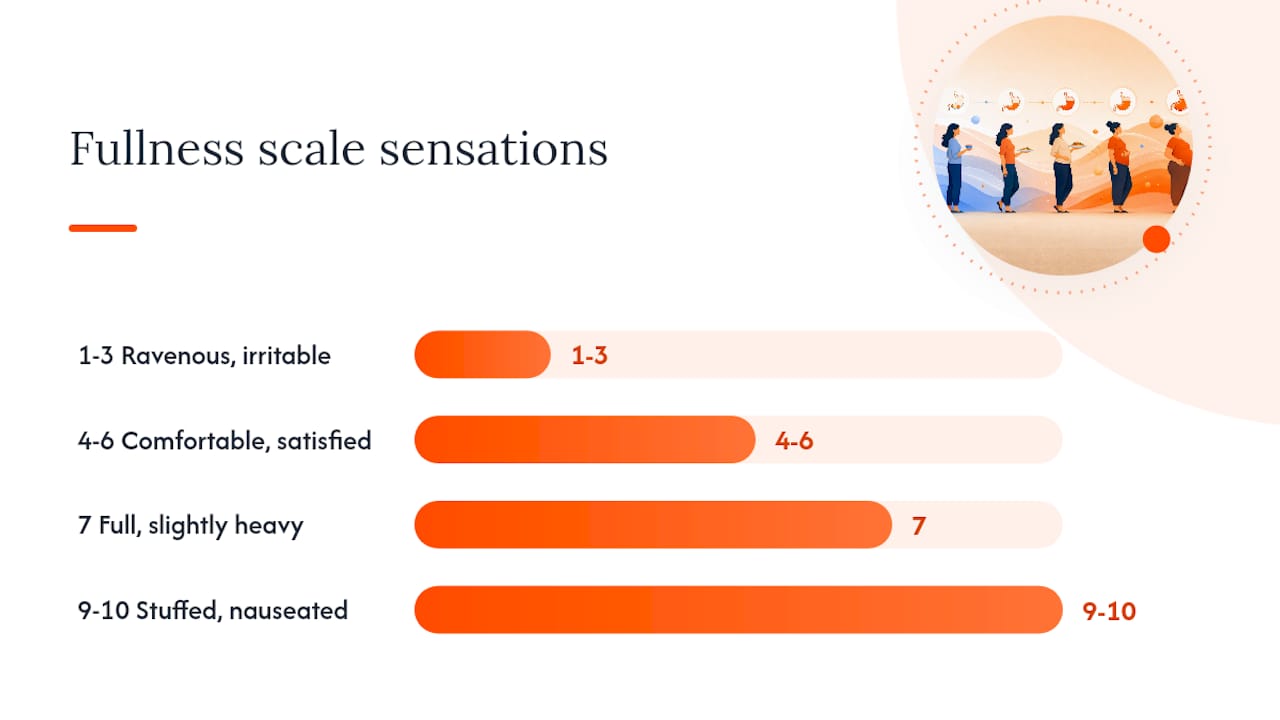
Aim to stop eating somewhere in the 4 to 7 range, not at 9.
Internal cues worth tracking mid-meal:
Steady energy instead of a post-meal crash
No more gnawing hunger, but no heaviness either
Breathing feels normal, not labored or tight
No shakiness or lingering food obsession
Try eating in smaller, deliberate bites, chewing thoroughly, and waiting the full 15 to 20 minutes before deciding on seconds. That pause alone prevents most cases of accidental overeating.
Habits That Prevent Uncomfortable Fullness Going Forward
Fixing the day-to-day pattern matters more than any single-meal fix, since repeated overeating can actually change how your body regulates hunger over time, not just cause one bad afternoon.
Do this:
Eat slowly and put utensils down between bites.
Build meals around protein, fiber, and water-rich vegetables, which slow digestion in a good way and support steady fullness.
Drink water before and during meals instead of sugary or carbonated drinks.
Skip this:
Very high-fat meals right before bed, since fat slows gastric emptying and prolongs discomfort.
Carbonated beverages with food, which add gas on top of a full stomach.
Eating straight from a large serving dish or bag, which erases your sense of portion size.
Three tactics that make portion control automatic rather than a daily fight:
Downsize the plate. A 10-inch plate instead of a 12-inch one cuts portions without any conscious restriction.
Pre-portion leftovers immediately after cooking, before you’re tempted to go back for more.
Fill half the plate with vegetables first, then build the rest of the meal around that anchor.
For people juggling unpredictable schedules, consistency beats perfection. Eating at roughly the same times each day keeps hunger and fullness signals predictable instead of erratic, and planning snacks ahead of time helps prevent sudden cycles of extreme hunger and overeating. A wearable like the VOLTRA biometric health band can help correlate meal timing with sleep and stress data, which often explains why certain days feel worse than others.
Pro Tip: Log what and when you eat for one week, nothing fancy, just notes on your phone. Patterns that feel random in the moment (always overeating on stressful workdays, always stuffed after late dinners) usually jump out within a few days. Nutrient-timing apps can automate this if a notes app feels like too much friction.

Red Flags That Mean It’s Time to See a Doctor
Occasional overstuffed misery after a big meal is normal and self-limited. A different pattern altogether needs a clinician, not another ginger tea:
Feeling full after only a few bites, repeatedly, over weeks
Unintentional weight loss alongside reduced appetite
Repeated vomiting, especially after meals
Severe or worsening abdominal pain
Blood in vomit or stool
Signs of possible obstruction, like an inability to keep food or liquid down
A doctor investigating these symptoms will likely start with blood work and possibly imaging or a gastric-emptying study before referring you to a gastroenterologist. None of this applies to last night’s second helping of lasagna. It applies when the pattern repeats and something feels genuinely off, not just uncomfortable.
The Science Behind Why Fullness Signals Lag Behind Eating
Three hormones run the show: ghrelin ramps up hunger before a meal, cholecystokinin signals fullness as food hits the small intestine, and leptin manages longer-term appetite regulation. The catch is timing.
Ghrelin rises before meals and drops once you start eating.
Cholecystokinin signals fullness from the gut, but that signal takes time to register.
Leptin manages appetite over hours and days, not minutes.
That gap between stomach and brain runs about 20 to 30 minutes, which is long enough to eat well past comfortable if you’re moving fast. The mechanisms involved are genuinely complex. Peer-reviewed research on postprandial fullness points to overlapping factors: gut motility, visceral sensitivity, and gut to brain signaling all interacting rather than one single switch flipping.
Fullness after a big meal is a normal signal working exactly as designed. Fullness after a few bites of a normal meal, over and over, is the version worth mentioning to a doctor.
Track the Pattern Before You Panic About It
Feeling wrecked after overdoing it at dinner happens to everyone, and it’s rarely a sign anything is wrong. Worth noting: the time of day, what you ate, and your stress level that day. That pattern usually tells you whether it’s behavioral or something to bring up with a doctor.
Frequently Asked Questions
Why do I still feel full hours after eating? High-fat or high-fiber meals slow gastric emptying, which can stretch the sensation of fullness out for several hours instead of the usual one to two.
Is it normal to feel full after just a small meal? Occasionally, yes, especially if you’re stressed or ate slowly beforehand. If it happens repeatedly, that’s early satiety and worth mentioning to a doctor.
What drinks help with feeling too full? Plain water sipped slowly and ginger tea both help. Avoid carbonated drinks, which add gas to a stomach that’s already under pressure.
Should I exercise when I feel stuffed? Wait at least one to two hours. A gentle walk helps almost immediately; anything strenuous right after a big meal usually makes discomfort worse.
When does feeling full become a medical concern? When it’s paired with unintentional weight loss, repeated vomiting, severe pain, or blood in stool or vomit. Those signs call for prompt medical evaluation, not home remedies.
This article is general information, not a substitute for advice from a qualified doctor. Consult a qualified healthcare professional about your own circumstances before acting on anything here.
Sources
Recommended
Comments