Role of Insulin in Fasting: What the Science Shows
- Tony Lindsay
- 1 hour ago
- 10 min read


During fasting, insulin falls and switches the body from storage mode to fuel-release mode. That single hormonal shift explains almost everything else that happens metabolically once you stop eating: the liver starts dumping stored glucose, fat cells release fatty acids into the blood, and the body gradually leans on ketones instead of glucose for fuel.
Three consequences follow directly from that insulin drop:
Reduced glucose uptake and glycogen storage — muscle and fat cells stop pulling glucose out of the blood as insulin signaling fades.
Increased hepatic glucose production — the liver ramps up glycogenolysis and gluconeogenesis to keep blood sugar stable.
Increased lipolysis and free fatty acid release — fat tissue, no longer suppressed by insulin, releases fatty acids for energy.
A widely cited human study found that a 24-hour fast raised circulating free fatty acids substantially compared with an overnight fast, alongside measurable drops in insulin sensitivity and acute insulin response. Reference labs commonly report fasting insulin between about 2.52 and 13.14 µIU/mL in healthy adults, though assay differences mean your lab’s own range matters more than any number you find online. For a plain-language overview of what the test measures and how to prepare, MedlinePlus’s insulin test guide is a solid starting point.
Key Takeaways
Insulin’s fall during fasting drives glycogenolysis, gluconeogenesis, and lipolysis, and interpreting fasting-insulin labs requires pairing insulin with glucose or C-peptide rather than reading it alone.
Point | Details |
Insulin drops, glucagon rises | This hormonal switch enables glucose release from the liver and fat mobilization from adipose tissue. |
24-hour mark is pivotal | Free fatty acids rise roughly 2.8-fold, with measurable drops in insulin sensitivity and acute insulin response. |
Reference ranges vary by lab | Fasting insulin commonly falls between 2.52 and 13.14 µIU/mL, but assay differences matter more than a single cutoff. |
Clearance complicates interpretation | Low fasting insulin can reflect reduced hepatic or renal clearance, not just improved sensitivity. |
Structure matters for long-term results | ForgeFast pairs staged fasting protocols with habit coaching to translate short-term hormonal shifts into sustained metabolic change. |
Table of Contents
The Role of Insulin in Fasting: A Stage-by-Stage Timeline
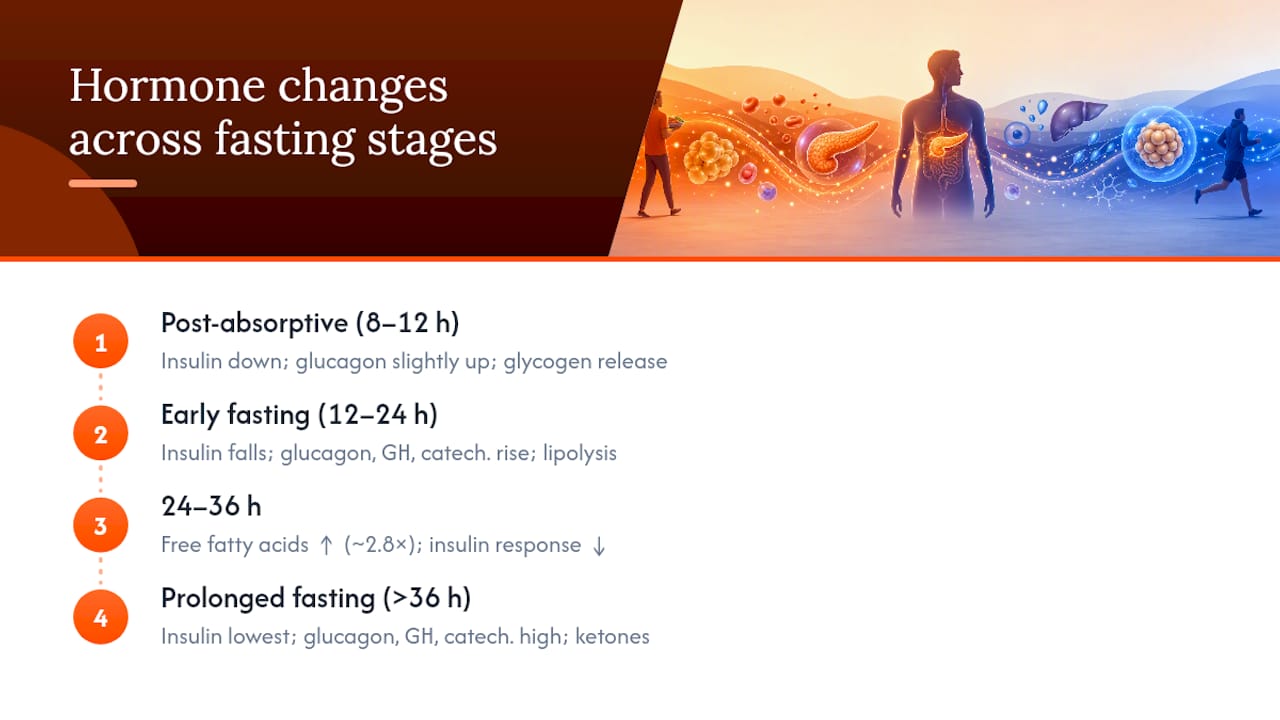
Insulin doesn’t fall in a straight line once you stop eating. It drops in stages, each with its own hormonal signature and metabolic consequence.
Post-absorptive phase (8–12 hours). This is the state most people are in when they wake up. Insulin has already dropped from its post-meal peak, glucagon has ticked up slightly, and the liver is releasing glucose from glycogen stores to keep blood sugar steady. Growth hormone and catecholamines are still near baseline. Nothing dramatic yet, but the switch has been flipped.
Early fasting (12–24 hours). Insulin continues to fall as glucagon rises further. Growth hormone and catecholamines begin increasing, reinforcing the liver’s glucose output. Glycogen stores start running low, so gluconeogenesis, the liver’s process of building new glucose from amino acids and glycerol, picks up more of the load. Lipolysis accelerates as insulin’s brake on fat release weakens.
24 to 36 hours. This is where the numbers get striking. Free fatty acids increase significantly above overnight-fasting levels in healthy adults, and the acute insulin response to a glucose challenge drops measurably alongside it. Some data also suggest that a 36-hour fast can produce a larger insulin spike at refeeding than a shorter 12-hour fast, as if the body overcorrects once food reappears.
Statistic Callout: In healthy adults, a 24-hour fast increased free fatty acids about 2.8-fold versus an overnight fast, with a parallel decline in insulin sensitivity and glucose-stimulated insulin secretion.
Prolonged fasting (beyond 36 hours). Insulin secretion drops to its lowest sustained levels. Glucagon, growth hormone, and catecholamines stay elevated, and the liver shifts increasingly toward ketogenesis as glycogen reserves are exhausted. Ketone bodies rise to supply the brain with an alternative fuel source, reducing the body’s reliance on glucose and, by extension, on insulin itself.
Across every stage, the pattern is consistent: insulin down, glucagon up, and a cascade of secondary hormones coordinating the handoff from stored fuel to mobilized fuel. It’s less a single switch and more a relay race, with each hormone picking up where the last left off.
How Lower Insulin Unlocks Glucose Production and Fat Burning
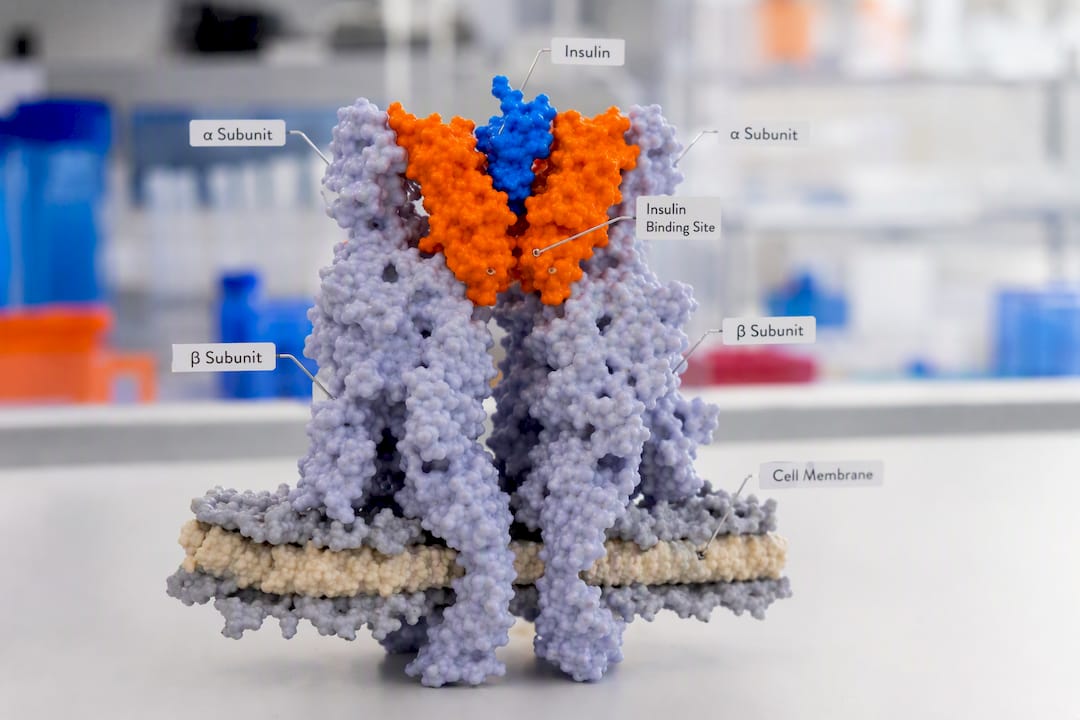
The mechanism behind all of this starts at the receptor level. Insulin normally binds its receptor and triggers a signaling cascade through PI3K and Akt, which pulls GLUT4 glucose transporters to the cell surface and activates glycogen synthase. That’s how insulin gets glucose into cells and glucose into storage. When insulin falls during fasting, that cascade quiets down. GLUT4 stops moving to the membrane, glycogen synthesis slows, and the metabolic door that insulin normally holds open starts to close.
With insulin’s suppressive effect lifted, two enzymes take over. Glycogen phosphorylase, activated by rising glucagon and catecholamines, starts breaking down stored glycogen into glucose. Hormone-sensitive lipase, no longer restrained by insulin, begins breaking down triglycerides in fat tissue into free fatty acids and glycerol. Insulin’s normal job is to suppress hepatic glucose output and lipolysis; fasting works precisely because that suppression fades.
There’s a subtler layer to this story that most explainers skip: beta-cells don’t simply shut off during fasting. They maintain a regulated basal secretion rate through a mechanism involving IGF2, IGF1R, and AKT2 signaling that restrains, rather than eliminates, insulin release. Basal secretion is a dial, not a switch. Insulin secretion itself is also multifactorial. Glucose is the dominant trigger, but amino acids, fatty acids, and other non-nutrient signals all modify how much insulin the pancreas puts out at any given moment.
One more variable complicates the picture for anyone measuring insulin directly: clearance. The liver and kidneys remove insulin from circulation continuously, and how efficiently they do that job shapes the fasting insulin number on a lab report just as much as secretion does.
Pro Tip: If you’re interpreting a low fasting insulin result in a research or clinical context, don’t assume it automatically means excellent insulin sensitivity. Reduced hepatic or renal insulin clearance can produce a low circulating number even when secretion and sensitivity are unremarkable. Pairing insulin with C-peptide, which isn’t cleared the same way, helps separate a secretion story from a clearance story.
What Human Studies Reveal About Fasting and Insulin Sensitivity
The clearest data on fasting and insulin come from controlled human studies using intravenous glucose tolerance tests (IVGTT) and clamp techniques, methods that measure insulin secretion and sensitivity far more precisely than a single blood draw.
The standout finding comes from research on healthy adults fasted for 24 hours: free fatty acids rose substantially compared with an overnight fast, and this was accompanied by a measurable decline in both insulin sensitivity and the acute insulin response to an intravenous glucose challenge. That combination matters more than either number alone. When insulin sensitivity drops, a healthy pancreas normally compensates by secreting more insulin. The fact that acute insulin response dropped too suggests fasting is temporarily uncoupling that compensation, not just dialing down sensitivity in isolation.
This is where the disposition index becomes useful. It’s calculated as the product of insulin sensitivity and insulin secretion, and it exists because either number alone is misleading. A person can have low insulin sensitivity but a healthy disposition index if their beta-cells compensate adequately. During a 24 to 36-hour fast, both terms of that equation move in the same direction, which is a distinct physiological state from the insulin resistance seen in early type 2 diabetes, where sensitivity drops but secretion tries to compensate.
Extending the fast to 36 hours introduces another wrinkle: refeeding. Several studies note that a longer fast can produce a bigger insulin spike upon refeeding than a shorter one, as though the pancreas overshoots once glucose becomes available again. That has practical relevance for anyone timing meals around longer fasting windows, a topic ForgeFast’s guide to hormonal optimization during fasting covers in more depth.
Study Focus | Population | Fasting Duration | Main Insulin-Related Finding |
IVGTT fasting study | Healthy adults | 24 hours | ~2.8x rise in FFAs; reduced insulin sensitivity and acute insulin response |
Fasting and refeeding comparison | Healthy adults | 36 hours vs. 12 hours | Larger refeeding insulin spike after the longer fast |
Fasting regimen reviews | Mixed adult populations | Intermittent protocols | Heterogeneous but generally favorable changes in metabolic markers |
Statistic Callout: A 24-hour fast in healthy adults produced a 2.8-fold rise in free fatty acids alongside reduced insulin sensitivity and acute insulin response, one of the largest and most consistently cited shifts in the fasting-insulin literature.
Broader reviews of intermittent fasting protocols report promising but inconsistent results on insulin sensitivity, largely because protocols, populations, and fasting durations vary so much between studies. That inconsistency isn’t a reason to dismiss the research. It’s a reason to be specific about which fasting duration and which population a given finding actually applies to.
Interpreting a Fasting Insulin Test: Ranges and Pitfalls
A fasting insulin result only means something in context. The commonly cited reference interval sits around 2.52 to 13.14 µIU/mL, or roughly 15.2 to 79.2 pmol/L, but that range shifts depending on the assay your lab uses. Two labs running the same blood sample can report meaningfully different numbers, so always read results against the reference range printed on that specific report, not a number pulled from an article.
Pattern matters more than the raw figure:
High insulin with normal glucose typically signals developing insulin resistance, the pancreas is working harder to keep glucose normal.
Low insulin with elevated glucose raises concern for reduced beta-cell function or, in more severe cases, pancreatic insufficiency.
Low insulin with normal glucose could reflect genuinely high sensitivity, or it could reflect a clearance effect rather than a true secretion story, which is why pairing tests matters.
Testing preparation affects the result directly. Standard clinical guidance calls for fasting 8 to 12 hours before the draw, water permitted. Biotin supplements are a frequently overlooked interference source: they can skew results on certain immunoassay platforms, so it’s worth pausing biotin for a few days before testing if your lab uses that method.
The single most useful upgrade to a standalone insulin test is pairing it with something else. Fasting glucose alongside insulin lets you calculate HOMA-IR, a widely used proxy for insulin resistance. C-peptide, released in equal amounts to insulin during secretion but cleared differently, helps distinguish a true secretion problem from a clearance-driven number. Neither pairing is exotic or expensive, and both add real interpretive value that a single insulin number can’t provide on its own.
Short-Term Adaptation Versus Long-Term Insulin Sensitivity
The most common misconception about fasting is treating the acute hormonal picture as identical to the long-term outcome. They’re not the same story.
In the short term, a single fast lowers insulin, raises free fatty acids, and can even produce a temporary dip in measured insulin sensitivity during that fasted window itself. That’s an expected, transient adaptation, not evidence that fasting harms metabolic health. The long-term question, what happens after weeks or months of a repeated intermittent fasting pattern, is different, and the evidence there is more encouraging but still uneven. Reviews of fasting regimens report generally favorable but heterogeneous effects on insulin sensitivity and related metabolic markers, with results depending heavily on protocol design, adherence, and starting metabolic status.
Some populations should avoid fasting or only attempt it under close medical supervision:
People with type 1 diabetes, due to serious hypoglycemia and ketoacidosis risk.
Anyone on insulin or sulfonylurea medications, which can cause dangerous blood sugar drops during extended fasts.
Pregnant or breastfeeding individuals.
Anyone with a history of eating disorders, where structured fasting can reinforce harmful patterns.
People with certain chronic conditions, including adrenal insufficiency or a history of hypoglycemia unawareness.
Fasting changes real hormonal physiology, not a cosmetic routine. If you take insulin, sulfonylureas, or manage a chronic condition, talk to a clinician before starting an extended fast. The mechanisms described here explain what happens in generally healthy adults, not a personalized medical recommendation.
Tracking Insulin-Related Changes Without a Lab Visit Every Week
You don’t need a blood draw every time you want a read on how fasting is affecting your metabolism. A fasting insulin test paired with fasting glucose gives you HOMA-IR, still one of the more practical insulin-resistance proxies available. C-peptide adds clarity when clearance might be muddying the insulin number itself, and an OGTT (oral glucose tolerance test) is worth considering if your fasting numbers look normal but something still feels off after meals.
Continuous glucose monitors offer a useful, needle-free proxy. Stable overnight glucose and a fast post-meal return to baseline after refeeding both suggest healthy insulin action, while prolonged post-meal elevations hint at reduced sensitivity worth investigating further.
Pro Tip: Don’t retest every week. Insulin and glucose markers move slowly in response to lifestyle changes, so retesting every three to six months gives a far more meaningful picture than chasing daily fluctuations. If a number looks concerning, that’s the time to loop in a clinician rather than adjusting your protocol on your own.
ForgeFast’s Take on Insulin-Aware Fasting
ForgeFast builds its protocols around exactly this staged physiology, structuring fasting windows to respect the post-absorptive, early-fasting, and extended phases described above rather than treating every fast as identical. The habit-coaching layer exists because knowing the mechanism isn’t the same as sustaining the behavior, and consistency is what actually moves insulin sensitivity over months, not the physiology of any single fast. Readers who want to go deeper on the hormonal side can explore ForgeFast’s guide to hormonal optimization or its breakdown of metabolic flexibility.
Physiology tells you what’s possible. Habits determine what’s sustainable. ForgeFast’s protocols are built at that intersection, with safety checks for anyone on medication or managing a medical condition.
A Candid Look at Starting Longer Fasts
Extending a fast past 24 hours will not feel neutral the first few times. Expect real hunger waves, some drop in energy mid-afternoon, and glucose that reads lower than you’re used to seeing. None of that is a red flag by itself; it’s the hormonal handoff described earlier, playing out in real time.
What actually helps is progressing gradually rather than jumping straight to a 36-hour fast, and tracking a small set of markers, fasting glucose, how you feel at hour 20 versus hour 30, energy levels, over several attempts instead of one. Pay attention to your own data before drawing conclusions from someone else’s study.
Ready to Put This Physiology Into Practice?
Understanding that insulin drops and glucagon rises during a fast is one thing. Building a fasting schedule you’ll actually stick with for months, timed to your own energy patterns and paired with real tracking, is a different challenge entirely.

ForgeFast turns the staged physiology covered here, post-absorptive, early fasting, extended fasting, into a structured protocol with built-in habit coaching, so you’re not guessing when to eat, when to push a fast longer, or when to back off. The platform pairs fasting windows with behavior tracking and psychological coaching designed to make the routine stick past the first difficult week, when most people abandon fasting before their body adapts. If you’re ready to apply what you now know about insulin, glucagon, and metabolic timing, start with ForgeFast’s fasting program and see how a structured protocol compares to fasting on instinct alone.
Sources
This article is general information, not a substitute for advice from a qualified doctor. Consult a qualified healthcare professional about your own circumstances before acting on anything here.
Recommended
Comments