What Is Metabolic Rate Fasting and How Does It Change Your Body?
- Tony Lindsay
- 2 days ago
- 8 min read


Fasting does not simply slow your metabolism down, and it does not simply speed it up either. The honest answer is that it does both, depending on how long you go without food and how often you do it. Short fasts of a day or less tend to trigger a brief uptick in metabolic rate, while chronic, severe calorie restriction stretched over weeks can push your body into an energy-saving mode that lowers it.
The clearest evidence for the short-term boost comes from a small study of 11 healthy men who fasted for three days and saw their resting metabolic rate climb by nearly 14%, an effect researchers linked partly to a surge in norepinephrine. That is a real, measured number, but it comes from a tiny sample of young, healthy men over a short window, so it is not a promise about what happens to everyone, especially over longer stretches or lower calorie intakes.
As you read further, you will see three distinct outcomes described in the research:
A transient rise in metabolic rate during the first one to three days without food, driven by stress hormones.
A fuel switch, where your body shifts from burning stored carbohydrate to burning fat and ketones.
Adaptive downregulation, where metabolic rate drops if severe calorie deficits continue for weeks without enough protein or muscle-protective training.
Key Takeaways
Short fasts can transiently raise metabolic rate through norepinephrine and fuel switching, while chronic severe calorie restriction risks adaptive metabolic slowdown over time.
Point | Details |
Short fasts can boost metabolism | One study found a 14% rise in metabolic rate during a 3-day fast in a small sample. |
BMR dominates energy use | Basal metabolic rate makes up roughly 60% to 70% of daily calorie burn, driven largely by muscle mass. |
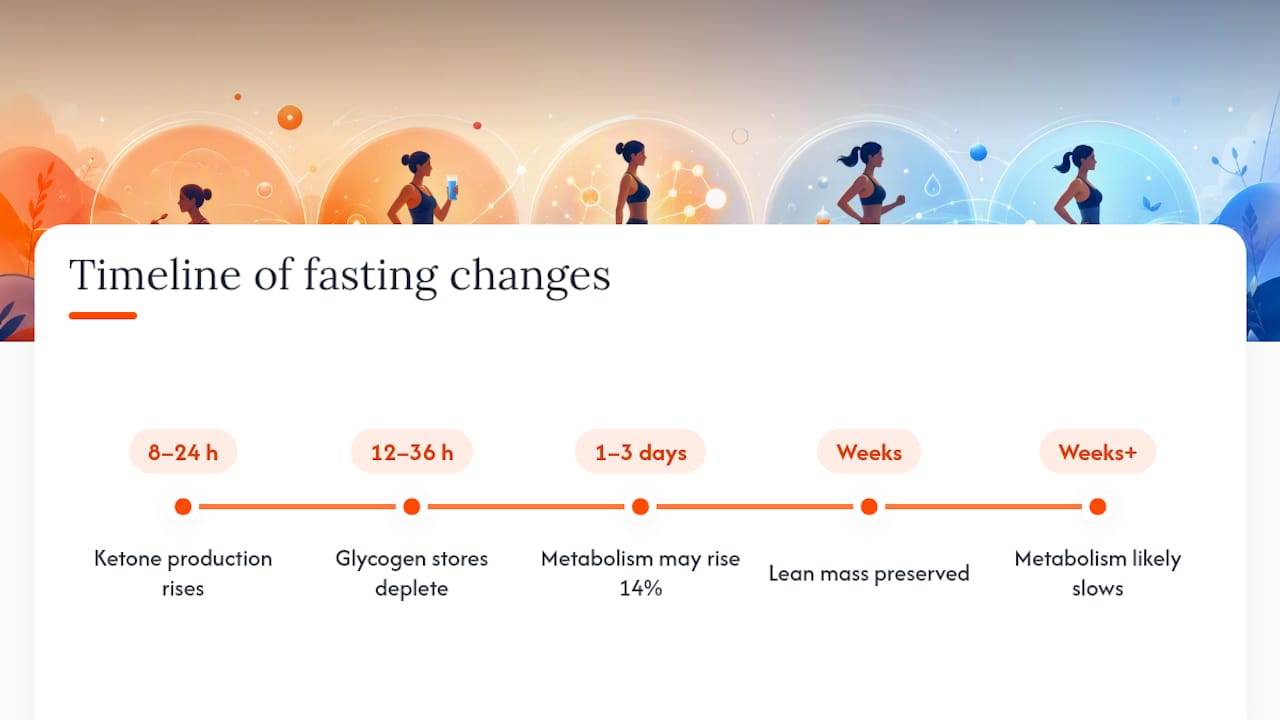
Fuel switching takes time | Glycogen typically depletes 12 to 36 hours into a fast, with ketones rising within 8 to 24 hours. |
Protein and training protect metabolism | Resistance training and adequate protein intake help prevent muscle loss during fasting periods. |
ForgeFast structures the process | ForgeFast pairs fasting schedules with habit coaching and tracking to help preserve muscle and avoid chronic under-eating. |
Table of Contents
What Is Metabolic Rate, and What Parts Make It Up?
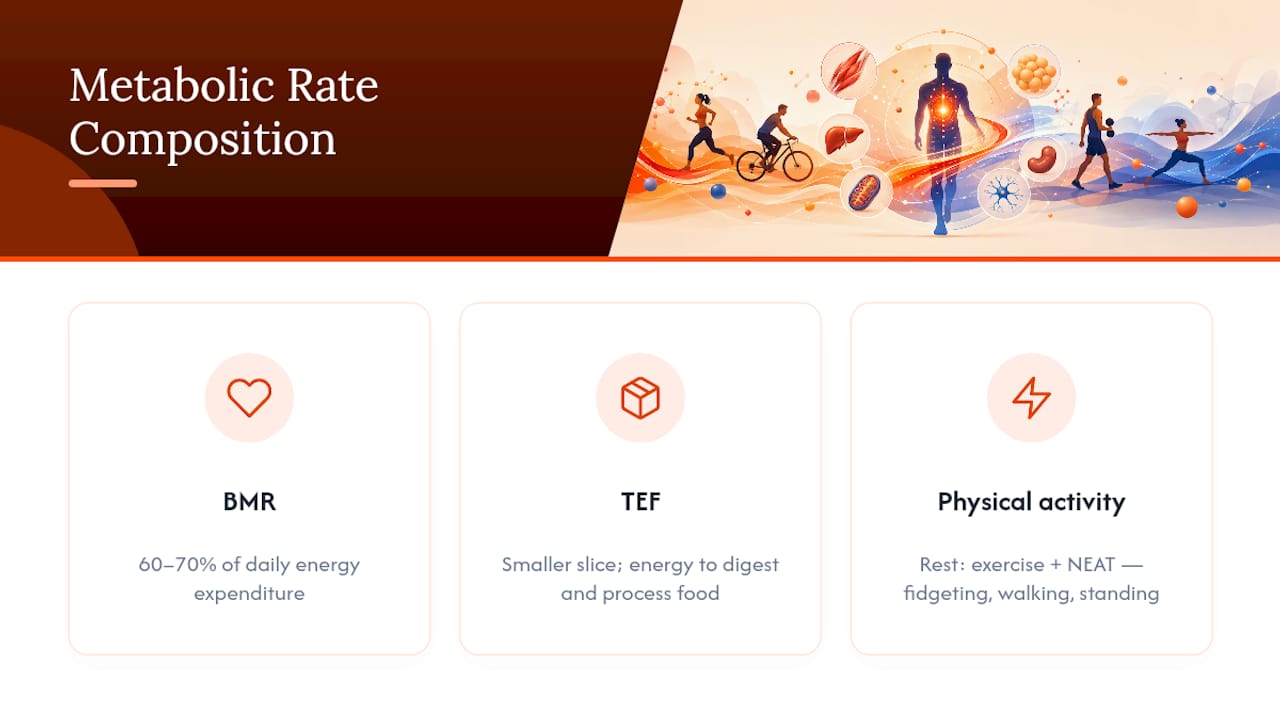
Metabolic rate is the total energy your body burns in a day, and it is made of three pieces. Basal metabolic rate (BMR) covers the energy your organs and cells need just to keep you alive, and it typically accounts for 60% to 70% of daily energy expenditure. The thermic effect of food (TEF) is the energy spent digesting and processing what you eat, usually a smaller slice of the pie. The rest comes from movement, split between structured exercise and NEAT (non-exercise activity thermogenesis) like fidgeting, walking, and standing.
When people talk about the “metabolic switch” in fasting, they mean the moment your body shifts its primary fuel source from stored glucose to fat-derived ketones. That switch is central to understanding everything fasting does to your metabolism.
How Does Fasting Change Your Body’s Fuel Use?
Your body does not flip a single switch when you stop eating. It moves through stages, each with its own hormonal signature. First it drains stored glycogen from your liver through a process called glycogenolysis. Once that supply runs low, it ramps up lipolysis, breaking down fat into fatty acids, and eventually ketogenesis, converting those fatty acids into ketone bodies your brain and muscles can use for fuel. Clinical physiology references describe this as a predictable, staged sequence rather than a sudden event.
Hormones drive every step of this shift:
Insulin drops, which unlocks fat stores for use as energy.
Glucagon rises, signaling the liver to release glucose and later ketones.
Norepinephrine increases, which is part of why short fasts can transiently boost calorie burn.
Growth hormone changes, helping preserve lean tissue while fat becomes the dominant fuel.
The metabolic switch to ketone metabolism does more than change what you burn. It is tied to improved cellular stress resistance, which is one reason researchers see fasting as more than a calorie-counting trick.
When Does Your Body Actually Switch Fuel Sources?
Timing varies by person, but general patterns hold across most healthy adults. Between 8 and 12 hours into a fast, your body is still leaning on glucose and glycogen, with digestion winding down. From roughly 12 to 36 hours, liver glycogen depletes and ketone production climbs, often reaching measurable levels within the first 24 hours. Push past 24 to 72 hours, and fat oxidation keeps rising while your body increasingly relies on ketones and, eventually, some amino acid conversion for glucose.
Your prior diet, activity level, and insulin sensitivity all shift these numbers earlier or later. Someone who trains hard or eats low-carb regularly may reach ketosis faster than someone coming off a high-carb weekend. Lab timelines are useful benchmarks, not guarantees for your Tuesday afternoon.
Does Fasting Raise or Lower Metabolism Long Term?
Short fasts and long-term fasting patterns tell two different stories, and mixing them up is where a lot of confusion starts. The 14% metabolic rate increase from the three-day fasting study is real, but it is a snapshot, not a lifestyle. Longer trials comparing intermittent fasting to steady daily calorie restriction generally find comparable, sometimes favorable, effects on resting metabolic rate and lean mass retention, particularly when protein intake stays adequate. Some alternate-day and whole-day fasting studies also report meaningful improvements in LDL cholesterol and triglycerides over several weeks to months.
The pattern that shows up again and again in the literature is this: brief fasting periods can nudge metabolic rate upward through norepinephrine and fuel switching, but chronic, aggressive under-eating over many weeks is the scenario most associated with adaptive metabolic slowdown.
Sample sizes across these studies stay small, protocols vary widely, and few trials follow people for more than a few months. The balance of evidence favors moderate, well-structured fasting windows over prolonged severe deficits, but nobody has run the definitive decade-long trial yet.
How Do You Fast Without Slowing Your Metabolism?
Preserving metabolic rate while fasting comes down to protecting muscle and avoiding chronic starvation-level deficits. A few practices make the difference between fasting that supports your metabolism and fasting that fights it.
Prioritize protein on eating windows to give your body the raw material to maintain lean tissue.
Keep resistance training in your routine, since muscle mass is a major modifiable driver of BMR.
Avoid stacking extreme deficits with prolonged fasting windows for weeks on end.
Plan refeed windows so your intake matches your goals over the week, not just each fasting day.
Shorter daily fasting windows (14 to 16 hours) fit people who want sustainable habits without dramatic calorie swings. Alternate-day or longer multi-day fasts fit specific short-term goals but carry a higher risk of muscle loss if protein and training are neglected.
Pro Tip: Track strength in the gym, not just the number on the scale. A dropping metabolic rate often shows up as fading strength before it shows up in your body weight.
Who Should Be Careful With Fasting?
Fasting is not the right fit for everyone. Pregnant or breastfeeding people, individuals with type 1 diabetes, anyone with a history of an eating disorder, and people on medications requiring food should avoid or closely supervise any fasting protocol. If you do fast for longer stretches, stay hydrated, replace electrolytes, and skip high-intensity training during deep fasting states unless a professional is guiding you. Talk to a clinician before starting if you have any underlying health condition.
Do These Common Fasting Claims Hold Up?
“Fasting always slows your metabolism.” False for short fasts. Studies show a transient rise, not a drop.
“16 hours is the universal sweet spot.” Not supported. Individual response varies with activity, diet history, and goals.
“Any calorie deficit eventually tanks your metabolism.” Only true at extremes. Moderate, well-structured fasting rarely does this when protein and training stay consistent.
How Does ForgeFast Apply This Science?
ForgeFast builds its framework around the distinction this article keeps returning to: structured fasting is not the same as chronic under-eating. The method centers on habit formation, mental coaching, and tracking, paired with resistance training guidance to protect lean mass while pursuing metabolic flexibility. Refeed windows and consistent monitoring are built in rather than left to guesswork.
Structured fasting works because it has boundaries. Chronic under-eating fails because it doesn’t. ForgeFast is designed to keep users on the right side of that line.
Readers looking for scheduling templates that respect this balance can start with structured fasting schedules built for people juggling demanding jobs.
A Coach’s Take on Fasting and Real Life
Most people don’t fail at fasting because the science is wrong. They fail because they treat a 16 hour window like a punishment instead of a habit, then abandon it the first week it gets inconvenient. The research on metabolic rate matters, but it only helps you if you actually stick with a protocol long enough to see it play out. Pair what you learn here with a clinician’s input if you have any health complexity, and treat consistency as the real variable you control.
Want Help Applying This Without the Guesswork?
If you have made it this far, you already know fasting isn’t a single lever you pull. It is protein intake, training, timing, and consistency working together, and most people burn out trying to track all of it with a notes app and willpower. ForgeFast turns that science into a structured daily framework, with habit tracking, coaching prompts, and resistance-training guidance built around protecting muscle while your body adapts to fasting.

The app pairs fasting windows with protein targets and strength benchmarks so you can see whether your metabolism is holding steady, not just whether the scale moved. If you train hard, a system like Fortivus can complement that resistance work, and a wearable like Voltra can help you watch how your body responds to different fasting windows in real time. If you want a guided version of everything covered here, start a trial at ForgeFast and get a plan built around your schedule instead of a generic 16 hour rule.
Frequently Asked Questions
What is metabolic rate fasting? It refers to how fasting affects the rate at which your body burns energy, including short-term increases from hormonal shifts and longer-term changes tied to fuel source switching and calorie balance.
Does fasting speed up or slow down metabolism? Short fasts of one to three days can transiently speed up metabolic rate by up to 14% in one study, while prolonged, severe calorie restriction over weeks is more likely to slow it down.
How long does it take for fasting to change your metabolism? Glycogen stores typically deplete within 12 to 36 hours, with ketone production rising within 8 to 24 hours in many people, though individual timing varies with diet and activity history.
Can intermittent fasting cause muscle loss? It can if protein intake is too low and resistance training is skipped, but trials show intermittent fasting can preserve lean mass about as well as steady calorie restriction when protein and training stay consistent.
Is fasting safe for everyone? No. Pregnant or breastfeeding individuals, people with type 1 diabetes, anyone with a history of eating disorders, and those on certain medications should avoid fasting or only attempt it under medical supervision.
This article is general information, not a substitute for advice from a qualified doctor. Consult a qualified healthcare professional about your own circumstances before acting on anything here.
Sources
Recommended
Comments