Protect Muscle and Bone With Intermittent Fasting in Menopause


Intermittent fasting can help many women control menopause-related weight gain and improve metabolic markers when the approach is tailored to their bodies, but it has to start gently. Women with a history of disordered eating, those on insulin, or those with significant bone loss need medical guidance first. The safest entry point is a 12-hour overnight fast, adjusted upward only if energy, sleep, and mood stay steady.
TL;DR:
Starting with a 12-hour overnight fast is safest for women new to fasting, with gradual increases only if energy, sleep, and mood remain stable.
Intermittent fasting offers cardiometabolic benefits similar to calorie restriction, mainly through modest daily deficits of about 250 calories.
Fasting reduces visceral fat and supports modest weight loss, but results depend heavily on protein intake, resistance training, and adherence.
Women with osteoporosis, hormonal sensitivities, or on medications like insulin should consult a doctor before attempting fasting protocols.
A slow, adaptive approach with attention to stress, hydration, and nutrient timing maximizes safety and effectiveness during menopause.
Table of Contents
What Is Intermittent Fasting and Which Method Fits Menopause?
Intermittent fasting is not one diet. It is a family of eating patterns built around when you eat, not just what you eat, and menopause changes which version makes sense for your body.
The most common approaches include:
Time-restricted eating (TRE): compressing meals into a daily window, typically lasting several hours.
16:8: a 16-hour fast with an 8-hour eating window, a commonly studied TRE variant.
14:10: a gentler fast with a corresponding eating window, often a better starting point for perimenopausal women.
12:12: a mild overnight fast matching normal sleep hours, useful as an introductory approach.
5:2: eating normally most days and restricting calories on two non-consecutive days each week.
Alternate-day fasting (ADF): alternating between days of normal eating and days with significantly reduced calories.
Timing matters as much as the method. Chan School of Public Health](https://hsph.harvard.edu/news/the-health-benefits-of-intermittent-fasting/). For midlife women, most clinicians favor starting with TRE rather than 5:2 or ADF. It’s gentler on cortisol, easier to sustain around family schedules, and gives you a lower-risk way to test how your body responds before considering anything more aggressive.
What Does the Research Actually Show?
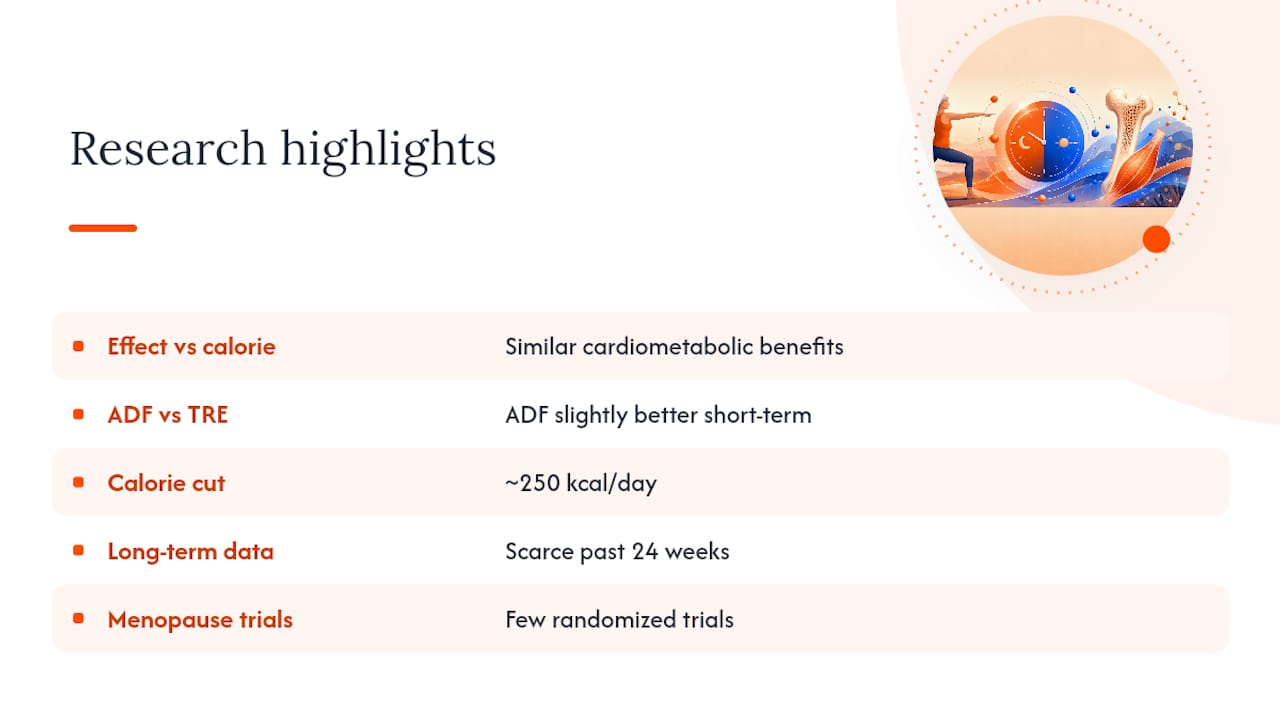
The strongest evidence available says intermittent fasting works about as well as ordinary calorie cutting, not dramatically better. A 2025 systematic review and network meta-analysis published in The BMJ compared several fasting strategies against continuous energy restriction and found similar cardiometabolic benefits across the board. Alternate-day fasting edged out time-restricted eating by a small margin in shorter trials, but that gap likely narrows over longer follow-up, since the same review noted a lack of long-term data past 24 weeks showing sustained superiority for any single method.
Time-restricted eating tends to cut daily intake by roughly 250 calories without any conscious counting, largely because a shorter window curbs late-night snacking and blunts hunger-hormone swings.
That roughly 250-calorie daily deficit translates to moderate weight loss per week for many people, according to Harvard Health. It’s not dramatic, but it’s consistent, and consistency is what actually moves the needle over a year rather than a month.
Menopause-specific research is where things get thinner. A clinical review focused specifically on IF during menopause found that fasting can reduce visceral fat and improve metabolic markers in this population, but the authors were candid about a real gap: menopause-specific randomized trials remain scarce, and unsupervised fasting carries a real risk of nutritional shortfalls or unwanted hormonal effects if it’s not planned around a woman’s changing physiology.
A smaller pilot study pairing IF with high-intensity interval training in postmenopausal women reported improved body composition and physical performance, suggesting fasting paired with the right kind of exercise may be more beneficial than fasting alone.
The honest summary: intermittent fasting is a legitimate tool for menopausal weight management, backed by decent evidence for its cardiometabolic effects, but it is not a menopause-specific miracle. It works within the same physics as any calorie-controlled approach, just delivered on a schedule your appetite hormones tolerate better.
What Benefits Can Menopausal Women Realistically Expect?
The most consistent, evidence-linked benefit is a reduction in visceral fat, the metabolically active fat around the abdomen that tends to increase sharply after menopause regardless of scale weight. Alongside that, many women see modest but clinically meaningful weight loss, improved insulin sensitivity, and better fasting glucose numbers within a few months of consistent time-restricted eating.
Beyond weight, IF shows up in a few other places worth watching:
Improved lipid markers (triglycerides and sometimes LDL) in several trials
Modest blood pressure reductions tied to earlier eating windows
Reduced markers of inflammation and oxidative stress in some studies
Preliminary signals of cognitive and cellular aging benefits, though this evidence is still early and shouldn’t be oversold
None of this happens automatically just by narrowing your eating window. Results depend heavily on adherence, how early your window falls, protein intake, and whether you’re pairing fasting with strength training. Two women doing the identical 16:8 schedule can get very different results based on those variables alone.
Pro Tip: Track your energy and mood for the first two weeks, not just your weight. If you feel sharp and steady by week three, your window is probably right. If you’re foggy or irritable by 2 p.m. every day, you’ve likely made the window too aggressive too fast.
Are There Hormonal Risks or Reasons to Avoid Fasting?
Fasting is a mild physical stressor, and menopause already changes how your body handles stress. That combination is where most of the real risk lives.
Cortisol and sleep. Longer fasts can raise cortisol in some women, and elevated cortisol during perimenopause is already linked to disrupted sleep and mood swings. If you notice worse sleep or more anxiety after starting a fast, that’s a signal to shorten the window, not push through it.
Thyroid function. A prolonged calorie deficit, especially combined with under-eating protein, can suppress thyroid signaling in people who are already sensitive to energy restriction. This matters more for women who are already lean or who have a history of thyroid issues.
Muscle and bone. Fasting without enough protein or resistance training accelerates the muscle and bone loss that menopause is already driving. This is arguably the single biggest risk for this age group specifically, more than for younger fasters.
Certain groups need medical supervision before trying any IF protocol, according to guidance from Johns Hopkins Medicine:
Anyone with type 1 diabetes or on insulin or sulfonylureas, due to hypoglycemia risk
Anyone with a current or past eating disorder
Women with advanced osteoporosis or a recent fracture
Pregnant or breastfeeding women
Anyone who is underweight or has unexplained weight loss
If you fall into any of these categories, talk to your doctor before changing your eating window, full stop.
How Should You Start Intermittent Fasting Safely?
Rushing into a 16-hour fast in week one is the most common mistake, and it’s usually what causes women to quit fasting altogether after a rough first week. A slower ramp works better and sticks longer.
Start with a 12-hour overnight fast for one to two weeks. This is basically an early dinner and a slightly delayed breakfast, nothing dramatic.
Extend to 13 to 14 hours once the first stage feels easy. Watch sleep, mood, and energy closely during this step.
Consider 16:8 only if the above stays stable. If energy dips, sleep worsens, or mood gets shaky, stay at 14 hours longer rather than pushing forward.
Choose an earlier eating window. Options like 7 a.m. to 7 p.m., 8 a.m. to 4 p.m., or 9 a.m. to 5 p.m. all outperform late-night windows for blood sugar control, per Harvard’s research.
Prioritize protein at every meal, aiming for roughly 20 to 30 grams per meal, along with adequate calcium, vitamin D, and healthy fats. Skipping straight to calorie cutting without protein is how muscle loss creeps in.
Pair fasting with resistance training two to three times a week. Keep some higher-intensity cardio if your joints and energy tolerate it.
Time medications carefully. If you’re on any glucose-lowering medication, coordinate dosing and meal timing with your prescriber before changing your schedule.
Skip the fast on hard training days or after poor sleep. Fasting on top of a bad night or a heavy workout stacks stress your body doesn’t need.
Pro Tip: Build in one or two “break” days a week where you eat on a normal schedule. It sounds counterintuitive, but it’s often what makes an eating window sustainable for months instead of weeks. Apps built for schedules tailored to busy routines can help you find a rhythm that survives a real work week, not just a perfect one.
How Do You Know If Fasting Is Working for You?
Give your body two to four weeks before judging results. That adaptation window is when most people move from feeling hungry and irritable to feeling stable and clear, according to Johns Hopkins. If you quit at day five because you feel awful, you likely never got past the hardest part.
Track a few concrete markers rather than obsessing over the scale alone:
Body weight and waist circumference, checked weekly, not daily
Strength progress in your resistance training sessions
Sleep quality and how rested you feel on waking
Mood stability across the day, not just after meals
Blood glucose readings, if you’re diabetic or prediabetic
Stop and call your doctor if you notice repeated lightheadedness or symptoms of low blood sugar, mood or sleep that keeps getting worse instead of better, or any signs of rapid bone loss such as a new fracture. Those aren’t “push through it” signals. They’re stop signals.
How Does Fasting Interact With Menopausal Bone Health?
Bone density loss accelerates in the years around menopause as estrogen drops, and that timing overlaps exactly with when many women start experimenting with fasting for weight control. The interaction isn’t automatically bad, but it isn’t automatically safe either.
The risk isn’t fasting itself. It’s fasting combined with too little protein, too little calcium and vitamin D, and no resistance training, which together can compound the bone loss that’s already underway. A pilot study pairing IF with structured exercise in postmenopausal women found favorable body composition changes, reinforcing that the exercise component isn’t optional for this age group; it’s protective.
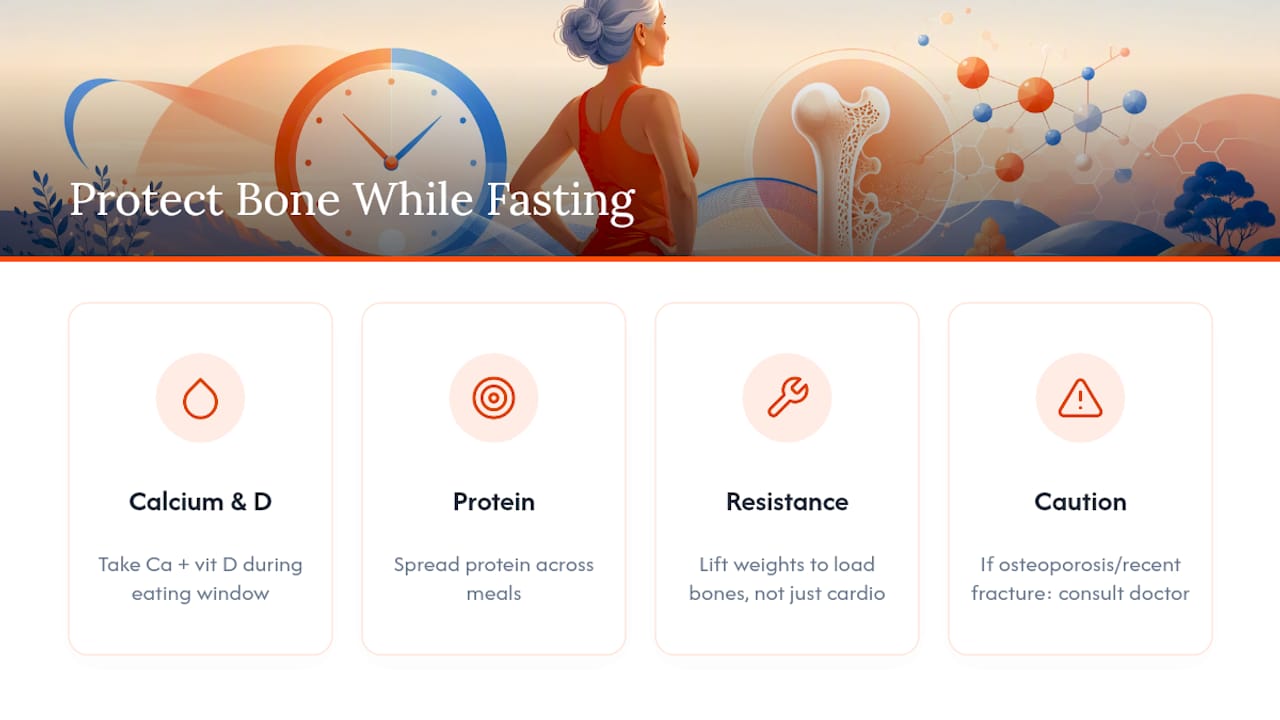
Three things matter most for protecting bone while fasting: adequate calcium and vitamin D intake within your eating window, protein spread across meals rather than crammed into one, and resistance training that loads your bones, not just cardio. Walking helps, but lifting weights does more for bone density specifically. Women with existing osteoporosis or a recent fracture should treat any fasting plan as something to run past their doctor first, not something to try solo and see what happens. The stakes with bone loss are higher than with a slow week of weight loss, and mistakes here aren’t easily reversible.
What Should You Know About Hydration and Nutrient Timing?
Fasting windows change when you eat, not how much water and key nutrients your body needs, and that distinction trips up a lot of first-time fasters.
Water, black coffee, and plain tea are generally fine during a fast and actually help manage hunger during the adaptation period. Electrolytes matter more than most people expect, especially for women already dealing with hot flashes or night sweats that increase fluid loss. A pinch of salt in water or an electrolyte supplement without added sugar can prevent the headaches and dizziness that sometimes get blamed on fasting itself when they’re really just dehydration.
Inside your eating window, sequence matters. Front-load protein at your first meal to curb hunger for the rest of the day, and don’t leave calcium and vitamin D sources for the very end of your window when you might be too full to prioritize them. Healthy fats, from sources like olive oil, avocado, or nuts, help slow digestion and keep you satisfied longer on a compressed schedule. Thoughtful meal preparation makes this dramatically easier, since scrambling to hit protein and micronutrient targets in a shorter window is where most fasting plans quietly fall apart.
How Do Stress and Social Life Fit Into a Fasting Routine?
Fasting is as much a psychological habit as a physical one, and menopause is already a period of significant mental load for a lot of women, between sleep disruption, mood shifts, and the general chaos of midlife schedules. Layering a rigid eating window on top of that without flexibility tends to backfire.
The women who stick with fasting longest tend to treat it as adaptable rather than absolute. A dinner invitation that falls outside your usual window isn’t a failure, it’s a reason to shift the window that day. Rigid all-or-nothing thinking is what turns a sustainable habit into another source of stress, and added stress works against the exact hormonal goals fasting is supposed to support.
Social eating deserves particular attention here. If your eating window consistently conflicts with family dinners or work events, the plan needs to bend, not your willpower. Building in break days, as mentioned earlier, gives you a built-in pressure release valve for exactly these situations. Fasting that requires isolating yourself from normal life rarely survives past a few months, no matter how good the metabolic theory behind it is.
How ForgeFast Applies This Evidence to Real Habits
Most of the science above is solid, but knowing it and living it are different problems. That gap is exactly where structure earns its keep. The fasting protocols described here emphasize gradual window progression, earlier eating windows tied to circadian timing, and habit coaching that treats consistency as a skill you build, not willpower you either have or don’t.
The behavior-tracking side matters more for menopausal women specifically, since adherence and mental resilience, not the fasting method itself, are what usually decide whether results show up at three months or never. The coaching approach pairs fasting schedules with reminders around protein targets and resistance training, addressing the muscle and bone risks covered earlier rather than ignoring them the way a generic fasting app might.
The Bottom Line on Fasting Through Menopause
Intermittent fasting can genuinely help with menopausal weight gain and metabolic markers, but only when it’s personalized rather than copied from a generic plan. Start small with a 12-hour fast, protect muscle and bone with protein and resistance training, and monitor closely if you fall into any higher-risk category. If you want a structured path through that process, ForgeFast’s fasting programs are built around exactly this kind of gradual, supervised approach.
The Take Nobody Wants to Hear About Fasting and Menopause
Most fasting advice aimed at midlife women oversells the hormone story and undersells the boring stuff that actually determines outcomes: protein intake, resistance training, and sleep. The research doesn’t support fasting as some special metabolic reset unique to menopause. It supports fasting as a decent tool for calorie control that happens to align well with circadian biology, nothing more mystical than that.
Where conventional advice fails most women isn’t the fasting schedule. It’s the assumption that once you pick a window, you’re done. The women who actually get results treat the eating window as the easy 20 percent and treat protein targets, strength training, and stress management as the harder 80 percent that determines whether menopause-related muscle and bone loss gets worse or gets managed.
If you’re starting out, prioritize the adaptation period over the ambition of your schedule. A sustainable 14:10 you can hold for a year beats a 16:8 you abandon in three weeks. Build the habit first. Tighten the window later, if at all.
— Tony Lindsay
Ready for a Fasting Plan Built Around Your Actual Life?
Generic fasting apps hand you a timer and call it done. Some fasting programs pair your schedule with habit coaching and protein and training targets as described here, aiming to protect muscle, bone, and mood while supporting weight loss.

That combination matters most for women in their 40s and 50s, where the margin for error on muscle loss and hormonal stress is smaller than it was at 25. Structured protocols often start with a gentle overnight fast as recommended here, then progress based on actual energy and sleep data rather than a fixed calendar. If you’re tracking eating windows manually right now, pairing that habit-tracking with the right hardware, like the wearable devices covered by Repbeats, can make the adherence side even easier to see day to day. Common missteps, like extending your window too fast or skipping protein, are covered directly in ForgeFast’s guide to fasting mistakes so you don’t have to learn them the hard way.
Start with ForgeFast’s fasting and coaching platform and try the reset challenge to see whether a structured, coached approach fits your schedule better than going it alone.
This article is general information, not a substitute for advice from a qualified doctor. Consult a qualified healthcare professional about your own circumstances before acting on anything here.
Sources
Recommended
Comments