Overnight Fasting and Athletic Muscle Repair: 2026 Guide


Overnight fasting supports athletic muscle repair when protein intake is adequate. The science is clear: pausing food intake during sleep hours does not automatically trigger muscle loss. What matters far more is whether you hit your total daily protein target and time your feedings strategically around your training. Athletes who manage both variables can use overnight fasting as a tool for metabolic recovery without sacrificing the lean mass they work hard to build.
Here is what the research shows at a glance:
Fasting of extended duration does not impair muscle protein synthesis when protein intake is matched across feeding windows.
Fasting triggers a hormonal shift, including reduced insulin and elevated growth hormone that activates autophagy and cellular repair.
Intermittent fasting preserves lean mass at the same rate as standard diets when total protein and calorie targets are met.
Pre-sleep protein intake, roughly 40g, boosts overnight muscle protein synthesis and can be layered on top of a fasting protocol without breaking its metabolic benefits.
The primary risk to muscle during fasting is not the fast itself. It is chronically low protein intake.
Endurance and strength athletes need different fasting timing strategies based on their metabolic demands and recovery windows.
How overnight fasting affects muscle protein synthesis and repair
Muscle is in a constant state of turnover. Old or damaged proteins break down through muscle protein breakdown (MPB), and new proteins are built through muscle protein synthesis (MPS). The net difference between these two processes determines whether you gain, maintain, or lose muscle over time.
During an overnight fast, insulin drops to its lowest daily level. That matters because insulin is one of the primary signals that suppresses MPB. When insulin falls, MPB rises to release amino acids from muscle tissue, which the body uses as fuel and as raw material for other tissues. This is a normal physiological process, not a crisis. The key is what happens when you eat again.
Growth hormone, which rises sharply during sleep and fasting, counteracts some of the catabolic pressure by promoting fat oxidation and supporting tissue repair. Autophagy, the cellular process that clears damaged proteins and organelles, also ramps up during fasting. For athletes, this is not a side effect. It is a genuine recovery mechanism that improves mitochondrial function and long-term muscle quality.
The table below summarizes the key hormonal and metabolic changes during overnight fasting and their relevance to muscle repair.
Mechanism | Change During Fasting | Effect on Muscle Repair |
Insulin | Decreases | Reduces anti-catabolic signal; MPB rises modestly |
Growth hormone | Increases | Promotes tissue repair and fat oxidation |
Autophagy | Activated | Clears damaged proteins; improves muscle quality |
Insulin sensitivity | Improves | Enhances nutrient uptake during refeeding |
Inflammation markers | Reduced over time | Supports faster recovery from training stress |
Mitochondrial biogenesis | Stimulated via AMPK/PGC-1α | Improves endurance adaptation and energy efficiency |
A randomized controlled trial found no significant differences in daily MPS rates between alternate day fasting, continuous energy restriction, and a control diet when protein intake was matched across all groups. There were no significant differences in daily muscle protein synthesis rates between alternate day fasting, continuous energy restriction, and a control diet when protein intake was matched across groups That is a striking result. It tells you that the fasting pattern itself is not the variable that drives muscle loss. Protein adequacy is.
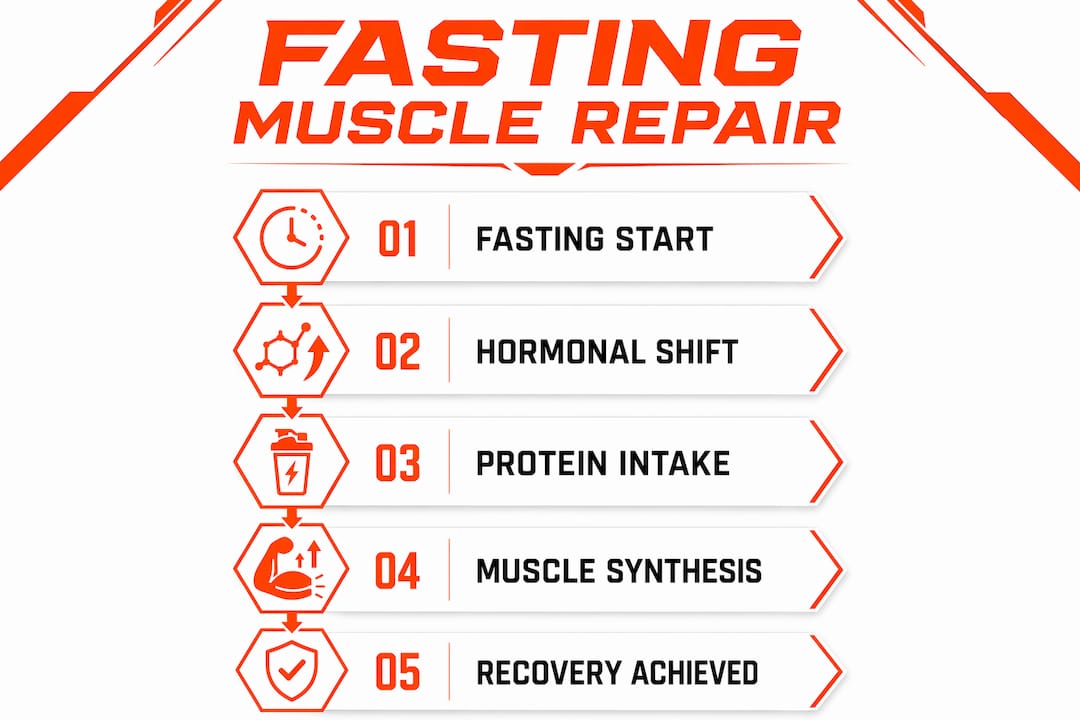
Where fasting does create a genuine challenge is meal frequency. Research on muscle protein turnover shows that MPS is stimulated by dietary amino acids in a saturable response. Cramming all your protein into one or two large meals risks hitting the anabolic ceiling, where excess amino acids are oxidized rather than incorporated into muscle. Spreading protein across multiple feedings separated by 3–5 hours produces more total MPS pulses across the day, which is why athletes using time-restricted eating need to be deliberate about meal structure within their feeding window.
How fasting changes your performance and recovery timelines
The effect of fasting on athletic performance is not uniform. It depends heavily on training type, fasting duration, and how well the athlete manages nutrition in the eating window.

For endurance athletes, fasting can actually be an asset. Training in a fasted state shifts fuel utilization toward fat oxidation and stimulates mitochondrial adaptations through AMPK and PGC-1α activation. Over time, this improves metabolic flexibility, meaning the athlete can sustain effort longer before depleting glycogen. The tradeoff is that high-intensity efforts, which rely on glycogen, may feel harder during the fasted window.
Strength athletes face a different calculus. Resistance training during a fast increases MPB, which in the absence of dietary amino acids can tip the balance toward net muscle loss in the short term. The good news: weight training combined with fasting preserves lean mass and improves fat loss when protein targets are met. The exercise stimulus itself is a powerful signal that partially offsets the catabolic pressure of the fast.
Recovery timelines during fasting follow a predictable pattern. The first 8–10 hours of an overnight fast represent normal postabsorptive physiology. Beyond 12–16 hours, MPB accelerates modestly, but the anabolic response to the next protein feeding is amplified, meaning your muscles are primed to absorb amino acids efficiently when you break the fast. Athletes should plan their first post-fast meal to be protein-rich for this reason.
Practical considerations by training type:
Endurance athletes benefit from fasted morning training for fat adaptation, but should consume carbohydrates and protein within 30–60 minutes after sessions lasting more than 90 minutes.
Strength and power athletes should schedule resistance training toward the end of the fasting window or early in the feeding window to minimize the overlap between peak MPB and the training stimulus.
Team sport athletes with unpredictable training loads need flexible fasting windows, typically 12–14 hours overnight rather than strict 16:8 protocols.
Masters athletes (over 40) face greater anabolic resistance and should prioritize protein at every meal within the feeding window, targeting at least 1.6g per kilogram of body weight daily.
Hydration and electrolytes deserve specific attention during fasting. Sodium, potassium, and magnesium all play roles in muscle contraction and nerve signaling. During extended fasts, especially in athletes who sweat heavily, electrolyte depletion can cause cramping and impair performance before any protein-related issue surfaces. Drinking water with a small amount of sodium during the fasting window is a practical fix that does not break the metabolic benefits of the fast.
Training Type | Recommended Fasting Window | Key Nutrition Priority | Recovery Focus |
Endurance | 12–16 hours overnight | Carbohydrate + protein post-session | Fat adaptation, mitochondrial health |
Strength/Power | 12–14 hours overnight | Protein at fast-break meal | MPS stimulation, lean mass retention |
Team sports | 12–14 hours overnight | Flexible protein timing | Glycogen replenishment, hydration |
Masters athletes | 12 hours overnight | High protein frequency | Anabolic resistance mitigation |
For athletes looking to build a structured fasting protocol around their training schedule, the key variable is not the length of the fast. It is the quality and distribution of protein in the eating window.
What to eat and when to maximize overnight muscle repair
Protein timing around sleep is one of the most underutilized tools in athletic recovery. Most athletes focus on post-workout nutrition but ignore what happens during the 7–9 hours they are asleep, which is when the majority of tissue repair and hormonal recovery actually occurs.

Pre-sleep protein intake changes that equation. Research published in 2023 shows that consuming protein immediately before sleep produces robust stimulation of both myofibrillar and mitochondrial protein synthesis overnight. Critically, this finding challenges the long-held assumption that casein protein is uniquely suited for overnight use. Both whey and casein produced meaningful MPS responses when consumed before sleep, though their kinetics differ.
Whey vs. casein for overnight recovery:
Whey protein is rapidly digested and produces a sharp, high-amplitude MPS spike. It is effective pre-sleep but may be fully absorbed within 2–3 hours, leaving a longer window without amino acid availability.
Casein protein digests slowly, releasing amino acids steadily over 5–7 hours. This sustained release aligns well with the overnight fasting window and maintains a positive amino acid balance for longer.
Practical recommendation: For athletes with a strict overnight fast, casein before sleep provides more sustained amino acid availability. For athletes who train late and eat their last meal 2–3 hours before bed, either protein source works.
Pro Tip: Consuming approximately 40g of protein (whey or casein) immediately before sleep can significantly boost overnight muscle protein synthesis without meaningfully disrupting the metabolic benefits of the overnight fast.
The anabolic ceiling is a real constraint. MPS is saturated at a moderate protein dose per meal, roughly 20–40g depending on body size and training status. Consuming more than that in a single sitting does not proportionally increase MPS. Instead, excess amino acids are oxidized. This is why the structure of your feeding window matters as much as total daily protein.
Protein Source | Digestion Rate | Overnight MPS Effect | Best Use Case |
Casein | Slow (5–7 hours) | Sustained, steady elevation | Pre-sleep for overnight fast |
Whey | Fast (1–2 hours) | High-amplitude, short-duration spike | Post-workout or early feeding window |
Whole food (e.g., cottage cheese) | Moderate | Moderate, sustained | Pre-sleep for athletes who prefer whole foods |
Plant-based blend | Variable | Lower per gram; requires higher dose | Vegan athletes; combine sources |
Aligning your feeding window with your circadian rhythm amplifies these benefits further. Finishing your last meal at least 3 hours before sleep improved nighttime blood pressure by 3.5% and heart rate by 5% in research tracking cardiovascular outcomes. The exception is the pre-sleep protein dose, which sits in a narrow window where the metabolic cost is low and the anabolic benefit is high. Athletes should treat it as a targeted recovery tool, not a late-night snack.
For a deeper look at how to structure your eating window around training sessions, ForgeFast’s guide on post-workout fasting windows walks through the timing logic in detail.
Balancing fasting’s metabolic benefits with your muscle recovery needs
The tension athletes feel between fasting and muscle building is real, but it is mostly a framing problem. Fasting is a metabolic tool. Muscle hypertrophy is a separate goal. When you treat them as competing priorities, you end up compromising both. When you treat fasting as the recovery and housekeeping phase and your feeding window as the building phase, they work together.
Autophagy, the cellular cleanup process activated during fasting, does not break down healthy muscle proteins at meaningful rates during a standard 12–16 hour overnight fast. It primarily targets damaged organelles and misfolded proteins, which is exactly what accumulates after hard training. Think of it as the maintenance crew that comes in after the construction workers leave. You need both.
The myths worth addressing directly:
“Fasting eats muscle.” Only if you are chronically under-eating protein. With adequate intake, intermittent fasting does not cause greater muscle loss than standard eating patterns.
“You need to eat every 2–3 hours to stay anabolic.” The research does not support this for most athletes. What matters is total daily protein and spacing meals 3–5 hours apart within your feeding window to generate multiple MPS pulses.
“Fasting is only for fat loss.” Fasting improves insulin sensitivity, reduces systemic inflammation, and activates autophagy, all of which directly support long-term muscle quality and recovery capacity.
“Longer fasts are always better.” Not for muscle. A 12–14 hour overnight fast captures most of the metabolic benefits with minimal catabolic risk. Extending beyond 16–18 hours without careful protein management starts to erode the benefit-to-risk ratio for athletes focused on performance.
Hydration during the fasting window is not optional. Muscle function depends on adequate fluid and electrolyte balance, and even mild dehydration impairs strength output and recovery speed. Athletes should drink water consistently through the fasting window and consider adding a small amount of sodium and magnesium if training sessions are long or sweat losses are high.
The practical framework for most athletes looks like this: a 12–14 hour overnight fast, a protein-rich meal to break the fast, feedings spaced 3–5 hours apart through the day, and a targeted pre-sleep protein dose if training demands are high. That structure captures the metabolic benefits of fasting while keeping MPS pulses frequent enough to support muscle maintenance and growth.
Endurance athletes may extend the fasting window slightly to amplify fat adaptation, while strength athletes should keep it tighter and prioritize protein density in every meal. The ForgeFast methodology is built around exactly this kind of individualized structure, combining the biological science of fasting with the behavioral framework athletes need to stay consistent over months, not just days.
Key Takeaways
Overnight fasting supports athletic muscle repair when protein intake is adequate, feedings are spaced 3–5 hours apart, and the fasting window aligns with circadian biology.
Point | Details |
Fasting does not cause muscle loss | Muscle loss during fasting is driven by inadequate protein, not the fast itself. |
Pre-sleep protein boosts overnight MPS | Consuming protein before sleep (whey or casein) significantly stimulates overnight muscle protein synthesis. |
Meal spacing matters as much as total protein | Feedings spaced 3–5 hours apart generate more MPS pulses than cramming protein into one or two large meals. |
Training type shapes fasting strategy | Endurance athletes benefit from longer fasting windows; strength athletes should keep fasts to 12–14 hours. |
Electrolytes protect performance during fasting | Sodium, potassium, and magnesium balance prevents cramping and supports muscle function throughout the fasting window. |
ForgeFast helps you build the structure that makes fasting work

Understanding the science is one thing. Applying it consistently across weeks and months of training is where most athletes fall short. ForgeFast is built for that gap. The platform integrates intermittent fasting with a disciplined lifestyle framework that addresses both the biological and behavioral sides of long-term physical transformation.
ForgeFast does not hand you a generic meal plan. It builds the mental architecture around fasting: the structure, the habit loops, and the metabolic flexibility that turns a fasting protocol into a permanent part of how you train and recover. For athletes who want to master their fasting and recovery approach, ForgeFast provides the framework to do it with precision and consistency.
Recommended
Comments